And that’s because ISIS isn’t about a finite pantheon of ruthless puppeteers. It’s about a region in violent disarray, a culture in crisis and all sorts of brutal crosscurrents that no drone alone can address. Our assault on ISIS must be multifaceted, and it was good at least to hear an appreciation of that in Hillary Clinton’s speech on Thursday.
We lose the war against ISIS by being simplistic. We lose it by letting emotion overtake reason.
via How ISIS Defeats Us – The New York Times.
ISIS is as good an acronym as any– we forget that an acronym, by definition, must be pronounceable and ISIS certainly is pronounceable, unlike DAESH– but it’s a mistake to try to sum this phenomenon up in words of two syllables.
The way to beat this threat to secular society is to make society so good that its allure is unbeatable. The tactics we need to use most are propaganda. Flooding the connections with propaganda about the good life– we are already doing that with our commercial programming today. That is why the Islamic State, in its founding document, bans satellite TV as an agent of the devil.
It is only a short step to developing deliberate propaganda such as was used during the Second World War against Hitler. In fact, there is an odd parallel between Hitler and the movement of violent jihad. Both looked back to ancient precedents for their ideology. Nazism has never been completely stamped out and there are pockets of Nazis in the guise of white supremacists living in the United States today.
It is time to resume the production of deliberately propagandistic films such as Casablanca, All Quiet on the Western Front, and the like. Repeated play of films such as these online and distribution of DVDs to follow.
The Russians have tried to stamp out jihadis in their territories, especially Chechnya, for many years. A famous series of terrorist attacks prompted the Russian government to strike back by applying their military heavy-handedly on the Chechen populace. They succeeded in quieting the area, and the terrorist attacks have ceased. But the Islamists who were left in Chechnya who had not been shot or arrested have been gradually emigrating to Syria and now to the Islamic State. The potential terrorists who were living in Chechnya under Russian control have simply left town for a more congenial venue.
Australia’s approach has been different; possibly due to the isolation of their island, they have been able to confiscate the passports of known jihadis and place them under close observation. They respond to these restrictions with an elaborate omission of any direct support for the Islamic State or for emigration there, since that would be against the law. But the rest of their speech is full of the hate and delusions that characterize their rants.
Another problem is that bombing will inevitably cause civilian casualties because the Islamic State fighters have many hostages, women, and children with whom they mix. There has been talk of “loosening the rules of engagement”, that is, allowing more civilian casualties, because the strikes so far have hit nothing but empty buildings. Only the Americans have been precise enough to kill a few leaders, including “Jihadi John”, the notorious narrator of terrorist videos.
According to adherents.com, there are 1.5 professed Muslims in the world; if 1/10 of 1 percent were committed to violent jihad, that would be 1.5 million people. The only way to prevent that many people from causing serious damage to the rest of the world without murdering them all is to convince them that it is in their best interests to respect the rights of the rest of the people. Demonstrating to them that life in the secular world is good is not enough, unless Australia is not a decent place to live, as demonstrated by those who have had their passports confiscated to prevent them from emigrating to the Islamic State. Military means are clearly necessary but it is possible that there is no completely successful way to eliminate them.
Basketball Practice
Before the official start of the basketball season my junior year in high school, the varsity basketball coach, Mr. Long, told me to practice on my own in the gym after school. I was usually there every afternoon, by myself or with one or two other elite high school basketball players.
The coach was a tall, thin, taciturn, moody man; he was not affable, nor cheerful, nor did he make friends with the players. He once told me that I had to choose between debate club and basketball; I told him I didn’t know how to play basketball and wanted to learn.
The gym was beautiful: it was a free dome covering the entire basketball court with bleacher seating all the way around, about eight rows of seats. The court was sunk into the ground, and the bleachers rose up to ground level. Around the bleachers was a running track, still inside the dome. On the west side, projecting out from the dome, were dressing rooms for home and visiting teams. On the east side were offices, an entrance hall, and a big room that was used for wrestling practice. The gym was almost new, and I was entranced by its modern appearance. The only fault in the building was a deep crack in the concrete floor that ran across the dressing rooms; it was said to be caused by the workmen leaving the freshly poured floor exposed to winter weather during a delay in construction.
I would practice layups and dribbling back and forth, then short jump shots, then free throws, then a short run around the track, a rest, then back on the court to dribble around, do layups, and if there was someone else there, practice free throws with one another.
I hadn’t had much experience with basketball; I started playing in eighth grade, having avoided the team in seventh grade. When I got to be eleven, however, I started growing rapidly, and by thirteen I had topped out at six feet seven inches. When that happened, I felt a lot of social pressure to be on the team. My sister, at six feet tall, in California, was pressured to become a model because of her height.
Through the first two years of high school I had been on the team, but I didn’t get much playing time, despite being five inches taller than the next tallest kid. I was just clumsy and inexperienced, and no-one took the time to work with me during the off season. I had a lot of other things to do, and I was on the cross country and track teams in the other seasons.
When I began my junior year, although I was taking courses at the college, the coach told me he didn’t want me to go out for cross-country (he coached that team too.) He told me to come to the gym and practice on my own. He wasn’t allowed to coach me himself, and no one else came out to the gym to tell me what to do, so I just practiced shooting by myself.
I could never get enough arch on the ball, and I was always impressed by the players who could send the ball way up into the rafters so it would come straight down and go through the basket without touching the hoop. The ball made a soft swishing sound as it went through the net.
After a couple of months it started to get dark earlier. My bicycle had a light on the front that was powered by a little generator that was spun by the rear wheel, and it caused a lot of drag that increased the pedal effort a lot. There was a little red light on the back. I thought it was not good, but there were no alternatives at the time other than a flashlight, and batteries were expensive and hard to get.
After practicing for a couple of hours I would cycle over to Terry’s house, and we would watch TV.
It would get to be six or so and I would get up and go home. My parents usually didn’t have dinner on until seven or so.
When the official basketball season started, the coach got us together and gave a speech about what the game was supposed to be and what he expected us to do, including haircuts. That particularly bothered a guy who sat next to me in biology, who had some problems with acne on his forehead. He liked to wear his hair long in front, to hang down and hide the pimples on his forehead. The coach said he had to have it cut.
First, we ran drills, such as starting at the half line and dribbling down to the basket, then making a layup, then running back around to the half line. With that drill, we would have a player on defense come out to try to stop the one with the ball. Each time you did defense, you would retrieve the ball and pass it to the next one in line to run the drill. Then you would run back to the end of the line of kids waiting to get the ball.
Then we would run up and down the court, stopping at the half, turning and running back to the base line. Back and forth we ran, squeaking loudly on the bright floor. Then we stopped and dropped down to do push ups on our fingertips.
We split up into pairs and spread out around the gym to the baskets on the side. We practiced free throws, one kid at the free throw line and the other recovering the ball, ten shots at a time. I rarely made more than four out of ten free throws in practice.
The guards and forwards would practice their long shots at the same time, on the main baskets. The long shots were my favorites, but sadly I had no arch on my throw and my shots went nowhere. I was especially bad at the shot from the baseline, out in the corner. This was the hardest shot for me, because you see the backboard edge on and it doesn’t give you any idea how far away you are. I also depended on the backboard to bounce my shots in so I needed to be where there’s plenty of it showing to have a chance.
After drills, we scrimmaged. Our offense was a three-two, that is, there were three players distributed around the outer court and two players who stayed close to the basket, just outside the foul line. One of the first three would bring the ball downcourt to the key, and pass back and forth between him and the other two guard/forwards; the two centers close to the basket could wander back and forth, into the foul area and out again before three seconds had passed.
I knew that other teams played different kinds of offenses, but I didn’t realize that the type of offense you played was supposed to be tailored to the kind of players you had. Our offense was appropriate only when we had two tall, slow players and three faster, short ones. We had one tall, slow player and a bunch of shorter, better playing ones. We would have done far better with a different offense, one in which I was the only one hanging around the basket, and the other four players could rotate around the outside, ready to drive in to the basket if the opportunity arose.
I didn’t know anything about that, and I hardly ever got to play anyway, so it didn’t matter to me. I could shoot a layup or pass off if I was being double-teamed; otherwise, on offense, I wandered around the foul line and watched the other players working the ball. Even when I was playing, it didn’t seem like I was doing much.
We played man-to-man defense full court the entire game. I watched our star center when I was a sophomore, and by the fourth quarter, he would be lagging further and further behind when it came time to run back to the other side of the court. He was very tall and thin, a good player, and again the only tall player on the team. By the end of the game he was exhausted from trying to run the length of the court to guard his man or get under the basket.
During scrimmage, there were usually several players who weren’t doing anything but watching the play. We were not allowed to sit down or lean against the pole that held up the basket and backboard. We usually paced, back and forth, as the players wove back and forth in their rounds.
I didn’t get to play much during scrimmage; the coach repeatedly pushed his top five players to drill the same plays, over and over. It was the same during games: only the top five players got to play almost the entire game, with two or three runner-ups used as short reliefs.
We used to play “shirts and skins” in scrimmage but that year we had a special reversible T-shirt that was gold on one side and crimson on the other, our school colors. We wore these T-shirts all season and washed them as often as our mothers would tolerate it; I think some kids had their jerseys washed every day. By the end of the season, those jerseys were ragged and frayed, stretched out of shape.
There were always times during practice when we would run around the track at the top of the bleachers, whether as a group, or individually for punishment. Running around the track was easier than running outside because there was no wind and the temperature was always reasonable. Sometimes running outside would get cold. At the end of practice, we usually ran ten laps around the track.
One day I wandered into the wrestling practice rooms, which were located on the east side of the basketball gym, next to a large entrance hall that was used for the public on game day. The wrestling practice was over, but one of the bigger wrestlers came up to me and challenged me.
I accepted, but he instantly ran and tackled me around the waist with his head down, knocking me over and nearly pinning me in two seconds flat. I laughed at his aggressiveness, but I didn’t realize that it was a big deal for him to put down someone like me who was so much bigger than everyone else.
I didn’t realize I was so big; I just felt normal-sized. I thought some people looked awfully small, but I got used to seeing regular sized people. When I came around someone who was nearly my height, they looked enormous to me.
At the beginning of our junior year, the coach was friendly to me after his fashion, and he said he wanted to play me a lot so I could learn how to play. The first game was away at a big high school thirty miles from our town. They had a big gym too, although it wasn’t new and dome-shaped like ours. For the varsity game, the bleachers were full of students and parents. Very few of our school’s contingent were there.
The coach put me in for the opening jump and two minutes later took me out. I soon realized that he was obsessed with winning and only wanted to play me for my obvious advantage: I was six inches taller than anyone else on the other team. Of course, I was a terrible player, partly because I didn’t get much playing time. The only thing he wanted me for was the tossup.
This performance was repeated at the beginning of each quarter: in for two minutes, out again. Once I tipped the ball directly to an opposing player, not concentrating on using my advantage.
We were winning in the third quarter, but the fans started to chant and stamp their feet. In that big old gym, the sound of stamping feet was deafening. We couldn’t hear the ball hitting the floor when our guard dribbled down the court. Within minutes, the opposing team took fire, and quickly erased our point advantage. They went on to win by five points.
I understood that I wasn’t up to the skills of the other players and the coach really wanted to win, but I was disappointed not to play. Ever since I had started playing in eighth grade, it was the same way. We practiced, and I sat on the bench, towering over everyone else. I was unhappy because I wanted to play basketball. Winning was important, and I knew that I just hadn’t had enough practice or playing time to get good.
In the middle of the season, the coach asked me a strange question: Are you planning to go to college next year? I didn’t see how it related to him, but I knew how he thought, so I lied: No.
It didn’t take long for him to find out that I had lied to him; the guidance counsellors or the principal or someone spilled the beans. Besides, I was already taking all my courses at the local college, so technically I wasn’t even in high school anymore.
After that, the limited playing time I had been given was suddenly eliminated. I sat far back on the bench, even at one game in the second row of bleachers. He said nothing to me. One night before a game, the zipper on my warmup pants broke. He called me over and taped it closed with athletic tape, saying nothing to me.
Two days before the last game of the season, a big home game, I took my washed and folded practice shorts and jersey and went into his office where he was sitting at his desk. I put the clothes on his desk and said: I won’t be needing these anymore.
I graduated with the class ahead of me, and someone else was the valedictorian. On the card I was given, where my place in the class was supposed to be listed, there was nothing. I wasn’t even number zero. I didn’t wear my mortarboard “hat” at the ceremony.
The next fall, I started school at Harvard College. I went out for basketball, but there were two other freshmen almost as tall as me. The coach told me: you’re too young, and I don’t think you’ll develop enough over the four years to be worth our time in coaching you; you’ll have plenty of other “learning opportunities” here. So I did something else, which turned out to be not as good.
Daesh has a mother: the invasion of Iraq. But it also has a father: Saudi Arabia and its religious-industrial complex. Until that point is understood, battles may be won, but the war will be lost. Jihadists will be killed, only to be reborn again in future generations and raised on the same books.
via Saudi Arabia, an ISIS That Has Made It – The New York Times.
This article explains how the Islamic State was born as a mutation of the same ideology, Wahhabism, that inspired the state of Saudi Arabia.
Now the Saudis are under threat from this new Islamic State, and their government is interested in maintaining stability and the balance of power, not the apocalyptic battle that the Islamic State devoutly wishes for and prepares every day. Iran is a cousin, in Shia form, of the Saudi state, and faces the same problems: maintaining their current position of power over their people and defending themselves against the Islamic State. Syria is a totalitarian state that maintains a republican fiction, run by minority Shia Alawite elites.
Iraq was a Baathist, or republican fascist secular government; it was oppressive to its people and many other things, but it was an organized government that kept the Sunni west and the Shia south of its country under control. It was already losing the Kurdish north of the Sykes-Picot state of Iraq, thanks to Western intervention and the no-fly zone, but that was before Bush came seeking the fabled “weapons of mass destruction.” Now Iraq is approaching the status of a “failed country” as the Kurds have left and the Sunni west has been over-run by the Islamic State.
The bottom line is that all these Middle Eastern governments are unstable and none of them are capable of meeting the challenges of drought, desertification, and resource shortages that are threatening to tear them apart. If the rest of the world can wean itself from dependence on oil by developing alternative fuel sources, then these governments’ power to propagandize their citizens into becoming suicide bombers will be greatly impaired.
I draw your attention to a post by a wordpress blogger, psych and society: https://ofpsychandsociety.wordpress.com/2015/09/24/debunked-the-european-refugee-crisis-and-syria-explained/
The arguments in this post are disturbing and may even become a self-fulfilling prophecy. The post states that Muslim immigrants, currently some 4 million Syrians, will contribute to crime in the countries they come to, will not integrate into society by finding jobs and working, and will substantially increase the Muslim populations of countries like Germany, which is expected to grow to ten percent.
Much of what the post states is arguably true. It may become a self-fulfilling prophecy if Muslim immigrants are segregated into ghettos, treated with suspicion by potential employers, excluded from educational opportunities, and generally treated as unwanted interlopers.
The only response that will prevent this eventuality is to aggressively attempt to integrate incoming immigrants with jobs, housing, educational placement, and close supervision by police and social services. This aggressive response will be very expensive, but it will ultimately benefit the society by boosting the new inhabitants into full membership. More importantly, it will prevent the development of new jihadis among the disillusioned young Muslim immigrants.
The alternative, especially in France, is the expansion of Muslim enclaves and increased unemployment among Muslim youth, with consequent increases in the Muslim prison population. This prison population is a prime breeding ground for jihadis: the jailers do not even take the elementary precaution of preventing potential jihadis from communicating with each other and radicalizing each other.
The United States will be spared much of this mayhem because the vetting process for Syrian refugees currently takes two years and is likely to slow down even more if Congress overrides Obama’s veto of the new anti-immigrant bill that has already passed the House with a veto-proof majority.
3 New Ebola Cases in Liberia
Three members of a family in Liberia have contracted Ebola, two months after the country was declared free of the virus, health officials said on Friday.
The first documented case in the family was a 10-year-old boy who started showing symptoms last week, said a Liberian health official, speaking on the condition of anonymity.
After attending school on Monday and Tuesday, the boy was admitted to a hospital and was transported to an Ebola treatment unit on Wednesday, the official said.
The boy’s test came back positive on Thursday, as did subsequent tests for his father and a sibling, the official said, adding that at least seven health care workers may have treated him without the protective equipment essential for Ebola cases.
via Ebola Cases in 3 Family Members Confirmed in Liberia – The New York Times.
The new cases come after Liberia was again declared (temporarily) Ebola-free on September third. Scientists are beginning to suspect that sporadic new cases can be the result of transmission from people with prior cases who had substantially recovered and carried Ebola virus in an immune-protected part of the body. Reservoirs of virus include the testes and the semen, which is easily passed on to others.
The virus is also often carried in the chamber of the eye and has caused severe recurrences in the eye. In addition, a woman who had completely recovered months ago fell seriously ill again recently with what was confirmed to be a recurrent systemic Ebola infection.
Over the past few months, sporadic new cases of Ebola have appeared in Liberia, including four in June, and medics have learned to respond more quickly with better techniques to reduce spread.. The population has also become less panicky.
The epidemic has killed at least eleven thousand in its epicenter, Guinea, Liberia, and Sierra Leone, where it was most prevalent, and a slow response by international organizations is said by some to be responsible for the rapid initial spread of the virus. Early predictions of exponential spread turned out to be exaggerated.
Strategy and Tactics versus Islamic State
Bombing the Islamic State is the obvious response to its terrorist acts, but it is important to understand that that is what they want us to do. They are trying to provoke a violent, all-out response. In fact, they would like it best if we were to invade Syria and attack the Islamic State, at a small town in northern Syria called Dabiq. This town, the new caliph has prophesied, will be the site of the battle corresponding to what we would call Armageddon. This is a specific and delusional prediction, and it is important for us not to fall into the trap of doing what he wants us to do.
Thus, the last thing we want to do is invade Syria, especially northern Syria. There is no good that can come from American or European soldiers going in to Syria or Iraq and fulfilling the caliph’s predictions.
There are an important precursor to the apocalyptic thinking of the Islamic State: an existential threat, that is a threat of destruction, such as a plague, famine, war, or natural disaster. People who are themselves constantly under threat may begin to see life as leading up to some kind of big explosion where everything is destroyed, and after which everything will be all right– for them. This is a comforting fantasy. It becomes an obsession with some people, and they find support for it in apocalyptic writings published in religious tracts and preserved from thousands of years ago. The final book of the Christian Bible, The Apocalypse of John, is a good example.
The thinkers of the Islamic State have studied such writings, although it should be noted that the Koran itself does not contain this kind of material; there are multiple sources for this sort of material, and they do not disdain to include the Apocalypse of John as one of them. They have concluded that the final battle, or Armageddon, will occur when Western invaders attack a small number of jihadis at this small town; apparently, through some miracle, they expect to prevail in this fight.
So, while remotely targeting the Islamic State with drones is conceivable, invading Syria is not. There are several potential problems with bombing Syria. One is the opinion of those who have engaged in and studied bombing campaigns that they never succeed. The Vietnam war is one war in which bombing was used extensively and failed to deter the North Vietnamese from pursuing their war effort to a successful conclusion. The second problem with bombing is that there are likely to be significant civilian casualties, which can be used for propaganda and which alienate the civilian residents of the area under attack.
On balance, however, careful, selective bombing with drones following intensive reconnaissance is likely to be more effective than counter-effective.
The second part of this war, after military action, is ideological action. The Islamic State propagates an ideology which is attractive to oppressed people in particular, people who are poor, marginalized, and discriminated against. France is especially vulnerable in this regard, because it has six million Muslim residents, most of whom are poor and discriminated against. Their prisons have many Muslims who are being radicalized by other prisoners. This oppressed minority is a prime source of homegrown terrorists, the most difficult to detect and the most deadly. Muslims in the United States, on the other hand, are more prosperous and usually integrated into their communities; most of the potential terrorists here are youthful converts whose zeal becomes destructive.
To eliminate this problem, it will be necessary to eliminate this oppressed minority, by providing jobs, housing, money, and remedies for past discrimination. Treating these people generously and with paradoxically loving them into submission is the most productive way to wipe out these pockets of proto-terrorism.
So, there is a two pronged strategy for elimination of the Islamic State: bomb it in its homeland with drones and keep our troops at home for defense; and treat Muslim residents in the West with enormous generosity.
A third, probably less effective but potentially helpful tactic is to try to cut off sources of funding for the Islamic State. The primary problem is the sale of oil, which usually goes through Turkey. Turkish border guards are said to be hopelessly corrupt, so it would be a major operation for the Turkish government to seal its border against smuggled oil from Syria. Nonetheless, if sufficient diplomatic pressure is applied or the Islamists further goad them with terror attacks, the Turkish government may be induced to begin the major work of reforming its border patrol. The Islamists also obtain money from ransoms; denying them the opportunity to capture hostages would help here. Finally, they make money when they over-run a significantly sized town or city by simply looting the banks and wealthy citizens. Preventing the Islamists from expanding their empire should help in this regard. Since they are dependent on currency to obtain food and other necessities of life, restricting their funding may be quite helpful, if not completely effective by itself.
The objective of terror attacks is to strike terror into the hearts of witnesses. But a secondary objective is to make Parisians, and Europeans generally, afraid of Syrian immigrants– who are appearing in hordes at their railway stations. The use of a fake Syrian passport, obtained from a dead Syrian soldier and used by the terrorist of Moroccan extraction (a Belgian child of a Moroccan father) to return to France as a tourist after leaving Belgium on his own passport and travelling to Syria without any hindrance, and its opportune appearance next to the body of the terrorist, speak to a motive to make everyone think think this is a Syrian coming to Paris to commit his crimes.
It is fairly clear that the passport was deliberately carried by the Moroccan terrorist; even its placement next to the body suggests a deliberate exposure. The objective is certainly to make it more difficult for Syrian refugees to escape the reign of terror perpetrated by the Islamic State. If Syrian refugees are suspected of being terrorists in disguise, then border guards will look at them more closely.
There are humanitarian reasons for admitting Muslim, as well as Christian, Druze, and Syrians of other faiths who are fleeing war and persecution. Many of them have advanced skills, for one thing. Prioritizing the admittance of refugees with at least some skills will help us a great deal. It should not be forgotten that there are also many child refugees from South America who have been threatened with death or worse; many of them are here in detention camps already. It should also be remembered that we admitted a million refugees from Southeast Asia after the end of the Vietnam war.
Another reason for admitting refugees is that most of them are young. Our American population actually suffers from the same ailment that the Japanese have: we are aging rapidly, and this potentially puts a severe strain on Medicare and Social Security. Fortunately, the expected boom of dementia patients has gone bust, but we still have too many old people for our retirement system that puts a strain on younger workers with taxes. So admitting large numbers of young people, who are likely to work for many years before they retire, is a benefit for the balance of taxes and retirement benefits that our government has to maintain.
On the other hand, the Islamic State wants people to stay in Syria so it can subject them to the reign of Caliph Ibrahim. This Caliph is banal, as Heinrich Himmler was banal.
A final note, probably deserving of a post by itself: the primary cause of war in Syria is climate change: the whole Middle East is getting hotter and dryer, and the desert is expanding. Food has to be imported, and water is poor quality and scarce. Inhabitants of this region normally live on the income from exporting oil; thus, they are dependent on world oil consumption.
[post-script, Nov 20: The AP carried a story on Nov 18 about Obama’s response to Republican fear-mongering that included this statement: “Germany’s top security official has said the passport might have been a fake intended to stoke fears.”]
The Islamic State, an organization I described in an earlier post entitled “About the New Caliphate, Mecca, and Stonehenge” and which I will here describe as an organization that specializes in theatrical terror, beheadings, immolations, crucifixions, slavery, sexual slavery, the payment of a special tax by Christians and Jews, and a monarchy based precisely upon a system propounded in the seventh century, is gradually expanding by capitalizing on its oil revenue, ransoms, protection payments, and utilization of slaves in the most degrading ways possible. This organization’s “charter” specifically anathematizes secular government, whether democratic, Communistic, or Islamic, politics as such, satellite television, women with anything visible, and anything else not specifically allowed by the Prophet Mohammed. This founding document also announces that according to the decisions of the traditional Shura and Sharia councils, the new caliph is Caliph Ibrahim. The organization encourages immigration by jihadi youth, captures isolated communities of religious minorities, and sells them into slavery.
How can I convince you further that this organization is evil and must be eliminated from the face of the Earth, like Nazism, fascism, and totalitarianism? Yet we tolerate totalitarian, fascist, kleptocratic countries all over the world and you can name a few just off the top of your head. What is different about the Islamic State is that it has captured territory and declared holy war on the rest of the world, with other Muslim countries high on their lists. The recent bloodbath in Paris in which 129 people at a half-dozen sites including sidewalk cafes were murdered by attackers with Kalashnikov automatic rifles who then blew themselves up with explosive belts is a good example of their style of combat.
What must we do to eliminate this terror from our world? If we find a successful strategy, every other country in the world, even pariahs like Syrian President Bashar al-Assad will cooperate with us in implementing something that might put them to flight.
For some thoughts on this, see also my post “Some thoughts on how to compete with ISIS”, but we will begin with discussing the most obvious tactic, which has been aerial bombing and strafing, partly by drones. The tactic of using drones to gather intelligence is likely to be helpful especially in the early stages, as it is said that “Time spent on reconnaissance is seldom wasted.” Using drones to map out movement patterns and identify specific people will help to fill in an order of battle, which is likely to be very fluid for this group, who mostly consist of young, restless men. Identifying individuals who appear to be high in the command structure is essential to planning an eventual strike which catches the commanders in a conference and eliminates them. At the same time, identifying innocent people like slaves who are also present will help to reduce civilian casualties.
This is the strategy, then: heavy on the reconnaissance, delay the strikes until you can catch them all together.
The idea is to kill all the leaders, repeat the process as new leaders come up, and thus wear them down by attrition.
The second issue is more difficult to comprehend: the capture and treatment of prisoners who are jihadis.
This must be handled with extreme delicacy and the ultimate object should be to convert the jihadi to Christianity (or alternatively agnosticism) or at least make him apostasize himself in private. The best way to do this is the opposite of what immediately occurs to the people usually entrusted with the care of prisoners: the prisoner must be treated like a guest with the sole exception that he can never check out. Escape must be made as near to impossible as it is plausible to do. The very thought of escape must be driven from the prisoner’s mind by the presence of five time a day prayer, a revered Koran and prayer rug, and halal food. Knowing the direction of Mecca is also important.
A sympathetic-looking Marine should be assigned to interview the prisoner on a regular basis, starting with trust building exercises like explaining to the prisoner what we know about him and what crimes he has committed or advocated that have brought him there, telling the prisoner what facilities are available to him, and asking the prisoner if there is anything he needs or any reading material he would like. After a week, the Marine will gently ask if the prisoner is aware of any plots about to come to fruition, after complimenting him on how much better he looks and asking if he likes the food. It is essential that the interviewer not be a woman; the prisoner should be kept at a distance from female soldiers.
Beyond that, as an inducement for apostasy, sexual slaves can be dangled as a reward and the “slave” can then inform on the prisoner’s statements in his unguarded moments. Interaction with any other prisoners should be eliminated; even seeing another prisoner might give a sense of solidarity not felt in complete isolation. It is possible to accommodate all these wants in a spacious cell that the prisoner never leaves, although a regular day/night lighting is provided (a glass ceiling open to the sky with natural light would also allow the prisoner to be surreptitiously observed.)
Legitimate-looking theological tracts can be subtly slanted to erode the jihadi’s apocalyptic worldview. A television can be provided to watch subtly biased sermons by serious looking imams. Reading material can also be historical, such as wide reviews of world history in the seventh century and a global view of Mohammed and his conquests, compared to the conquests of Alexander the Great, for example; the idea is to place Mohammedanism in true historical perspective compared to other world movements(although this can backfire if we point out that Islam is the world’s second greatest religion and is growing). The history of science, the Enlightenment, the development of The Rights of Man, the history of democracy versus the decline of monarchy; all knowledge that tends to push canonical Islam (and the prisoner is likely to be ignorant even of that) to the back of his mind.
The possibilities are endless, but the point is that if you can get a fair proportion of these jihadis to apostasize themselves, even privately, they could be used for propaganda.
I’m just saying.
The alternative would be to attempt to establish a treaty with the Islamic State, and there is a document mentioned in the group’s founding charter, the Pact of Umar, which models the type of treaty that Caliph Ibrahim claims the world’s Jews and Christians have violated and need to re-establish. The historic Pact of Umar is a document of submission signed by the Patriarch of Jerusalem in 637 after the city had been under siege by the Arabs for six months. Under this pact, which the Patriarch insisted Caliph Umar come in person to Jerusalem to confirm, non-Muslims in Jerusalem paid a tax but were allowed to practice their religion. I think that Caliph Ibrahim is under the impression that all the Christians and Jews in the world are going to submit to him and pay a tax, which is physically impossible, not to say outrageous. We would rather bomb him flat.
a footnote: the Kaaba in Mecca, the holiest site in Islam, is about the same age as Stonehenge. The only difference is that they’re still maintaining the Kaaba.
[material not already cited in my previous posts, especially the excellent Atlantic article, can be found in the Brookings Institution’s document on the subject: http://www.brookings.edu/~/media/research/files/papers/2015/03/ideology-of-islamic-state-bunzel/the-ideology-of-the-islamic-state.pdf and the Pact of Umar comes from the invaluable Wikipedia, to which I have donated $10, thankyewverymuch ]
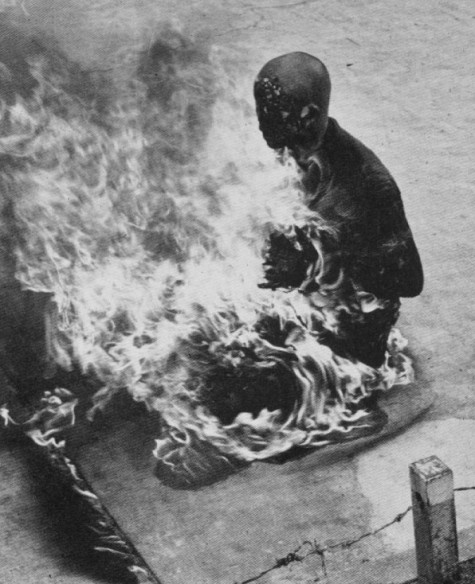
via Sucker Stamp: 58-year-old Disgruntled Wal-Mart Employee Burns Self To Death in Parking Lot – By Team eXiled – The eXiled. (February 27, 2009)
I just learned this today and I am compelled to include a photograph. I wouldn’t have believed it from just this site but it was reported in Fox News as well as several other media sites on the day it happened. The dying man’s explanation for his act: “I just couldn’t take it anymore.”
Unfortunately, the photograph, which comes from the news source involved, has no caption, so it is not immediately obvious that it is of someone else, some time ago; note the bald head suggesting a Buddhist monk, and the barbed wire in the foreground. I have come to the conclusion that it is a fake news story. It was reported on over a dozen low level sites on the same day, all in the exact same language. It wasn’t on AP, UPI, CNN, or any big sites except Fox.
The self-immolation occurred in 2009, and the man’s name was not given; his son could not see any reason for the suicide nor any indication that he was about to perform the act. He was an overnight stocker at WalMart– a boring, late night, lonely, thankless task– and had been with WalMart for seven years. He had not been laid off according to a WalMart spokesperson and there was no information available on his last night at work, immediately prior to his suicide, because “it is a personnel issue.”
It is of some interest that he didn’t do it in front of WalMart, but in front of the store next door– possibly an attempt to distance his act from his employer? He used lighter fluid, which is much less effective than gasoline for this purpose; it allowed bystanders to get close enough to throw coats on him, but he threw them off, refusing help.
His act may have been admired by Buddhist suicides, one of which occurred just outside the Pentagon and caused MacNamara to reconsider his support of the Vietnam war (see his memoir.) Over a hundred such self-immolations have been performed by supporters of freedom for Tibet from Chinese control, to no effect. This particular suicide will also have no effect, partly because no one knows about it and there is no clear reason why.
If you want to read about another self-immolation, this one possibly real, try this: http://www.texasmonthly.com/articles/man-on-fire/

