
Guns and “gun control” part 3
Wayne La Pierre, head of the National Rifle Association, promises to bring more lawsuits to challenge gun restrictions, and urges gun enthusiasts to donate so it can buy more political ads. In asking more gun enthusiasts to join the group, LaPierre admits it doesn’t represent anywhere close to a majority of gun owners. “We must reach out to the tens of millions of gun owners who are not yet NRA members—to the gun owners who care about their own rights but who have been duped by Obama and the national media into believing that the Obama and Bloomberg gun controls will only affect other people,” he says. “We will not surrender. We will not appease. We will buy more guns than ever.”
“We will buy more guns than ever.”
The more guns bought, the more profit for the gun manufacturers. The coincidental presence of this sentence, “We will buy more guns than ever”, could be interpreted, clearly, as an urge to act by purchasing more firearms. This activity will stimulate the “gun market.” Increased demand will raise prices and increase supply.
(these post on guns were drafted some time ago but not published)
The current discussion about gun control laws unfortunately neglects the most prevalent form of gun violence: shootings with illegal handguns. Most murders committed with firearms are done with handguns, and most of these guns are illegally obtained on the black market. The highest incidence of these shootings is in the so-called “inner city”, such places as Chicago and Oakland. Virtually all (97%) of the murders are committed with handguns.
Therefore, the discussion of banning so-called “assault weapons” misses the vast majority of murders committed today. It turns out that assault rifles with large (100 round) magazines are almost universally owned by people who use them legally on the firing range, and most of them store their weapons safely. It is obvious that even a “safely stored” weapon can be turned against you, as it was in Newtown. Unfortunately, even a ban on such weapons would not eliminate them, as most older weapons will be grandfathered in. There are many issues that can reduce risk without actually removing the weapons from the hands of citizens. Safe storage, background checks, and reduction in potential for violent impulses are all alternative methods for reducing risk.
The techniques that will reduce gun deaths the most in the current atmosphere of widespread access to firearms include aggressive mental health outreach, retrieval and interdiction of firearms by law enforcement personnel as their primary mission (with a de-emphasis of drugs, for example), and federal registration statutes for all firearms. There is a huge black market in guns, and it is estimated that 40% of guns are bought illegally (mostly handguns.)
The current loopholes for gun purchases in the private market and at gun shows allow almost half of purchases to avoid background checks. This is besides the street market, which is almost entirely in small handguns.
We noted in our previous post about “gun control” that there are approximately 300 million firearms in the United States (another source states, more precisely if not more accurately, 276 million firearms of all types.) This plethora of arms is unique in the world: it has also been estimated that, with 5 percent of the world’s population, the United States has 50% of the world’s firearms. A parallel, and probably not coincidental, fact is that the United States federal government spends more than virtually all other countries in the world combined on its military establishment.
The reasons for the quantity of arms and related paraphernalia in the US are, first, that the US is one of the richest countries in the world, second, that the US was a victor (and chief arms supplier to the Allies) in the last world war, and third, there was for many years (until 1968) little or no regulation of private civilian arms purchases. Contributing to the laissez-faire attitude of the public has been the tradition of rural arms possession for hunting and self-defense that has persisted since the settlement of the West in the early nineteenth century. In fact, in parallel with the urbanization of America, the percentage of people owning firearms has gradually but consistently dropped to about one-quarter of the adult population.
However, the number of firearms in civilian hands has consistently risen. In part, this is because firearms are extremely durable and have been manufactured to very high standards for over a hundred years. Once manufactured, with a little care and proper storage, a firearm is likely to last well over a hundred years. Because of the durability of modern firearms and the reduction of interest in firearms over recent years, manufacturers have been forced to market new types and calibers of arms to people who are already owners, and to attempt to market an interest in firearms to the younger generation. Without this marketing, manufacturers fear a reduction in sales would be inevitable.
Despite the durability of arms and lack of interest by the younger generation, gun sales are booming. Incidents such as the election (and re-election) of Barack Obama and the Newtown school shootings have been blamed for spikes in sales over the last few years. It can only be inferred that sales are being made to people who already own firearms. These people appear to feel that their present arms are inadequate, and that they need semi-automatic firearms in military calibers that can accept large magazines.
The reasons behind the insecurity of those who already own firearms are complex, but we can hypothesize that the reasons include intensive marketing by arms manufacturers.
“I have said it repeatedly: Because of these prophecies, going in on the ground would be the worst trap to fall into. They want troops on the ground. Because they have already envisioned it,” said Jean-Pierre Filiu, a professor of Middle East Studies at Sciences Po in Paris, and the author of “Apocalypse in Islam,” one of the main scholarly texts exploring the scripture that the militants base their ideology on.
“It’s a very powerful and emotional narrative. It gives the potential recruit and the actual fighters the feeling that not only are they part of the elite, they are also part of the final battle.”
via U.S. Seeks to Avoid Ground War Welcomed by Islamic State – The New York Times.
This is the problem with invasion that Trump and the Republicans are ignoring: The Islamists want us to invade Iraq and Syria so they can engage us in “the final battle.”
We cannot win by doing what they want us to do.
Muslim Radicals
Note how these two are dressed. Do you suppose that could be the basis for a profile?
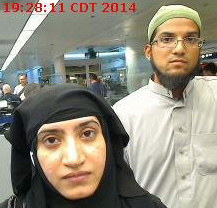
“Religious conservatism and piety are not the only thing institutions like Al-Huda spread,” said Husain Haqqani, a former Pakistani ambassador to the United States now at the Hudson Institute, a think tank in Washington. “Their teachings have a strong dose of ‘Muslims are destined to lead the world’ and ‘the corrupt West must be confronted.’ ”
via Killers Were Long Radicalized, F.B.I. Investigators Say – The New York Times.
Here is the essence of the “conservative” Islamic worldview: “the corrupt West must be confronted.” and “Muslims are destined to lead the world. ”
This is what we have to face. The people who oppose “the corrupt West” and want to “confront” the secular establishment. Whether it is with words or with .223 bullets, the truth is that they think we are screwing up the world and they have to take control away from us. “We” are secular, corrupt, and sinful.
See also the photograph of the two people who killed 14 and wounded 21 before they were killed themselves in a shoot-out with police. More in a future post.
The most striking hallmark was Mr. Trump’s constant repetition of divisive phrases, harsh words and violent imagery that American presidents rarely use, based on a quantitative comparison of his remarks and the news conferences of recent presidents, Democratic and Republican. He has a particular habit of saying “you” and “we” as he inveighs against a dangerous “them” or unnamed other — usually outsiders like illegal immigrants (“they’re pouring in”), Syrian migrants (“young, strong men”) and Mexicans, but also leaders of both political parties.
via 95,000 Words, Many of Them Ominous, From Donald Trump’s Tongue – The New York Times.
The New York Times (NYT) has taken the trouble to quantitatively analyze all 85,000 words spoken by Mr. Trump in one week– and they are ominous, threatening, fascistic words. Delivered in his breezy, off-the-cuff style, with unapologetic falsehoods, his words are increasingly prompting the support of a know-nothing, atavistic electorate.
In another pattern, Mr. Trump tends to attack a person rather than an idea or a situation, like calling political opponents “stupid” (at least 30 times), “horrible” (14 times), “weak” (13 times) and other names, and criticizing foreign leaders, journalists and so-called anchor babies. He bragged on Thursday about psyching out Jeb Bush by repeatedly calling him “low-energy,” but he spends far less time contrasting Mr. Bush’s policies with his own proposals, which are scant.
Here’s a mythical anecdote on the San Bernadino massacre:
… on Friday night in Raleigh, he mocked people who reportedly did not contact the authorities with concerns about the California shooting suspects for fear of racial profiling.
“Can anybody be that dumb?” Mr. Trump said. “We have become so politically correct that we don’t know what the hell we’re doing. We don’t know what we’re doing.”
As I noted in a previous post (“Comment of the Day”) Trump ignores or contradicts facts and confirmed realities:
… Mr. Trump uses rhetoric to erode people’s trust in facts, numbers, nuance, government and the news media, according to specialists in political rhetoric. “Nobody knows,” he likes to declare, where illegal immigrants are coming from or the rate of increase of health care premiums under the Affordable Care Act, even though government agencies collect and publish this information. He insists that Mr. Obama wants to accept 250,000 Syrian migrants, even though no such plan exists, and repeats discredited rumors that thousands of Muslims were cheering in New Jersey during the Sept. 11, 2001, attacks.
His rhetorical style and the substance of his attacks is patterned after well-known demagogues of the past:
This pattern of elevating emotional appeals over rational ones is a rhetorical style that historians, psychologists and political scientists placed in the tradition of political figures like Goldwater, George Wallace, Joseph McCarthy, Huey Long and Pat Buchanan, who used fiery language to try to win favor with struggling or scared Americans. Several historians watched Mr. Trump’s speeches last week, at the request of The Times, and observed techniques — like vilifying groups of people and stoking the insecurities of his audiences — that they associate with Wallace and McCarthy.
A significant difference between Mr. Trump and 20th-century American demagogues is that many of them, especially McCarthy and Wallace, were charmless public speakers. Mr. Trump, by contrast, is an energetic and charismatic speaker who can be entertaining and ingratiating with his audiences. There is a looseness to his language that sounds almost like water-cooler talk or neighborly banter, regardless of what it is about.
For some historians, this only makes him more effective, because demagogy is more palatable when it is leavened with a smile and joke.
Mr. Trump is the fascist demagogue par excellence. By the way, the word “demagogue”, as described by commenters, comes from the same class of words as “pedagogue” and literally means “leader of the people”, just as “pedagogue” originally meant a leader of the children, that is, the slave who escorted children to school. The words have come to mean something pejorative, a despised class of orator in this case.
There is a distinct probability that Mr. Trump will become the Republican nominee for President, and if he doesn’t, that he will, despite his pledge, become a third-party candidate. Either way, he will shift his attacks to Mrs. Clinton and become ever more vitriolic as he describes her liberal supporters, possibly as closet Communists and subverters of the American Dream, responsible for preventing America from “becoming Great again.” There is no question that Mr. Trump is a narcissist, only out for what it can get him, and when he loses the general election, he will still win because his name-recognition will increase even further. If he were to win the Presidency, he would turn over his administration to the same Republican conservative administrators and cronies who served President George W. Bush, that is if he does not make over the country in his fascistic mold.
Comment of the Day
Empirical Conservatism
United States
The Times continues to see the trees and not the forest.
It’s not climate science the GOP is fighting. The Republicans must attack the scientific method itself. They are required by their politics to attack the very idea of empiricism. If they admit that science can achieve irrefutability in this area, then they must admit that it has and can determine it elsewhere, particularly in areas where they need ambiguity and room to lie: public health, environmental law, even the historical record. They aren’t attacking what’s happening in Paris. They are defending their right to pathological subjectivity and the right to externalize its costs onto people who eagerly accept it.
The Left keeps making the same mistake: they detect instances but not the pattern. They diagnose after the fact. This gives liars the freedom they have to strike and move and strike again.
Karl Rove explained all this years ago, when he told your reporter, “”We’re an empire now, and when we act, we create our own reality. And while you’re studying that reality—judiciously, as you will—we’ll act again, creating other new realities, which you can study too, and that’s how things will sort out. We’re history’s actors…and you, all of you, will be left to just study what we do.” The whole Conservative battle plan is right there. How long before you figure it out that for one moment he was telling the truth?
[Comment to an NYT article about Representative Lamar Smith’s attack on a climate science paper that states global warming pause was illusory]
It’s the scientific method itself that the Republicans are fighting. The very notion that reality is a mutually agreed concept that can be tested and confirmed to everyone’s satisfaction. The Republicans want to impose their own reality which you will have to accept because they will use force to make you . That reality cannot be the subject of reasoned discussion but must be precisely the way they say it is. Nothing can be modified or contested.
Scientific American: “Climate Science Predictions Prove Too Conservative.” (December 6, 2012)
Comment of the Day
From Mor in California at about 7 pm:
I am sorry but I am not convinced. Saying that the supporters of Da’esh are not real Muslims amounts to the “no true Scotsman” fallacy. They call themselves Muslims. Islam has no central religious authority, so you cannot excommunicate them. The most you can do is to say that your interpretation of Islam differs from theirs, which is of course true. But what DOES mainstream Islam stand for? Platitudes about “religion of peace” go nowhere to explain the profound social and ideological dysfunction in so many majority-Muslim countries of the world. They go nowhere in explaining the prevalence of female genital mutilation, inequality, violence, cultural and technological stagnation, and extreme fundamentalism in the Middle East and beyond. Comparison between majority-Muslim Pakistan where the shooter is from and India is instructive: the two countries have a similar ethnic and racial makeup but different religious compositions. Which one is more democratic, scientifically-minded and (relatively) peaceful? “Islamophobia” is often used as a way to stifle any criticism of Islam. But just as not all political ideologies are the same, not all religions are the same. I accept that the majority of American Muslims are peaceful. This does not answer the question why the religion they profess to follow leads others into terrorism.

