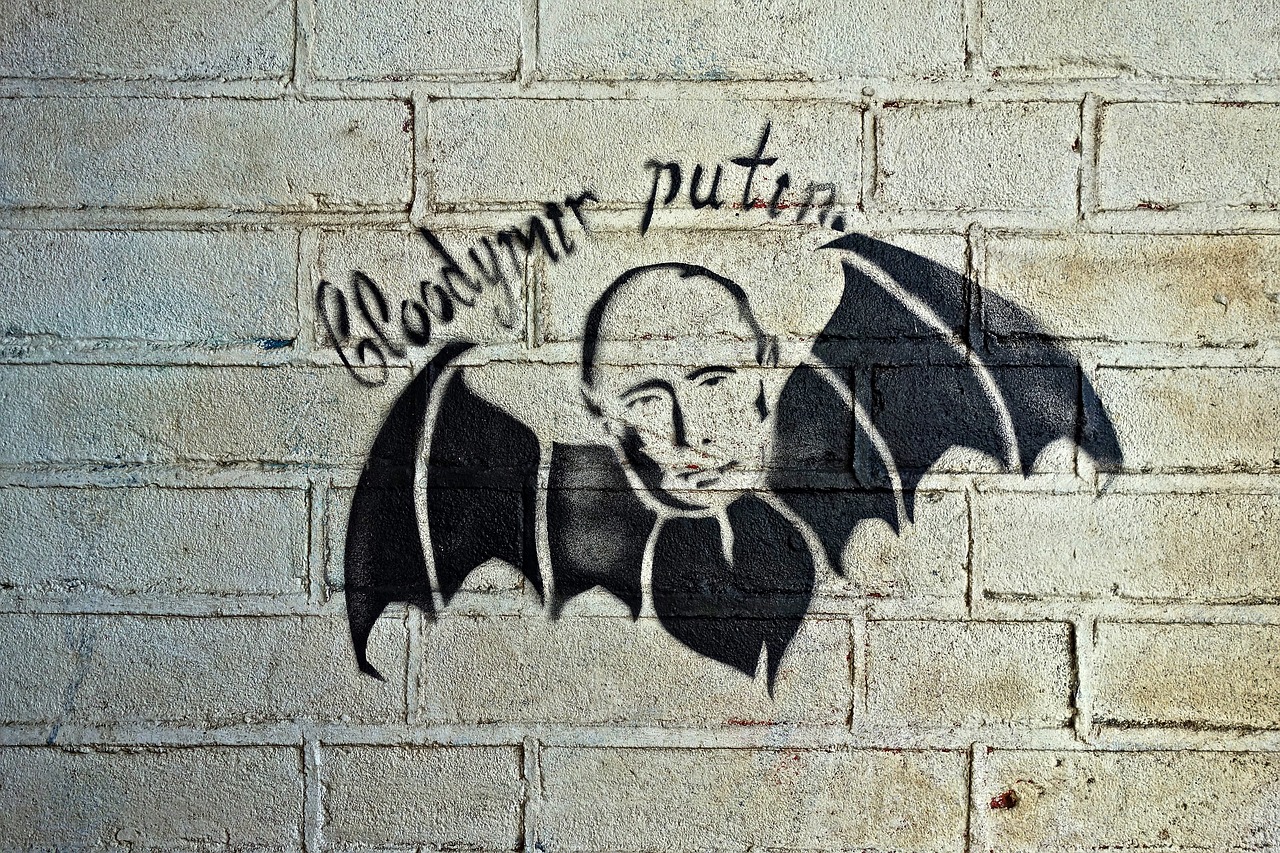
Lyudmila Putina once called President Vladimir Putin a vampire, while he in turn has suggested that anyone who could put up with her for three weeks was heroic and deserved a monument.
––from the Moscow Times June 7, 2013
(photo of graffiti courtesy of pixabay.com and MabelAmber)
Quote of the Day: Representative Trey Gowdy Says Interference With Mueller Would Cause a “Bad 2018”

Rep. Trey Gowdy (R-S.C.), a member of the House Intelligence Committee, warned Trump that any interference in the Mueller probe would result in “a very, very long, bad 2018.”
This quote comes from the Washington Post via Microsoft’s news feed, which relieves me of the cost of a subscription to the paper. I already subscribe to the New York Times and at $15 a month, it is more than I can afford. At least I can excuse a subscription to the New Yorker at $10 a month because of the beautiful artwork on the cover. Unfortunately, subscribing to a news feed of any kind is growing more and more futile as the Orange-Haired Demon fills up every possible news opening.
Mr. Trump seems to be getting more and more frustrated with the investigation into his campaign and now, his personal finances. He has already warned prosecutors not to cross a “red line” between the Russia connection and his personal finances in general. He already failed to release his income tax returns, as every prospective President has done for the last sixty years. He has received large loans from Deutsche Bank since the Great Recession, when many fortunes were wiped out. Deutsche Bank, by the way, has recently paid $600 million in fines to the EU and the US for laundering money from Russia. Mr. Trump has accumulated an unblemished record of sycophancy to Mr. Putin for the last ten years. He just has “guilty” written all over his face. There is only one thing holding him up: his ultra-Republican policy choices.
Our Constitutional system makes it impossible to impeach Mr. Trump until January 2019 because the Republicans hold a majority in the House and they agree with most of the policy that he lays out. That’s not to say that they don’t wince at some of the more offensive things he says or does, but they think that “his heart is in the right place”– meaning that they, too, are anti-immigrant, pro-protectionism, anti-abortion, anti-gay rights, and so on. Mr. Trump has made the obvious conclusion that the more regressive his policies, the more rabid his followers. This makes the 35% or so of people who support him more active than the majority that opposes him.
This means for the opposition that they must pump up their energy as much as possible. It’s as simple as that. You’ve got to really, really, really hate Trump to really get rid of him.
FDA Opens Comment Period on New Proposal to Lower Nicotine Levels in Cigarettes– Officially

According to Medpage Today and Stat News (yesterday), as well as an official announcement from the FDA today, the FDA has opened a public comment period for a new rule which would lower the nicotine levels in cigarettes to “non-addicting” levels– 0.3-0.5 mg/gram of tobacco.
Cigarette fiends will find this proposal shocking if not actually heartbreaking.
While this idea is in line with the new administration’s starkly regressive anti-drug policy (illustrated by the comments of Attorney General Sessions about the KKK), it may find resistance from personal-liberty advocates like libertarians.
On the other hand, public-health activists are sure to celebrate the prospect of a new Prohibition. Theoretically, removing nicotine from cigarettes could save millions of lives over the next ten years. Statistics published in the Stat News article claim that the present number of smokers (about 15% of adults in the US) could be reduced to 1.4%. This is a great idea, but it ignores the lessons of Prohibition. Mandating emasculated cigarettes would instantly stimulate a black market in high-potency smokes. Just ask anyone who has tried to quit smoking. The lack of availability of sufficient nicotine to relieve withdrawal symptoms would result in cravings, with mood and personality disturbances like intense irritability, periods of obsessive rumination about obtaining a supply of nicotine-laced smoking materials, and aggressive attempts to obtain those materials.
The only way this could work is for all tobacco companies to gradually reduce nicotine content simultaneously, so that orderly withdrawal could take place. Experience with other substances like opioids suggests that an addicted person could tolerate a five percent reduction in nicotine ingestion per week… but due to the nature of the source, victims are likely to try to smoke more and develop unnatural hoarding behaviors. Past experience with low-nicotine cigarettes (such as those that have holes in them to dilute the smoke) shows that users will smoke more, inhale deeper, and retain the smoke in their lungs longer in an attempt to compensate for the lack.
All in all, I rate this as A Bad Idea. There are few Good Ideas available in relation to the use of poisonous, addictive substances by the general public– particularly widely-available substances.
(photo courtesy of pixabay.com and comfreak)

“Russia today poses a danger, but it is not unpredictable in advancing its own interests,” Tillerson told senators. “We need an open and frank dialogue with Russia regarding its ambitions, so that we know how to chart our own course.”
This comes from an article in Bloomberg View from March 13, 2018, entitled, “Tillerson Refused to do Another Russia Deal” which explains that, although Tillerson did do a deal with Russia before the rupture in US-Russia relations over Ukraine (a business deal worth $500 billion between Exxon and Rosneft, the Russian state oil company) he gave a “clear condemnation” of Russia’s actions in the Crimea and their support of Syria’s Bashar al-Assad when he was under consideration for the Secretary of State post. He also blamed Russia for the chemical attacks in Syria, hardly a friendly position. Tillerson knew how to negotiate with Putin to advance his business position, but he was not planning on being ensnared in the Trump-Russia collusion scandal by appearing to be weak on Russian issues. His last act as Secretary of State was to blame Russia for the poisoning of a Russian refugee in Britain; Trump’s statement on the incident was supportive of Britain but otherwise wishy-washy. It’s not likely that Pompeo will be any more accommodating to Putin, but he will be a Trump loyalist in every other respect– unlikely to put the brakes on when Trump’s policies take a sudden turn for the bizarre. What’s more, as a former military man, he has completed Trump’s encirclement with military advisors and secretaries. There is no question that Trump will be closely advised by men with military mind-sets, and we already know how easily influenced he is by his sycophants.
We also know that Pompeo will be good for the morale of the remaining State Department employees, as he is likely to do more effective at working with the department (see the article in the New Yorker we previously cited about Pompeo being a super-hawk at State.) Unfortunately, State’s problems have more to do with a lack of policy rather than personality issues. Former UN ambassador John Bolton (an extreme conservative) may be under consideration to replace McMasters as National Security Advisor; in this case, even military doesn’t satisfy Trump (supposedly he is tired of the general’s long-winded lectures.) This administration is likely to lurch, unpredictably, further and further to the right.
(photo courtesy of pixabay.com)

There is a hidden and disturbing aspect to the national obsession with owning guns. Three percent of the people own half of the guns, which means that a few people have a large number of firearms each. These unusual people are overwhelmingly white, mostly male, and usually rural. The most disturbing part is the connection between the character of these gun owners and their obsession with stockpiling arms. The possession of a firearm makes a white male feel more powerful and assuages his fear of being robbed of what is “rightfully” his… even though his net worth is rather small. He feels that brown invaders are going to come and steal his precious possessions, although he owns little other than ammunition.
They’ll probably rape his wife too, and then kill them all. The movie “In Cold Blood” had a powerful effect on elderly rural whites, but long before that, during the Civil War, there were many episodes of that kind involving soldiers and civilians alike in pillage and rapine, sometimes simply because of starvation. “Racial memory” of atrocities haunts those who dwell in rural houses far from their neighbors.
Modern insecurity is different: poorly educated white males often lose their livelihoods and have nothing but time to brood over their ill fate. This has occurred more and more over the last forty or fifty years, in waves with factory and retail closures and the disappearance of entire industries. Employment in the US steel industry collapsed between 1975 and 1999, from 521,000 to 153,000. The coal mining industry employed roughly 175,000 men in 1986 and 52,000 in 2016 (this compares to an all-time high of 883,000 in 1923.) (Wikipedia)
The problem is that the system in this country has both created the insecure white man and provided him with a means to relieve his anxiety: the immediate presence of a loaded firearm. The insecure white man is motivated by racism and poverty: he doesn’t have enough stuff and he is afraid that brown people are coming to take it from him.
This is the situation that obtains and there is nothing that can be done to change it, unless we relieve the victims of perceived persecution: the white male. Nonwhite, mostly nonmale, nongunowners will congregate in cities where the police will be forced to protect them from the depredations of gun owning thugs (including some of the policemen themselves.) Of course, the gun collectors will probably stay in their compounds out in the country and avoid venturing into the city where they might meet their imagined enemy.
The key to real relief of this situation is to provide real security for the people: jobs, money, and protection from thieves and assault. A nationwide jobs program that gives everyone who can work (especially poor white men without educations) a job with a living wage– coupled with a welfare program that gives everyone who cannot work basic security: food, housing, medical care. The cost of this program will be large, but if successful will be rewarded with dramatic growth in gross domestic product, median household income, and lifespan– sufficient to support dramatic improvement in the economy. Unfortunately, this program will not increase the incomes of those who are already wealthy– it will cost them money, in taxes. But it will be worth it to reduce the death rate from firearms and to reduce the number of mass shootings (besides making many people happy by easing their poverty.)
A comprehensive program includes mental health evaluation and treatment, starting in grade school with emphasis on identifying those who might become isolated enough and vengeful enough to precipitate violence. All this costs money, and money means taxes. It won’t be good enough to protect our country from military invasion with a huge army and modern nuclear missiles if society is falling apart from the inside.
(By the way, I oppose a national gun-confiscation campaign because it will play directly to the fears of the alt-right. It is inefficient to attack this problem with weapons that simply provoke more paranoia.)
Therefore, the national obsession with low taxes will have to be changed. I suggest an intensive propaganda campaign that emphasizes the duty of the wealthy to protect civil society and prevent internecine violence. Yes, it’s a liberal idea that is anathema to the conservatives who control the national conversation. This means the propaganda of the extreme right wing will have to be drowned out. Intensive propaganda efforts are needed to speak louder than the NRA and the National Enterprise Institute, among others. Propaganda costs money: Tom Steyer, are you listening?
(photo courtesy of pixabay.com and jabbacake)

“Trump is methodically destroying the moderate camp in his Administration and moving steadily crazy-hard right,” Joseph Cirincione, the president of Ploughshares Fund, an N.G.O. dedicated to containing the spread of nuclear weapons, told me. “Today’s firing and the crude, insulting way that he did it weakens the traditional conservative camp, the State Department, and American credibility. It’s almost as if someone is paying Trump to do it.”
From an article in the New Yorker about Trump’s selection of Mike Pompeo to be his new Secretary of State. Just keep repeating that in your mind: “It’s almost as if someone is paying Trump to do it.” What does that imply to you?
(photo courtesy of pixabay.com and hansbenn)
Stephen Hawking: ‘It would not be much of a universe if it wasn’t home to the people you love.’

Stephen Hawking died last night at the age of 76.

This morning (California time) the Guardian reported that Russian exile Nikolai Glushkov had been found dead in his London home. Mr. Glushkov had been imprisoned in Russia on a probably trumped up fraud charge and gave evidence in the UK for Boris Berezovsky when he sued Roman Abramovich (another oligarch who is still “on friendly terms with the Kremlin”) in British court for an alleged five billion pounds fraud in 2011. That didn’t go over too well, and was on appeal. Then Boris died in 2013, found hanged in his bathroom; apparently the coroner was not convinced it was suicide, but had no better ideas.
On March 4 of this year, another Russian exile, Sergei Skripal, and his daughter Yulia, were found critically ill in a park in Salisbury, UK. Yesterday PM May denounced the Russian government, saying that her chemists (in the US sense, not pharmacists) had found definite evidence of a Russian nerve agent known as a Novichok (“newbie”) as the cause of their poisoning and the concomitant critical illness of a British first responder, as well as the contamination of as many as 500 British subjects in the vicinity. She gave the Russians twenty-four hours to explain; instead, today they demanded access to samples of the purported nerve agent– samples which probably do not exist, as the lethal dose of this agent is said to be 10 milligrams (less than a thirtieth of an aspirin tablet.)
Today Rex Tillerson was out at the State Department. Apparently he was fired without warning or explanation. According to CBS News, his statement read, in part: “The Secretary did not speak to the President and is unaware of the reason, but he is grateful for the opportunity to serve”… The operative word here is serve; in this sense anyone who works in US government is serving his master, Don the Con. Tillerson is trying to say that he has been serving “the public”, as in “public service”, but that is just a weasel word for being close to Mr. Trump and doing his bidding. Apparently, accusing the Russian tyrant of poisoning refugees from his domain and standing by countries that accept such refugees is not doing Mr. Trump’s bidding. Once again, we see that Mr. Trump is unable to criticize Mr. Putin in any way, shape, or form– why is that? Just what does Putin have on Trump? Given the Stormy Daniels story, it seems petty that a tape of Russian prostitutes performing “golden showers” for the golden boy could constitute “kompromat”– it is impossible to shame someone who is shameless. What Putin must have on Trump is documentary evidence that Trump collaborated (not just colluded) and conspired with Putin to “rig” the 2016 election so that Trump could become President. That’s the only kompromat that is serious enough to keep Trump dancing to Putin’s tune this long.
(cartoon courtesy of pixabay.com and dutchpirates)

Here’s the abstract of a case report published February 27, 2018 in the British Medical Journal:
An 84-year-old man presented to the emergency department following recurrent falls over several weeks and onset of new left-sided weakness. CT of the brain revealed a large air cavity (pneumatocoele) in the right frontal lobe thought to be secondary to an ethmoidal osteoma communicating through the cribriform plate allowing air to be forced into the skull under pressure. Subsequent MRI confirmed these findings and also revealed a small focal area of acute infarction in the adjacent corpus callosum. The patient had a prolonged hospital stay, declined neurosurgical intervention and was discharged home on secondary stroke prevention.
This man suffered a “lower respiratory infection” (bronchitis, probably) in the hospital but was thoroughly evaluated and informed of his condition and the proposed treatment. Major surgery would have been needed to correct this problem, in part because the osteoma was quite large and probably had been present for years. The follow-up report (in the complete text of the case study, available free at the above link) stated that the man had survived twelve weeks post-hospitalization and felt well, with improvement in his left-sided weakness, which was caused by a small stroke (shown in the man’s corpus callosum– the band that connects the two halves of the brain– on his MRI scan.) Apparently, he had a small benign bone tumor in his ethmoidal sinuses (these are behind the bridge of the nose) that broke through the cribriform plate (a bony plate with many tiny holes that pass nerves from the smell sensory nerves in the nose) and allowed air to enter a space that developed in the right side of the front of his brain. The air space apparently had developed gradually, and was/is pressing on his brain, so far without causing damage… but eventually this will cause a serious problem. The man, who at 84, apparently felt comfortable with the end of his life, declined surgery with its attendant risks and is still alive and ambulatory (walking around.)
If this sort of thing interests you, use the link to go to the report and peruse the MRI scan images– they are impressive.
(illustration courtesy of pixabay.com and OpenClipArt-Vectors)
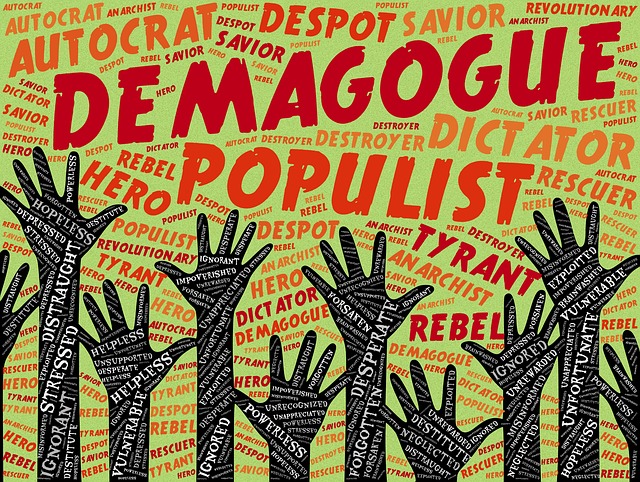
Our president appears to depend on rallies to shore up his psychological well-being: he has been having big rallies (5,000 people or more) an average of twice a month since he was inaugurated. This is not purely because he announced his candidacy for re-election in 2020. He also gets a personal boost from the adulation of crowds and delivers some of his most obnoxious statements at rallies as applause lines. For example, he recently introduced publicly his imaginary solution to the drug problem: the death penalty for drug dealers. If you think Mexico had violence problems when it cracked down on drug trafficking, “you ain’t seen nothing yet” like what would happen if drug dealers were dealt with in such a crude, counterproductive, and unconstitutional way (remember there is a prohibition against “cruel and unusual punishments” and what could be crueler than the death penalty?)
What is particularly repellent about this psychological dependency on the love of the crowd is that he responds at rallies with rambling, hour-and-a-half long “speeches” in which he repeats his talking points, lies, exaggerations, insults, and one-liners. He may use a speechwriter but a large proportion of his speeches depends on things he has dreamt up on his own, often on the spot, and hones according to the level of crowd reaction.
He obtains what little information he gets from Fox “News” and there is a positive feedback relationship between the two: he often suggests topics, then feeds off the resulting “news” segments that bear the hyper-conservative stamp, the half-truths, and the outright lies that for which Fox’s commentators are specialists in response to his expressions of interest.
This president is far gone into being a demagogue and this signals a terrible danger to the US public: his point of view is reinforced, the hypnotic attachment of his core supporters is strengthened, and the anti-democratic pitch of his policies is further exaggerated. A minority of one-third of the public could exert control over the majority by removing the controls that democracy was supposed to have to prevent tyranny.
Let us take tariffs for example: for thirty years, he has been an outspoken protectionist with little or no understanding of the real meaning of trade balances. He thinks that, somehow, when we buy something from another country without selling them an equal amount of stuff we are the losers. Never mind that we are richer by the value of the items that we have bought. Never mind that the raw figures in a balance of trade sheet leave out intangibles like the exchange of services such as intellectual expertise. Never mind that the money we spend in another country is spent by the other country in ways that usually enrich us (tourism, for example, or the hiring of American providers who pay taxes on their salaries.) Despite having graduated from the Wharton school of business, he appears to have learned nothing about business.
The tariffs on imports of steel and aluminum show how backward-thinking this president’s behavior is. Forward-thinking “futurologists” have predicted that the production of cars will be reduced more than 90% as a result of the introduction of autonomous vehicles because cars will not have to sit in parking lots all day waiting for their owners to get out of work. The cars will be available to transport other people who will need them for the short term: errands, shopping, and the like. Wives (sorry, feminists) will no longer need to drive their breadwinners to the railroad station or the office in order to drive home, then leave again to run errands. Cars will be able to drive themselves home after dropping off their passengers.
Because of this drop in the sales of new cars, the need for steel and aluminum to build them will be drastically reduced as well. Since we already produce 75% of the steel that we consume domestically, it is likely that our entire steel needs will be satisfied by domestic production and new producing plants will not be needed.
It is likely that production will shift to batteries and solar panels as a result of technological advances in these devices and increases in the use of battery-powered cars with increasing range, capacity, and speed. Has Mr. Trump even seen this coming? Are there any plans in hand with members of his administration? No? Mr. Trump’s entire vision is focused on self-aggrandizement and re-election and he cannot see the FBI slowly gathering evidence of his money-laundering and acceptance of enormous financial assistance (in addition to assistance with cyber-sabotage) from the Russian government. He is already obstructing justice in every way he knows how and violating the Emoluments Clause of the US Constitution every day with his Trump Washington DC hotel.
The only check on Mr. Trump’s autocratic power that is available is a massive surge of Democratic votes that will re-establish Democratic majorities in both houses of Congress. If this does not happen, we will be in for a very rough time, as America becomes more and more of a dictatorship. Oligarchy is bad enough (it at least gives room to rational voices in favor of our survival on Earth) but dictatorship is inherently unstable and inefficient. We are facing an opponent (Russia) that has established a relatively stable oligarchy, albeit one dependent on the sale and consumption of fossil fuels for the monetary support of its government. If we totally sink into a dictatorship, we will be at a serious competitive disadvantage.
Our other “opponent”, China, has been an oligarchy for some time; its endorsement of a dictatorial leader recently makes a confusing picture. It would appear that China will continue to be an oligarchy and that Xi Jinping will exercise his dictatorial powers with discretion; Xi will be a figurehead, a Chinese “God” whose every pronouncement is law but is subject to endless interpretations and obfuscation by practical translations. That leaves the United States, where its “God” speaks plainly and clearly, needing no interpretation, in a condition like Nazi Germany in 1933: trembling on the edge of tyranny.
(image courtesy of pixabay.com and johnhain)
 Conrad Theodore Seitz