photo courtesy of Gerd Altmann (geralt) via pixabay.com

a photo of me, by me, looking quizzical. I’m not mad, really I’m not. Or we’re all mad here.
This morning I posted a link to a NYT story that had multiple bits of new information. One of the more important bits (that I didn’t get to this morning) was that seismometers all over the world have responded to the lockdown orders that have some 90% of the world’s population staying home other than for essential activities. I personally was little affected by that order (even though I live in California).
As a result of that “stay at home” order, we (not I) are mostly staying at home. I still take walks in the splendid isolation of my abode among the peach and almond trees. I still go to the pharmacy for the medications that I take, most important of which is ibuprofen. I still go to the grocery store. All my banking needs are taken care of online and most of my bills are paid online.
My wife is still working as a physician assistant. We still fill up the gas tank on our Toyota Highlander. Nothing has changed except that I am posting to this blog more frequently.
Yet the seismometers say the world is quieter, and as a result we can hear the smaller earthquakes and the little things that are just the earth’s crust moving around. What is more, the air quality in Los Angeles has greatly improved. Now wouldn’t it be grand if all of the people who were running around like chickens with their heads cut off would just stay still?
I know, that’s terribly cynical. I do feel bad, very bad, for all the people who are dying miserably, alone, because they are under quarantine or isolation in the hospital. Yet human existence is suffering, or so the Buddha says.
So, if you meet the Buddha on the road, kill him. Or don’t. I’d rather you didn’t. You don’t have to follow every ridiculous instruction you get, do you?
Only follow an instruction if it makes sense– or if you can make sense out of it, which means you may have to think about it for a while.
What did the Buddha mean when he said, if you meet the Buddha on the road, kill him? Let me know if you figure out what it means. I’ll be sitting here, quietly listening.
Jobless claims hit 17 million, with many unable to file due to crashing websites and busy signals

photo courtesy of kzd via pixabay.com
The NYT reports that the stock market has responded to the news that the jobless rate has risen by 6.6 million in the past week. Other reports say that many who lost work are unable to file because they couldn’t get through on the web site or were forced to dial up repeatedly by busy signals. Some were compelled to physically go to unemployment offices, and Florida has begun handing out paper claims. Once a person has filed (which takes 20 to 30 minutes on the web site) it takes two to four weeks to begin receiving benefits, which are less than half of an employee’s previous wages. The federal stimulus package (the third) offers an additional $600 a week to jobless benefits.
Meanwhile, the Fed reports that it will start buying “junk bonds”. These bonds are high-risk and high-profit for investors when they come through. It is unclear how this will benefit the average worker fired through the lockdown, who has no stake in the junk bond market.

image (an old engraving) courtesy of pixabay.com
An article in last night’s NYT reveals that the test positive rate for the disabled living in group homes was five times that in the general population, and the death rate was also five times as high. Disabled people in NY mostly live in group homes rather than at home with relatives, although many are still cared for by family and friends. The article details the difficulties of social distancing, especially with many psychological care workers unable to go to the homes as usual. It also indicates that 10% of those who test positive are dying, similar to the rates of death in countries like Italy where most of the population is older (and consequently sicker).
Other reports from veteran’s homes indicate that patients with COVID were kept with other patients in rooms with four occupants until their tests came back positive, too late to remove them from their rooms and isolate them. This isolation and re-shuffling resulted in infections being passed on to other residents with ruthless efficiency. One veteran’s home has had 25 deaths in the course of a few days over late March. Some rooms had six occupants and people were kept in the dining hall. Now there have been so many deaths that the original rates of four to a room have been re-established.
Reports from Japan show a similar picture: one group home in Chiba had 86 positive test results. This is dramatically worse than in NY because Japan as a whole only had 2,000 positive tests at the time (over a week ago).

caption courtesy of pixabay.com and OpenClipArtVectors
An article in last night’s NYT contains several new tidbits about the novel coronavirus. The first is that genetic analysis of thousands of virus genomes has revealed that most of the cases in New York have come from Europe, long before the ban on travel from Europe by the federal administration and He-who-must-not-be-named. It seems that these cases came in as early as mid-February, after cases had been detected in wastewater samples from the Netherlands.
Other tidbits will follow in succeeding posts. PS much of the coronavirus news coverage has been placed in the “free” category by multiple web sites.
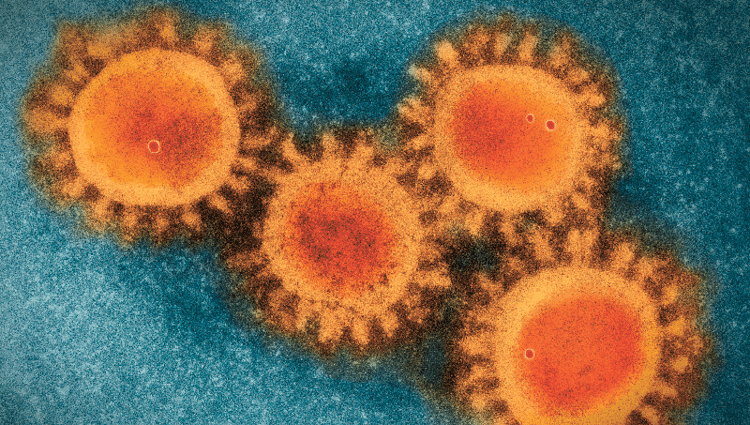
SARS-COV-2 virions by EM: JAMA Open Network
This MedRxiv paper indicates a higher prevalence of COVID-19 cases than individual tests would have showed. A STAT news article reporting on the paper says that the number of cases in the community served by the wastewater treatment plant(s) was reported as 446, but analysis of the wastewater with the same technology as the individual tests (RT-PCR) suggests at least 2300 people were infected, with a small possibility that as many as 100,000 people could have had the virus. This discrepancy may relate to the lack of available individual testing; how much virus RNA is shed in the stool may vary, but previous tests suggest that stool virus is no longer infectious due to breakdown by the digestive process.
Another study from the Netherlands found SARS-COV-2 RNA in wastewater on February 6, three weeks before anyone in the country had reported a positive test. These studies are based on those done at the time of the first SARS epidemic in 2003. The company which performed the tests, Biobot, plans to expand testing to many other wastewater plants in the US. They are offering free testing for municipalities at this time.
These studies show that the virus has been spreading in communities worldwide long before anyone was tested, not a surprise considering many cases of COVID-19 are asymptomatic. Remember that studies reported in MedRxiv have not yet been peer-reviewed, so there may be methodological or other errors. Nonetheless, this particular research appears to be solid and to be the basis for wider community testing.
photo courtesy of qimono (Arek Socha) via pixabay.com
According to STAT news (statnews.com) the Drug Enforcement Agency (DEA) has responded to reported shortages of certain essential controlled drugs (fentanyl, for example) by increasing quotas. As I noted on a previous post, Schedule II drugs are produced under a yearly quota system that limits how much can be prescribed and dispensed. Pharmaceutical companies have responded by cutting back on production of generic versions and increasing the amounts of brand-name, higher-profit versions. This is from the statnews article:
The agency is increasing production quotas by 15% for several controlled substances, including fentanyl, morphine, hydromorphone, codeine, ephedrine, and pseudoephedrine, as well as certain so-called intermediates that are essential to producing these medicines. The DEA also plans to approve increased imports of ketamine, diazepam, midazolam, lorazepam, and phenobarbital
Because of the pandemic, however, supplies of Schedule II drugs used in patients who are intubated and on ventilators have become very tight. The percentage of orders fulfilled has dropped. In response, the DEA ordered increases of their quotas. This is a .pdf file from fda.gov.
Increases also apply to certain over-the-counter drugs like pseudoephedrine (Sudafed) that are limited due to their possible use as raw ingredients for illicit production of methamphetamine.
Whether this increase will result in an improvement in the supplies of these drugs is an open question. Reading the DEA order, it appears to be quite tentative– while the demands are great, not to say unprecedented.
Quantum uncertainty makes long-term predictions of the orbits of black hole triplets impossible

three body problem, from livescience web site
Science News reports (based on a paper published by the Royal Astronomical Society) that new calculations show the prediction of the orbits of triplets of black holes is fundamentally impossible. This is because the uncertainty principle limits the accuracy of positional determinations. The orbits of three bodies are chaotic, that is they are highly sensitive to the initial positions of the bodies. This makes their orbits impossible to determine very far into the future. There are a few solutions to the equations representing these orbits, but they are far between.
New calculations show that predictions of these orbits are impossible to nail down with certainty, and the uncertainty only gets worse with time. When the uncertainty principle is included in the calculations (the principle is actually a mathematical equation that tells you just how close you can get to accurate determination of speed and location of any one particle), the result is that, no matter how accurate your measurement of the initial positions of the three bodies, after a while your prediction of the orbits will be wrong.
“The Three Body Problem” is a famous science fiction trilogy, written by an author raised in the People’s Republic of China (PRC). The novel is deeply influenced by the culture of communist China. It makes for fascinating reading. You can spend quite a bit of time while you are in self-imposed isolation reading this trilogy, and you will gain much knowledge and understanding, both of science fiction and the psychology of people who live in China. Since this is one of the two largest countries on Earth, I think that understanding the psychology of its people is important.
SARS-COV-2 virions by EM: JAMA Open Network
There has been a lot of publicity surrounding the new test for SARS-COV-2: a point-of-care test that gives you results while you wait (positive in five minutes, negative in fifteen minutes). This test is not yet widely available, and until it is, people who have symptoms should not wait but should isolate themselves. Even if you have had tests for influenza, strep throat, and other respiratory infections that show another condition, you could still be co-infected with the novel coronavirus. Self-isolation will prevent transmission of all types of infections.
Patients with typical symptoms of dry cough, fever, headache, and possibly sore throat, loss of sense of smell (without a stuffy nose) or upset stomach, vomiting, or diarrhea: assume that if there is novel coronavirus circulating in your community, you have it. A SARS-COV-2 test may not be available due to shortages of supplies, and even if you have had the test, you may not get results for some days. So isolate yourself, don’t go to work, and notify all your contacts that you are sick. You don’t have to tell them that you have the novel coronavirus; you might have a cold or flu. Regardless of your actual type of infection, you will prevent passing it on to others if you isolate yourself until you feel better.
Treatment is another issue. Most infections of this type (upper or lower respiratory) are caused by viruses that cannot be killed any known medications. You should take a cough medicine, a decongestant, and acetaminophen (paracetamol). If the acetaminophen doesn’t help, then you should take ibuprofen for fever, aches, and pains. International medical organizations have stated that there is no evidence that ibuprofen makes your illness worse, despite theoretical considerations that have been widely aired. Always take ibuprofen with food to prevent upset stomach. Never exceed the recommended total daily dose of acetaminophen of 3,000 milligrams, as your liver could be affected. Check the ingredients of combination medicines for colds and flu, as they often contain acetaminophen with other ingredients.
If you are given hydroxychloroquine (HCQ) (and you can get it by prescription if the pharmacy has any), you should start taking it as soon as possible, and never exceed the prescribed dose. Overdoses of HCQ can be fatal, and the difference between the potentially effective dose and the toxic dose is small. We do not yet know whether HCQ is helpful in treatment of COVID19, but if you can get it, you can take it and keep in mind that it is an experiment, not a cure-all.
If you are given an antibiotic, you should take it at the recommended dose (several times every day in most cases) and at recommended times (some are taken on an empty stomach and others with food). Read the label, please. Be sure you take your antibiotic with or without food exactly as the doctor or pharmacist tells you. Some antibiotics don’t work unless they are taken on an empty stomach; others may cause severe stomach upset if not taken with food (some will cause diarrhea by killing beneficial bacteria in your intestines). Take your antibiotic for five to seven days, or at least three days after you start to get better. Do not stop the antibiotic too early, nor should you take it off and on, as any possible effect will not happen unless it is taken regularly. Whether an antibiotic will do you any good is an entirely open question. Most likely it will not make any difference, but if you take it, you should take it as recommended.
SARS-COV-2 virions by EM: JAMA Open Network
A study of pooled samples, 292 in total, taken between January 1 to February 26, 2020, revealed only two positive results by RT-PCR (reverse transcriptase-polymerase chain reaction), both in late February. This study, while intended to demonstrate the greater sensitivity of pooled samples from nasopharyngeal swabs and bronchoalveolar lavage (BAL), seems to have inadvertently demonstrated that the novel coronavirus wasn’t circulating undetected before the first positive patients came to light.
As a post yesterday noted, even the great sensitivity of RT-PCR is not able to detect all cases of the virus in the routine nasopharyngeal swab test– BAL is the most reliable way to detect the actual virus, showing it in 14 of 15 confirmed cases. Nasopharyngeal swabs showed virus in roughly 75%, or three-quarters, of all confirmed cases.
The importance of these tests is that, first, swab testing will not detect the virus in all patients who have the infection. BAL is most reliable, but it requires bronchoscopy, which is not a good idea because it can spread the virus all over the room during the procedure. Second, the study referenced above shows that the virus was not present before it was first reported in late February in the San Francisco area.
Patients with typical symptoms of dry cough, fever, headache, and possibly sore throat, loss of sense of smell (without a stuffy nose) or upset stomach, vomiting, or diarrhea: assume that if there is novel coronavirus circulating in your community, you have it. A SARS-COV-2 test may not be available due to shortages of supplies, and even if you have had the test, you may not get results for some days. So isolate yourself, don’t go to work, and notify all your contacts that you are sick. You don’t have to tell them that you have the novel coronavirus; you might have a cold or flu. Regardless of your actual type of infection, you will prevent passing it on to others if you isolate yourself until you feel better.
 Conrad Theodore Seitz