
photo by Queven courtesy of pixabay.com
Medscape published a piece on April 19 with critiques of the high estimates issued in a MedRxiv preprint from April 17 that studied 3300 Santa Clara County volunteers. That research found 50 people with positive tests for antibodies to SARS-COV-2, or 1.5% of those tested. The conclusion of the preprint was that the case fatality rate (number of people who die after being infected) would be only 0.2% based on the calculations that were done.
If we work backwards and guess that the true case fatality rate is 0.4%, we could slash the final number of inapparent cases by half; this works out to a number of people in the US already infected quite a bit lower. So perhaps 8 to 10 million people in the US have had infections with COVID-19. This is considerably less dramatic than the upper limit of estimates given before, but still a lot of asymptomatic or undetected cases.
We will go with the lower numbers because they make more sense. Nonetheless, we are still left with the desperate need for more testing. The approach that has been taken has led to a large number of independent antibody testing companies, over 90 already. The majority of these tests are likely to be inadequate to the task. Four larger companies have come forward with antibody tests. Most of them require a formal blood draw rather than finger-pricks and analysis in the laboratory rather than immediate results. Only time will tell whether these approaches will work.
We need tests with extremely high specificity; the test used in the study cited above had a rate of 99.5%, which sounds good until you do the calculations. With the prevalence of positive results at the rate given, 1.5%, that specificity works out to half the positive results being false positive. This is entirely inadequate.
Getting out of this national nightmare requires excellent science and extremely precise testing at a huge scale. Germany has set the goal of testing everyone in their population, and we should try to do the same. I fear that the federal government will fail at this task.
By the way (not a minor problem) the state governments and the US Postal Service are being bankrupted by this emergency and state/local services will suffer as a result. the Postal Service is at risk for being taken over by a private company like Amazon, with the retirement plans of employees wiped out. Without urgent action by Congress, the result will be a government small enough to drown in a bathtub, just as the libertarians and Republicans wanted. We should all be afraid, very afraid.
Shiva (a Hindu G-d) by PatrikPhotos courtesy of pixabay.com
On April 18, at 8 AM, the Washington Post published a story about the CDC diagnostic test that was rolled out shortly after the Chinese came out with a complete genome for SARS-COV-2 on January 11. The whole story is not yet known, but experts who have evaluated the available information conclude with some confidence that one of the reagents was contaminated with exogenous virus.
The contamination probably occurred because the kits were manufactured in the same facility and under the same isolation hood as previous experiments that isolated the virus. A tiny quantity of virus was probably transferred by a shared pipette or other piece of equipment– no one knows and they probably never will know. Here is a quote from the article:
The cross contamination most likely occurred because chemical mixtures were assembled into the kits within a lab space that was also handling synthetic coronavirus material. The scientists also said the proximity deviated from accepted procedures and jeopardized testing for the virus.
The contaminated part of the test, ironically, was a third, confirmatory step that looked at the possibility that another type of coronavirus was being detected. This step was not included in the tests that were being done successfully in other countries. It was designed to make sure that the detected virus was, in fact, SARS-COV-2 and not some other virus such as a cold virus. It turned out that the first two steps were specific enough to conclude with high confidence that the novel coronavirus was found.
The test protocol published by CDC required that the third test be done, so it was not a “legal” option to skip that confirmatory step. The rigid requirement that the third step be performed was a roadblock to performing the test at all, in the eyes of the end-users. CDC failed to issue guidelines that allowed the third step be skipped for some time, although they had been warned about its intermittent false-positives.
Another quote from the article:
But after the difficulty emerged, CDC officials took more than a month to remove the unnecessary step from the kits, exacerbating nationwide delays in testing,
And another:
The development and rollout of the original kits are subjects of an investigation led by the Department of Health and Human Services, federal officials said.
Yet another:
The failure with testing kept the public health labs from performing disease surveillance intended to predict and minimize harm before the virus became widely established in the United States. The impact has been magnified by the nation’s inability to rapidly expand the availability of testing.
The conclusion is that the CDC violated its own lab procedures in doing in-house manufacturing of a test kit that it had successfully developed, and then took a month to acknowledge the problem and correct it. This critical delay caused confusion and led to a stutter in our ability to discover that the virus was spreading rapidly through-out the US.
As I noted in a previous post, low case counts are a plus for [redacted]’s re-election prospects, at least in his own mind. Minimizing the extent of the pandemic in the US fits in with His fantasy narrative that Democrats are exaggerating the pandemic and trying to incite unwarranted fears among voters.
Voters and the general public are afraid, more because they don’t know what is going on than anything else. Widely shared, accurate knowledge about the real state of affairs will do more to assuage fears than attempts at coverup. The coverup will become the focus of the story rather than the virus itself, which just scares people more than telling them the truth in the first place.
The CDC should have cooperated with European and Chinese investigators to adapt and use the virus tests already developed instead of starting from scratch. They should have, at least, followed their own isolation procedures if they insisted on developing their own test (which they claimed was more specific, even if it turned out to be not necessary). They should have investigated immediately the reports of testing problems and corrected the errors in a transparent way. The correction turned out to be very simple: just stop doing the third part of the test. The tests were accurate even without the third step, and an immediate order to the labs to stop doing the third part would have saved critical time.
Why wasn’t this done? Why all the errors in what turned out to be a critical time? Who knows? What is important now is to move forward from where we are, to vet and confirm that the many privately-developed tests are specific and sensitive, convincing the public that we are doing everything we can to provide the knowledge that they need to go on with their lives.
On April 18, at 8 AM, the Washington Post published a story about the CDC diagnostic test that was rolled out shortly after the Chinese came out with a complete genome for SARS-COV-2 on January 11. The whole story is not yet known, but experts who have evaluated the available information conclude with some confidence that one of the reagents was contaminated with exogenous virus.
The contamination probably occurred because the kits were manufactured in the same facility and under the same isolation hood as previous experiments that isolated the virus. A tiny quantity of virus was probably transferred by a shared pipette or other piece of equipment– no one knows and they probably never will know. Here is a quote from the article:
The cross contamination most likely occurred because chemical mixtures were assembled into the kits within a lab space that was also handling synthetic coronavirus material. The scientists also said the proximity deviated from accepted procedures and jeopardized testing for the virus.
The contaminated part of the test, ironically, was a third, confirmatory step that looked at the possibility that another type of coronavirus was being detected. This step was not included in the tests that were being done successfully in other countries. It was designed to make sure that the detected virus was, in fact, SARS-COV-2 and not some other virus such as a cold virus. It turned out that the first two steps were specific enough to conclude with high confidence that the novel coronavirus was found.
The test protocol published by CDC required that the third test be done, so it was not a “legal” option to skip that confirmatory step. The rigid requirement that the third step be performed was a roadblock to performing the test at all, in the eyes of the end-users. CDC failed to issue guidelines that allowed the third step be skipped for some time, although they had been warned about its intermittent false-positives.
Another quote from the article:
But after the difficulty emerged, CDC officials took more than a month to remove the unnecessary step from the kits, exacerbating nationwide delays in testing,
And another:
The development and rollout of the original kits are subjects of an investigation led by the Department of Health and Human Services, federal officials said.
Yet another:
The failure with testing kept the public health labs from performing disease surveillance intended to predict and minimize harm before the virus became widely established in the United States. The impact has been magnified by the nation’s inability to rapidly expand the availability of testing.
The conclusion is that the CDC violated its own lab procedures in doing in-house manufacturing of a test kit that it had successfully developed, and then took a month to acknowledge the problem and correct it. This critical delay caused confusion and led to a stutter in our ability to discover that the virus was spreading rapidly through-out the US.
As I noted in a previous post, low case counts are a plus for [redacted]’s re-election prospects, at least in his own mind. Minimizing the extent of the pandemic in the US fits in with His fantasy narrative that Democrats are exaggerating the pandemic and trying to incite unwarranted fears among voters.
Voters and the general public are afraid, more because they don’t know what is going on than anything else. Widely shared, accurate knowledge about the real state of affairs will do more to assuage fears than attempts at coverup. The coverup will become the focus of the story rather than the virus itself, which just scares people more than telling them the truth in the first place.
The CDC should have cooperated with European and Chinese investigators to adapt and use the virus tests already developed instead of starting from scratch. They should have, at least, followed their own isolation procedures if they insisted on developing their own test (which they claimed was more specific, even if it turned out to be not necessary). They should have investigated immediately the reports of testing problems and corrected the errors in a transparent way. The correction turned out to be very simple: just stop doing the third part of the test. The tests were accurate even without the third step, and an immediate order to the labs to stop doing the third part would have saved critical time.
Why wasn’t this done? Why all the errors in what turned out to be a critical time? Who knows? What is important now is to move forward from where we are, to vet and confirm that the many privately-developed tests are specific and sensitive, convincing the public that we are doing everything we can to provide the knowledge that they need to go on with their lives.
photo by PatrikPhotos courtesy of pixabay.com: A Taoist guardian god
The South China Morning Post (SCMP) has published an opinion piece, “The coronavirus pandemic is nature’s wake-up call to humans who have lost their Way“, that takes the Chinese government to task for losing its Way (from the Chinese Tao, meaning “Way” or “principle”). Its subhead reads, “The prevention of future pandemics must be a collective effort by the world, but China has a crucial role to play. The country must adopt a more environmentally sustainable development model, and it can start by relearning Taoist teachings.” It was written by Lijia Zhang and Xia Chen, and dropped on April 18 at 9 AM (Hong Kong time). Lijia Zhang is described in the footer as a “rocket-factory worker turned social commentator”; Xia Chen is “a research fellow at the Institute of Philosophy, Chinese Academy of Social Sciences, Beijing.”
The SCMP is considered to be editorially independent of the Chinese Communist Party and is based in Hong Kong. The city of Hong Kong was turned back to China by the British government in 1997, and is governed under the philosophy, “One country, two systems.” The city has been more and more controlled by the mainland Chinese government over the past 23 years, and has been the location of massive citizen protests against its leadership, especially since last summer. The SCMP has encouraged the protests, while still decrying the few episodes of violence and disruption that have brought tear gas and even occasional gunfire from Hong Kong police. For the scale of the protests (more than a million people regularly turn out), there have been remarkably few outbreaks of violence or vandalism. Public protests died out with the pandemic.
Taoism is an ancient Chinese philosophy and religion that traces its origin to a book that has been discovered in graves dating to the second fourth century BC (before Christ, or, to historians, BCE or “Before the Common Era”). The book, “The Classic [Ching, silk scrolls that early books were written upon] of the Way [ Tao ] and its Power [Te, power or virtue]” or Tao Te Ching, has been generally dated to the sixth century BCE. This book is said to have been written by Lao Tse (Zi), a shadowy figure whose name is sometimes translated as “the old boy” (in the British sense) or “the old Master”. The surname Li, derived from Lao, is the second most common surname in China. (In Chinese, surnames are shown before the individual, “Christian” name, as in “Smith, John”.)
There is no definite historical evidence for the existence of Lao Zi. The earliest certain reference to the present figure of Laozi is found in the 1st‑century BC Records of the Grand Historian collected by the historian Sima Qian from earlier accounts. There are many variations of a story retelling his encounter with Confucius, most famously in the Zhuangzi.
The Tao Te Ching is a collection of essays that explain the origins of the world and set forth a group of principles or aphorisms. These aphorisms have come into common use as sayings that express deep philosophical principles, such as “The journey of a thousand miles begins with a single step”. Another, less obvious saying is “The greatest teacher teaches by non-teaching”– meaning, approximately, the best teacher does so by not lecturing to his students but rather letting them ask questions and helping them to answer their own questions.
The Taoist religion is a popular synthesis of the philosophy of the Tao and traditional Chinese religions that involved the worship of household gods (an outgrowth of animism, the belief that all inanimate things like rocks and trees had inside of them spirits or gods). It was supplemented by Buddhism, a religion that was imported into China from India, where it started in the sixth century BCE with the Buddha.
Buddha (also known as Siddhartha Gautama) was a historical figure who was revered for his philosophy and personal dedication, particularly his asceticism. He is said to have been born April 8, 563 BCE, but his death date is not given. Wikipedia says, “The Buddha taught a middle way between sensual indulgence and the severe asceticism found in the Indian śramaṇa movement. He taught a spiritual path that included ethical training and meditative practices such as jhana and mindfulness. The Buddha also critiqued the practices of brahmin priests, such as animal sacrifice.”
The philosophy of Confucianism originated with the historical figure of Confucius (Kung Fu Tse or Kong Qiu), who is generally believed to have lived in the sixth century BCE; in fact, he is given the historical dates of September 28, 551 BCE to April 11, 479 BCE. His thought “emphasized personal and governmental morality, correctness of social relationships, justice, kindness, and sincerity.” (Wikipedia)
These philosophies and religions, Taoism, Confucianism, and Buddhism, long predated Christianity and formed the bases for Chinese thought, principles that persist until the present day.
Communism took over China in 1949, with the victory of insurgent armies led by Mao Tse Tung (Mao Zedong) who had been fighting the Chinese government since 1927– when they broke with Sun Yat-sen (who died on March 12, 1925 of gallbladder cancer) (and is unique among modern Chinese leaders for being “widely revered” in both Taiwan and mainland China) (he formed a “brittle alliance” with the Chinese Communist Party in 1923) and Chiang Kai-shek (who took over the Kuomintang or Nationalist Party of China after Sun’s death) over the leadership of the Chinese revolution of 1912 1911 . Chiang Kai-shek evacuated the mainland to the offshore island of Taiwan and remained the tyrant dictator of Taiwan (although he pretended to be democratically elected) until his death in 1975. Mao Zedong, who was functionally the tyrant of mainland China, died in 1976.
Sun Yat-sen (born Sun Wen) is known in Communist China as “Forerunner of the Revolution” and on Taiwan as “Father of the Nation”. He was “fortunate” in having died at the age of 58 in 1925, before the split between the Kuomintang and the Chinese Communist Party. Of interest to me and a few other medical people, he was diagnosed at autopsy as having adenocarcinoma of the gallbladder metastatic to the liver. He underwent an exploratory laparotomy at Peking Union Medical College Hospital, where his true condition was discovered. He was initially treated with radium, although given his prognosis of “ten days to live” at operation on 26 January, little was to be expected. He survived long enough to be transferred to Kuomintang headquarters on February 18 and began treatment with traditional Chinese medicine against the advice of doctors. He died 22 days later, on March 12, 1925. He was generally (and mistakenly) thought to have cancer of the liver, until an American pathologist noticed an original copy of his autopsy report on display at the Sun Yat-sen Memorial Hall in Guangzhou in 2016. Currently, liver cancer is far more common than gallbladder cancer; the incidence of these diseases in China at that time is not known. The difference lies in the cause; liver cancer is often caused by chronic viral hepatitis, commonly type C or type B, while gallbladder cancer is commonly caused by gallstones.
After Mao’s death, the official atheism of the Chinese Communist Party was tempered somewhat with the recognition of Confucianism as a legitimate philosophy that was somewhat consistent (in their view) with Communist principles. Taoism, with its emphasis on freedom and individuality, and Buddhism, with its pacifist and quietist tendencies, did not fit in well with official Chinese doctrine. Both were suppressed and discouraged.
Taoism has many facets, one of the most prominent of which is its emphasis on recognition of nature’s role in human affairs. As such, it is consistent with the green movement and encourages such green concepts as reverence for Nature, vegetarianism, recycling, and diminution of man’s footprint on Earth.
This is the basis for the SCMP’s opinion piece. I invite you to read and digest the news and opinions of this influential newspaper and web site. Its orientation is specifically Chinese, but it shows remarkable independence from the official line of the Chinese Communist Party.
(The information about Taoism, Buddhism, and Confucianism and the parts about Chinese history are sourced from my extensive readings on these subjects, but I don’t guarantee its total accuracy, just the general thrust. See Wikipedia for a more accurate line.)
April 18, 2020 1:30 PM PDT: Some changes were made. Additions are in bold italics. Removals are shown as strikeouts.

Santa Clara del Mar, Claudio Bianchi, pixabay.com (not Santa Clara County CA)
A study published in MedRxiv on April 11 reported on a sample of 3,300 people tested for antibodies to SARS-COV-2 on April 3-4, 2020 and found an unadjusted prevalence of 1.5%. This works out to a population-weighted prevalence of 2.81%. With further adjustment for various testing parameters, the prevalence in the county as a whole is estimated at between 2.49% (95CI 1.80-3.17%) and 4.16% (2.58-5.70%), or a total of “48,000 to 81,000 people infected in Santa Clara County by early April, 50-85-fold more than the number of confirmed cases.”
This means that, if we multiply that by the confirmed case count today (roughly 662,000 according to Johns Hopkins) about 30-56 million cases already with antibodies (infected more than two weeks ago) in the United States. That is in line with the estimate I gave in a post earlier today. If this is true, then most of the country is already infected and there’s not much point in trying to isolate everyone anymore– we must find a treatment that works and apply it to the people who have severe symptoms.
At the same time, we need to do something for the patients in nursing homes who are dying like flies. I won’t give a reference for this– there are too many news articles about it already. I suggest a federal program that allocates half a trillion dollars to beefing up the staff presence and resources for the country’s devastated nursing homes. This would provide much-needed employment and infrastructure spending to help the economy and relieve the terrible burden of suffering for our elder and disabled population.
But don’t ask me– I’m only observing this pandemic from a safe space (my computer).
photo courtesy of pixabay.com and Erika Wittlieb
One persistent mystery of this pandemic is what happened to the federal response. There have been numerous press reports that the federal response, since [redacted] was forced by the stock market crash to face up to the fact that people are afraid of the new virus, has been opaque, obtuse, and corrupt. The issue of testing is one example that carries all the other federal issues with it.
Why are there so few tests available? Why is there such a shortage of swabs, reagents, and other testing materials? The answer is simple. More tests means more people found to have the virus. More people with virus means more political trouble. Never mind that all the experts say the economy cannot be re-opened without a massive increase in testing. No more testing can be done because [redacted] wants it that way.
Despite His best efforts, the death toll in nursing homes (to mention only the worst news so far) has forced people to face the fact that the virus is everywhere. Nothing He can do to cover up the rate of infections will do any good, but that won’t stop Him from trying.
He is trying distractions: blame the Chinese, defund WHO. But this reaction only creates a vacuum of international leadership into which the Chinese are only too glad to step. International coordination has already been severely damaged by His abandonment of international accords and shabby treatment of allied democratic governments. Now, when push comes to shove, his withdrawal has led to further discoordination and a power vacuum. China is almost ready to take over as the world’s leading economic power, and when the we recover from this pandemic, Beijing will surely be in a better position.
Even if the origin of the virus is China’s fault, the response to it is all down to [redacted].
The bottom line is that the economy won’t get better until people get over their fear of the new virus. The only sure way to fight that fear is with knowledge: have everyone tested to find out who had it, who has it now, and who is going to get it. Antigen tests (the nasal swab) will show who is actively infected, and antibody tests (a drop or two of blood) will show who has developed an immunity (whether partial or total, we don’t yet know). Only knowledge can fight fear, and there is nothing [redacted] can do to prevent us from eventually learning the truth.
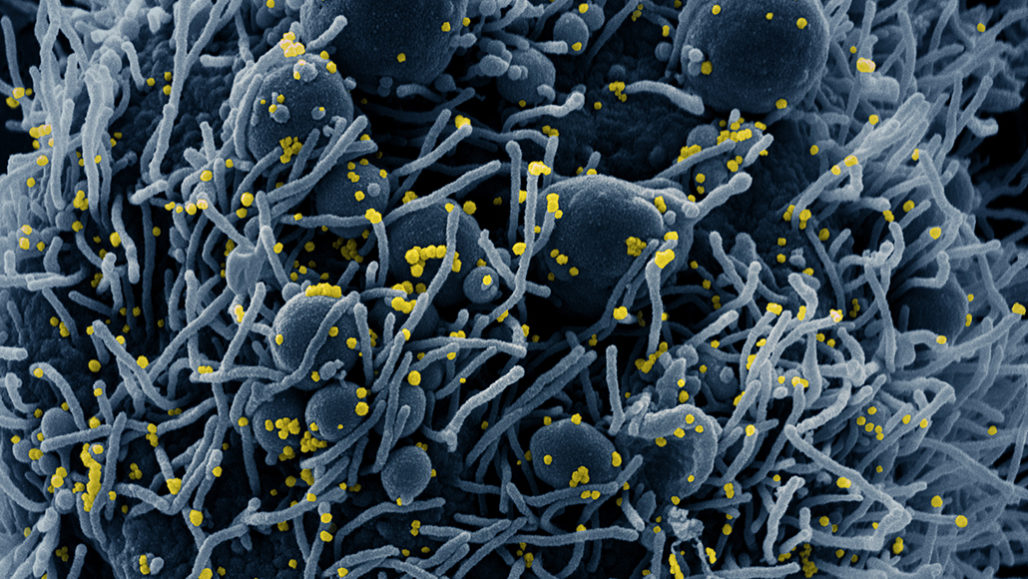
SARS-COV-2 electron micrograph from NIAID– CC license
We know from previous research reported on here that tests of populations without symptoms have shown 20% or more are shedding virus at the time of testing. We don’t know how long they will continue to shed, whether they will develop symptoms later, or what percentage of false negative tests are in these samples. We also don’t know if asymptomatic shedders will develop protective antibodies with time, although that seems reasonable.
With that in mind, we could look at the total population of the United States and say, “how many are now infected?”– although we know the infection rate varies with location, age, and many other factors. Some areas have many infections and rapid spread: mostly large cities. Other areas have few infections but also have rapid spread: mostly rural areas and small towns. A few areas have almost no infections and very slow spread: isolated places.
Just by adding up those two numbers– the percentage of positives in screening studies (ones that sample everyone in a group) and the number of people in the US– we get, veryveryvery roughly, 60 million people. That result is absurd. How could so many people be infected only three months after the introduction of this virus to the US?
The famous author of the web site fivethirtyeight, Nate Silver, introduced an Excel spreadsheet on April 4 that models the spread of SARS-COV-2. The post is titled “Coronavirus case counts are meaningless– unless you know something about testing. And even then it gets complicated.” He links to the spreadsheet at the very end of the post because there is a great deal you need to know before you start playing with the model– and when you look at the spreadsheet, you tend to forget about everything else and possibly ignore the warnings in his post. So read the post carefully, then come back here.
Once I had the spreadsheet in my hot little hands (with the help of an introductory offer from Microsoft for Excel itself), I was entranced. I raised the number of people in the model from 10 million to 330 million and started tweaking the R (the actual number of people to whom each infected person passes the virus). I changed the initial number of people introducing the infection from one to five. I found that, with an R of 3 (well within the range of actual estimates) that dwindled starting on March 1 gradually to 0.4 (consistent with the time that the country went on lockdown), the numbers of actually infected people were staggering. By the end of March, there would be over 110 million people infected.
With an R of 2.7 (the conservative R that the model was shipped with), there would have been 36 million infected by the end of March and 40 million by today. Thereafter, with a lockdown in effect and an R of 0.4, the pandemic would die out. The same is true of most models with a lockdown date of March 1; by now, the infection would be dwindling and very few more people would become infected.
Under these models, with a maximum testing rate of 2 million a day, there would have been about 1.5 million cases detected by today. Unfortunately, there were only 100,000 to 150,000 tests run a day this last week. There have been numerous bottlenecks in raising the test rate, including shortages of swabs and reagents, but in general there has been a lack of federal will and direction to ramp up testing. Despite the population’s worries and the nearly nationwide lockdown, shortages of tests and personal protective equipment (PPE) have continued to hamper our reaction to this pandemic. At the federal level the response is obtuse, opaque, and corrupt.
Based on this simple model, which is available to everyone to tweak and study as they wish, there are possibly on the order of 50 to 80 million people in the US who have had or are having an infection with the novel coronavirus. This guess is really staggering, but it’s based on some simple calculations from real-world numbers.
There is another real-world number that may be consistent with these estimates: yesterday over 1200 people died with COVID-19, not counting the deaths that New York added that had been missed before. Deaths with this virus tend to lag actual infections by two weeks: those who fall ill often seem to be getting along all right until the second week, when they gradually or suddenly start to go downhill and die.
Many of these late deaths may be related to an immune reaction to the virus that surges out of control, attacking the body as well as the virus. Lung, kidney, muscle, brain, and heart tissues seem to be breaking down as the infection progresses. There are also a few who die very quickly very early in the disease process. Some of these people were found at home dead and not counted before.
There is no estimate in the spreadsheet for deaths related to the virus, but this could be easily added. The death rate in the US appears to be roughly 4-5% of those infected. However, accounting for inapparent infections, the death rate may be as low as 0.4%.
My conclusions are that no-one knows how many people in the US have the virus. No-one will know for a long time. By then, we will be left with a wrecked economy and a much larger number of poor people. We will be mourning for many famous people. In November, we will find out whether this nightmare will get worse or will get better. You know what to do– “vote the bums out”.
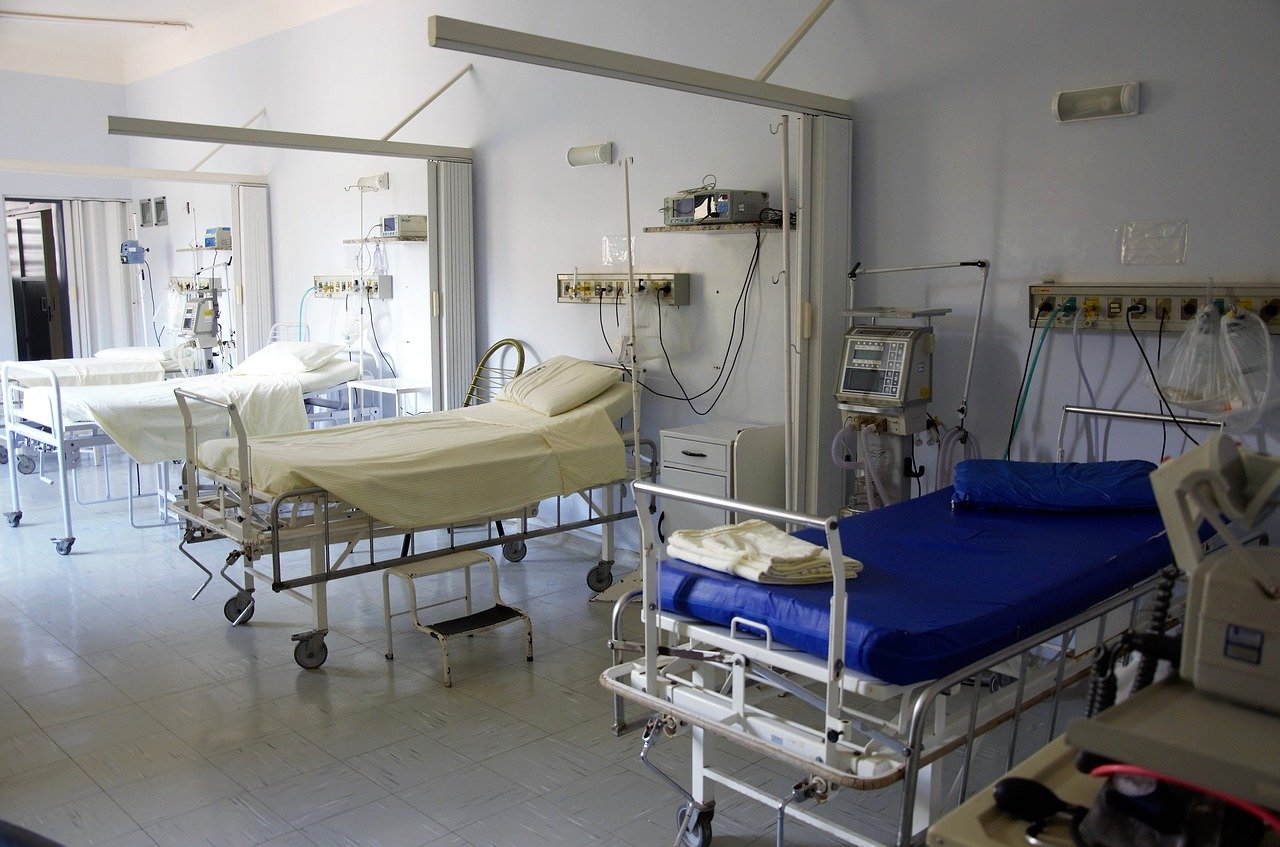
hospital by Silas Camargo Silao via pixabay.com
Here’s a link to the article. It states that 44% of cases may be transmitted before symptoms appear; this was found in a series in which one patient was definitely known to be infected by another. The study quoted was performed in China in the first two weeks of February. Here’s a quote from the article:
Analyzing 77 infector-infectee pairs allowed researchers to calculate when people are most contagious. The team estimates that contagiousness starts 2.3 days before symptoms begin and peaks 0.7 days before symptoms start.
Based on the information from the aircraft carrier docked in Guam, 60% of cases may be free of symptoms; even when there are symptoms, the patient will be spreading the infection before the symptoms even start. This is the most insidious known virus, clearly highly evolved to spread through-out the human population.

aircraft carrier by David Mark courtesy of pixabay.com
Reuters published a report about the aircraft carrier Theodore Roosevelt stranded in port on Guam on April 16. The Navy has nearly completed testing of all 4,800 sailors on board– 94%– and says that 60% of positive tests (for virus RNA in secretions) were in people who reported no symptoms of COVID-19. This high rate of asymptomatic “carriers” of the virus indicates that previous reports of 25%-50% were underestimates, at least in this relatively young and healthy population.
We need to have nearly universal testing to determine how many people in the US have (or have had) the new virus. This will include antibody testing to find people who have carried the virus and are now recovered. Without such testing, we will not be able to reassure the public that it is safe to come out of hiding.
With about 3.1 million tests performed as of Tuesday and 145,000 tests a day, we are far from this goal. Shortages of testing materials continue, and commercial labs have been unable to perform as many tests as they have capacity. We are not out of the woods yet; in fact, we’re in the rough, so to speak.
There are many conspiracy theories about COVID-19 (coronavirus disease 2019) and the virus that causes it, SARS-COV-2 (severe acute respiratory syndrome coronavirus 2). The sequence of the virus that erupted in Wuhan, China with the first known case November 17, 2019 was published by Chinese researchers in early January (5 genomes were sequenced by January 12). Since then, a large number of sequences (3,965 in the latest report on March 27, with hundreds more every day) have been published for viruses recovered in other locations (particularly the US and Europe, but smaller recoveries in southeast Asia and Australia). The numerous sequences are very closely related, but differences indicate that one variety spread from China eastwards to the western US (with an introduction into Washington State), and another spread west to Europe (with a separate introduction into Washington State, making two clusters in that state; and a second introduction into New York City).
Unlike many other viruses (such as influenza), the novel coronavirus has a correction mechanism that reduces natural variability. It does this by fixing errors in the RNA chain (ribonucleic acid, of which there are 29,903 bases in this virus, each base being one of four types that make up an alphabet) that are introduced by a naturally sloppy duplication system unique to viruses. This is good news for the prospect of a vaccine, because it makes the virus less of a moving target. In comparison, the influenza virus has no correction mechanism and has eight or ten separate RNA chains that can recombine, or mix, with each other. This makes it possible for influenza virus to vary so much that a yearly new vaccine is required to establish immunity.
The virus is closely related to a bat virus– but there is at least 92% whole-genome identity with a pangolin virus. Researchers have found that bats naturally harbor many different viruses, including coronaviruses, without apparently getting sick. A laboratory in Wuhan has been studying the natural reservoirs in bats since the original SARS-COV-1 outbreak in 2002-4. This fact has led some conspiracy theorists to blame the Wuhan lab for the outbreak– either by synthesizing a new genome or by accidentally releasing the new virus and introducing it into a Wuhan “wet market” (a place where many different varieties of live animals are held and custom-slaughtered individually for human consumption). Both theories are at least theoretically possible but extremely unlikely for several reasons.
The first reason is that the Chinese government conducts research into these viruses for prevention rather than as a mechanism for bio-terrorism. To claim that the virus was intentionally introduced would imply that the Chinese intended to slaughter their own citizens first and destroy their own economy, an idea which is akin to national suicide. The Chinese could not have anticipated that the US would fail to protect their own citizens by effectively quarantining international travelers– this fact has resulted in US citizens (China’s richest customer base) being the most affected by a worldwide pandemic of unprecedented proportions.
The second reason is that an accident at the Wuhan laboratory that resulted in the release of the virus would have spread differently. This idea is more tenable but still unlikely. It would have involved a single person who then went on to a wet market (hardly a popular place for a person interested in science and not traditional varietal animal consumption) and gave the virus to a bat, which then gave it to one or two other people, who spread it around. Why would “a Chinese intern” (as the theory goes) have gotten infected, then headed to a wet market instead of going home and giving it to her close relatives?
The third reason is that the coronavirus is not a particularly effective killer, although it is a supremely effective spreader. To be a good bio-terror weapon, a virus needs to be a good, rapid killer that doesn’t spread easily. If it doesn’t kill quickly, it won’t be much use on the battlefield. If it spreads easily, it will infect your own troops as well as the enemy. A virus that leaves over half of the enemy unaffected, while only killing less than four percent of them, doesn’t sound like a very good weapon.
The final reason that this variety of conspiracy theory surrounding the virus is unlikely is the sort of people who are spreading the theory around. They seem to have xenophobia (fear of outsiders) as a political motive for engaging in this sort of thinking. The motives of people who spread conspiracy theories are, at base, highly paranoid and suspicious. They naturally believe this sort of thing because it fits into their world-view (Weltanschauung, in German, or “world-onlook”) which is that “the whole world is out to get me, in particular, because they all hate me, in particular”. People with this Weltanschauung are also highly narcissistic: they believe that the whole world revolves around them, and everything that happens is directed at them by a unified outside force which either seeks to build them up or destroy them.
Narcissism of this type is particularly unrealistic. The whole world in general doesn’t even know that you in particular exist, and that tiny minority who does know of you is hardly unified in their appreciation of your special gifts or hatred and jealousy of your unique qualities. You aren’t unique, and you don’t have special gifts (or do you?). Certain people, world-famous people, are especially prone to this type of thinking because a much larger proportion of the world does know who they are. But, to [redacted]’s eternal chagrin and disappointment, Barack Obama (a person who is much less concerned about how he appears to others, and who is much less attention-seeking) has twice as many followers on Twitter. What’s worse, former President Obama really cares about people in general and has a highly developed ethical sense (qualities that [redacted] completely lacks).
So I am skeptical of this particular variety of conspiracy theory. It may turn out that this virus was accidentally released from a virological laboratory in Wuhan, China– but that doesn’t make any difference to the millions of people who have already been infected. It’s still a naturally derived virus according to the expert virologists, and it’s still a newly evolved “zombie” that takes over your body– for a while, perhaps forever. You can’t run away from it, no matter where it came from. The only thing you can do is stand and fight.
 Conrad Theodore Seitz