The pharmaceutical giant Johnson and Johnson was forced to agree to the third largest settlement in a drug case ever by the Justice Department, as announced by chief Eric Holder today. The New York Times online article can be found at: http://www.nytimes.com/2013/11/05/business/johnson-johnson-to-settle-risperdal-improper-marketing-case.html The investigation involved three drugs, the most famous of which is Risperdal, a powerful antipsychotic drug that J+J promoted for controlling behavior in demented patients and children with behavior disorders– inappropriately, as it turned out.
The other two drugs were obscure, a heart-failure treatment and another antipsychotic, both of which were marketed inappropriately.
In the case of Risperdal, which has coincidentally gone off patent recently, the drug was only approved by the FDA for use in patients with disorders such as schizophrenia. Doctors were free to use it for other problems on their own, but the drug companies were not supposed to promote the drug except for the approved indications. To increase Risperdal’s use, drug representatives (who personally buttonhole physicians in their offices and extol the virtues of their drugs) went beyond the approved indications to other, much more common unapproved uses. Antipsychotic drugs are among the most used ones in cases were a patient’s behavior is a problem due to their restlessness or aggression.
However, there is no research showing effectiveness of these drugs for these purposes and it is likely that they produce benefits primarily through their sedative action. In addition to making patients drowsy, Risperdal also interferes with their ability to think connectedly and causes unpleasant feelings of confusion. In addition, Risperdal frequently causes increased appetite and uncontrollable weight gain, usually resulting in Type 2 diabetes. A large number of serious chronic mental patients have been transformed into grossly obese, drooling, shambling zombies by Risperdal and related drugs.
There are a few patients in whom Risperdal is not only indicated, primarily schizophrenics, but the drug of choice. Unfortunately for J+J, these patients are few and far between, minimizing their profit potential.
The article states that “As part of the settlement, Johnson & Johnson has agreed to plead guilty to a criminal misdemeanor, acknowledging that it improperly marketed Risperdal to older adults for unapproved uses. It did not admit to wrongdoing for the civil portion of the settlement, which involves claims that the company promoted the drug’s use in children and the developmentally disabled, as well as accusations that it paid kickbacks to doctors and pharmacists in exchange for writing more prescriptions.” We hope that a 2 billion dollar fine will inhibit further inappropriate promotion of branded drugs for unapproved indications.
Hidden Deer
Koch Strategy: Start Small
An article in today’s New York Times online demonstrates a key aspect of the Koch strategy to take over politics with its money. This aspect is as genius as it is money-saving. The idea is to start by influencing the smallest possible races, so as to be able to concentrate efforts and win control of government starting at the most local level.
The article discusses a town called Coralville, Iowa, which has taken on debt to establish a special economic zone on its waterfront property. The Koch brothers’ organization has blanketed the community with flyers and other low-tech campaign devices, supporting a set of candidates for city council who it says will get the debt under control. The current city government claims that it already has the debt under control and any changes would be irresponsible. Among other things, it points to a fourfold increase in the city’s revenues.
Unfortunately for the Koch brothers, the area is heavily Democratic and appears to be well informed on political issues. The candidates supported from the outside by the Koch brothers are not doing well amid speculations that they are, in fact, controlled from outside.
However, the Koch organization has had considerable success in backing anti-tax measures in many small towns. The single organization identified in the Times article was said to have 35 branches across the country. Apparently, five million dollars was designated for the race in tiny Coralville, Iowa.
The link to the Times article is at: http://www.nytimes.com/2013/11/04/us/politics/koch-group-has-ambitions-in-small-races.html?pagewanted=2&_r=0&nl=todaysheadlines&emc=edit_th_20131104&pagewanted=all
Seagull in the Face
California Fines Nonprofit Group Sixteen Million Dollars for Diverting Anonymous Contributions
The Koch brothers (and other right wing zealots) were implicated in a complex contribution-laundering scheme that funneled some $16 million into California referenda last year. The “nonprofit” organizations were fined the entire amount by the state’s Fair Political Practices Commission after an investigation.
The identities of all the donors has still not been publicly revealed, and the fine has not been collected yet. This is still a victory for openness in politics on the state level. Both of the referenda that were bankrolled by these contributions lost at the polls, and now the money spent on pushing them will be clawed back. Unfortunately, only thirteen other states have laws as strong as California’s, and federal law (especially after the Citizen’s United Supreme Court decision) allows unlimited anonymous donations with no oversight. The Koch brothers have taken advantage of lax federal laws to spend hundreds of millions of dollars to try to defeat President Obama in the last election. A total of nearly $1.3 billion was spent on last year’s election, only $255 million coming from the parties themselves and $609 million coming from “super PACs.” (This includes only reported spending; some kinds of money doesn’t need to be reported at all.)
This means that in the neighborhood of $20 was spent for every vote cast in last year’s election.
The editorial at the New York Times can be found at: http://www.nytimes.com/2013/11/03/opinion/sunday/a-victory-against-dark-money.html?src=recpb
This type of anonymous political contribution to influence elections and referendums has the potential to allow organized crime to gain control of our so-called “democratic” government. With less than fifty percent of people eligible to vote actually going to the polls, even at presidential elections, the influence of anonymous money is even greater. There is a lack of political interest among most of the electorate, fueled by an impression that one’s votes don’t count. There is also a lack of sufficient outrage at the mishandling of our government by elected officials.
The only solution to this problem, really, is a requirement that everyone vote. This should be accompanied by adequate time and space for voting. The “first Tuesday in November” is an anachronism. Voting should be open at least all weekend, if not for a week. In addition, there must be an option to vote for “None of the Above” so that voters can express their discontent with all available candidates. These reforms will blunt the effects of anonymous contributions, if a law eliminating all money from politics cannot be accomplished.
One Third of Herbal Supplements are Fake
An article in today’s New York Times online describes a study of herbal supplements– pills and powders– that found that a third of those tested turned out not to contain any of the purported active ingredient. Forty-four bottles of herbals were selected at random from store shelves, from twelve different companies. DNA bar-coding was used to identify any plant ingredients present in the pills. In a third of the bottles, none of the herb was found; in some of these cases, other herbs or even weeds were identified, and in others only rice (as rice flour), wheat, or other fillers were found.
The article can be found at http://www.nytimes.com/2013/11/05/science/herbal-supplements-are-often-not-what-they-seem.html?hp
Part of the problem here is that there is minimal regulation of the herbal medicine market. The purported ingredients are only required to show that they are “safe”, not that they are effective (as prescription drugs are required to do.) Even when the described ingredient has been shown to be safe, there is no guarantee that it is actually present in the pills that you buy. Certainly a pill containing nothing but a filler would be quite safe, although its effectiveness could be reasonably questioned.
The other part of the problem is that there is little or no inspection of the manufacturing plants that produce herbal remedies. Even if a plant were inspected, the absence of any “active ingredient” could easily be missed. Manufacturers are counting on this lax oversight to cut costs by minimizing their expenses on obtaining the herbs involved. It is cheaper to fill a pill with rice flour than with an herb.
At this point it would be nice to see a study of generic drugs to find out how much of the active ingredients they actually contain. I would not be surprised if a significant percentage of generics were similarly mislabeled.
Old Faithful at Night– Yellowstone

Birds on a Telephone Wire

Eggs on the Ground

Mary found these eggs laid directly on the ground. A few minutes later, they were gone.
Stained Glass Window in Abandoned Church
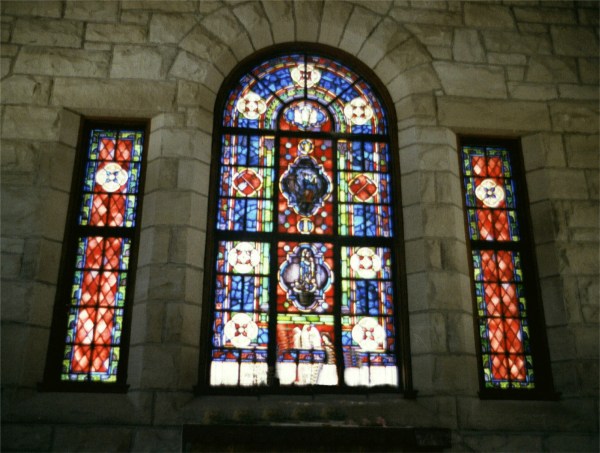
This church is in Eastern Wyoming. It was abandoned, although the roof was still intact. Photoshop was used to remove an altar which obstructed the view of the window at the bottom. If you look closely, you will see the verticals are blurry. Another photo taken here was “Broken Window” which will appear later.

