Cat With One Blue Eye and One Green Eye

This cat was all white and had mismatched eyes. He made a good photo subject and was very docile.
Red Wall
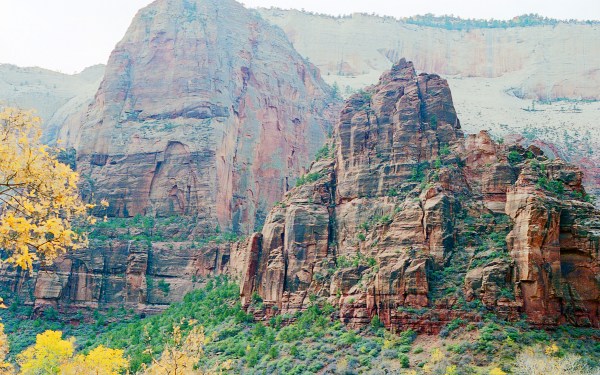
Canyon Walls in Zion National Park
The Preamble to the Constitution of the United States of America states:
“We the People of the United States, in Order to form a more perfect Union, establish Justice, insure domestic Tranquility, provide for the common defence, promote the general Welfare, and secure the Blessings of Liberty to ourselves and our Posterity, do ordain and establish this Constitution for the United States of America.”
Here’s how the tenets of the Preamble break down:
1. A more perfect Union. This referred to the previous document that had established the United States, which document was considered inadequate for a number of reasons.
2. Establish Justice. An efficient, honest, and fair system of civil and criminal law, with Judges appointed by the President and approved by Congress.
3. Insure domestic Tranquility. This refers to the suppression of riots, insurrections and mobs, which required a National Guard. This may have been the motivation for the Second Amendment.
4. Provide for the common defence. Clearly this means repelling invaders, with an Army. The President is Commander in Chief, although he/she is considered a civilian.
5. Promote the general Welfare. This refers to everybody getting a roof over their heads, enough to eat, clothes to wear, even possibly medical care.
6. Secure the Blessings of Liberty. This means freedom from the oppression of the British and leads directly to the Bill of Rights.
7. Ourselves and our Posterity. The authors wanted the government they were establishing to last for a long time and hoped to make the document alterable to fit changing circumstances. Thus the Amendments in general, particularly the Tenth Amendment, which reserves un-enumerated rights and powers to the States and the People.
Now, the Republicans are trying to deny or avoid enforcing one of the six or seven basic parts of the Constitution: promoting the general Welfare. Someone has to point out to them that they are doing this, and that it is wrong. Surely they can’t knowingly ignore such a basic part of the Constitution. Even if they are conservatives and don’t believe in giving people welfare, they can’t deny that there is such an obligation clearly expressed in the Constitution that they have to accept unless they can amend it by a supermajority vote to remove the offending language. Otherwise, they are bound by civility to follow the existing laws even if they don’t like them.
This is another basic aspect of Constitutional government that is ignored by the Republicans at their peril. Surely they realize that wealth inequality, when stretched beyond a reasonable degree, will lead to civil unrest, and if stretched far enough, will lead to civil war. The haves must be made to understand that the have-nots can be abused only so much. Clearly, it is in the rich people’s own self-interest to provide for the welfare of the poor people. There’s plenty enough to go around.
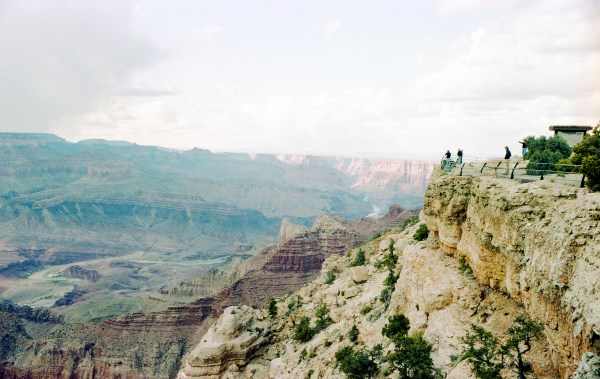
Grand Canyon View Point
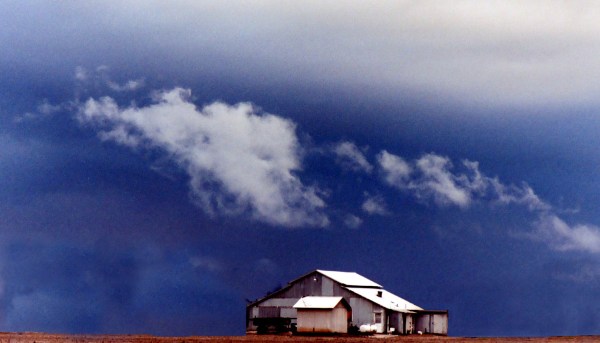
Cloud Over Barn Threatening Thunderstorm
The National Economy: A Brief Lesson
This comment, recorded by the New York Times yesterday, said it all about the federal economy and money:
When I took my first course in Money and Banking in the 1960’s, I realized the general public is never going to understand how the system works – not because it’s too complicated, but because it violates rules people think are essential to virtue. That all our money is, in fact, debt is over the top, despite the words “Federal Reserve Note” printed on every piece of paper money. It’s a promissory note from the Federal Reserve, created out of thin air, with no limit except a promise not to create too much. (I hate to mention this, lest Congress get the idea of a statutory money supply ceiling which right-wingers could then threaten not to raise.)
My professor kept repeating that the national budget is not analogous to a family budget, a business enterprise budget, a city budget, or a state budget. The national government has powers and responsibilities that are profoundly different. Nobody pays attention when things are rocking along, but when economic trouble arises, people suddenly want the national government to start behaving like a thrifty citizen, exactly the wrong thing to do.
As long as inflation is low and people are out of work, the government needs to start passing out paychecks to people who perform useful work that the private economy won’t underwrite. The government can pay off it’s own debt, if it has to.
But that seems malevolent, especially in the South, where that same government is still resented for abolishing Jim Crow fifty years ago.
(November 7, 2013, 9:44 PM)
That just points out that the federal government has the sovereign ability to create its own debt which can be repaid later at a smaller percentage of its original value, meanwhile stimulating the economy to grow at a multiple of its prior rate–an ability that only a sovereign state can exercise. This is an ability that must be exercised during a recession, the worse the recession, the more urgent the exercise.
FDA Proposes Eliminating Trans Fats
In a shocking and interesting move this week, the Food and Drug Administration proposed a rule that would all but eliminate trans fats from the American diet.
First, an explanation: trans fats are the type of fat that is created when certain vegetable oils are “hydrogenated”– that is, solidified by a chemical process– to produce a consistency more like butter or lard. The solidification process removes a double carbon bond in the fat molecule and adds a hydrogen atom. This new single carbon bond is randomly either cis- or trans- placed, that is, left handed or right handed. Normally, this type of fat molecule always has cis- bonds, making a long straight chain of hydrophobic carbon atoms. When a trans- bond is randomly inserted, it produces a kink or bend in the chain; it is still hydrophobic, but it’s not as long . This chemical process is at the heart of the margarine industry: you take an oil like soybean oil, hydrogenate it, and add the flavor molecule that makes it taste like butter. The result is a product that is semisolid at room temperature and has all of the flavor, most of the consistency, and none of the quality of butter.
It appears that the type and quantity of fat in one’s diet have an effect on one’s chances of developing arteriosclerosis in later life and one’s risk of dying from a heart attack relatively young. Some people are susceptible to hardening of the arteries brought on by a diet high in animal fats. This connection is sufficiently obvious that over a hundred years ago doctors were advising reducing diets low in animal fats. Fish oils were recognized to be more beneficial. The margarine industry enjoyed a perceived lower degree of risk because it was made from vegetable fats known to be benign. However, the end result of the hydrogenation process was a fat that turned out to be more toxic than butter fat. This disastrous (to the margarine industry) fact was not widely know up til now, and in fact is still not widely known.
Fats (and oils) that are solid at room temperature appear to be more likely to increase one’s risk of arteriosclerosis, while oils that are liquid at room temperature and below seem to be more benign. Thus coconut oil, which is solid or nearly so, is known to promote atherosclerosis in rabbits that are susceptible to the condition. Fish oils, like that derived from salmon, are liquid well below room temperature, and are thought to be quite beneficial for arteriosclerosis.
Thus, the enjoyment derived from melting butter on hot toast derives from butter’s tendency to promote arteriosclerosis with its chemical property of hardness.
The only other problem with removing trans fats from our diet now is the food industry’s persistent attachment to obsolete methods of production, methods that are now known to cause serious ill health effects that include premature arteriosclerosis and coronary infarction.
For the New York Time’s version of this historic announcement about banning trans fats: http://www.nytimes.com/2013/11/08/health/fda-trans-fats.html?nl=todaysheadlines&emc=edit_th_20131108&_r=0&pagewanted=all
Sunset On a Mountain Lake With Pine Branch

Lake in the Mountains
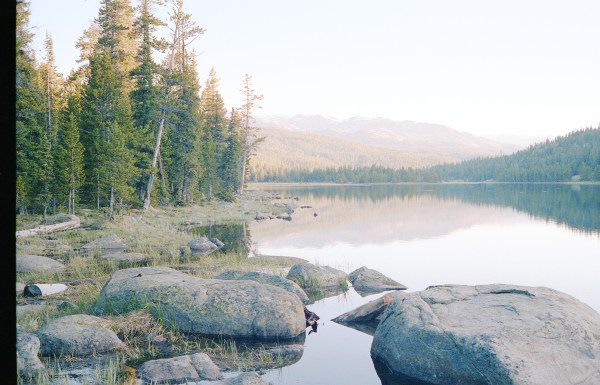
Late afternoon light reflects the mountains in the still lake. Rocks in the foreground look like a good place to sit and watch the sunset. Pine trees grow right up to the shoreline.
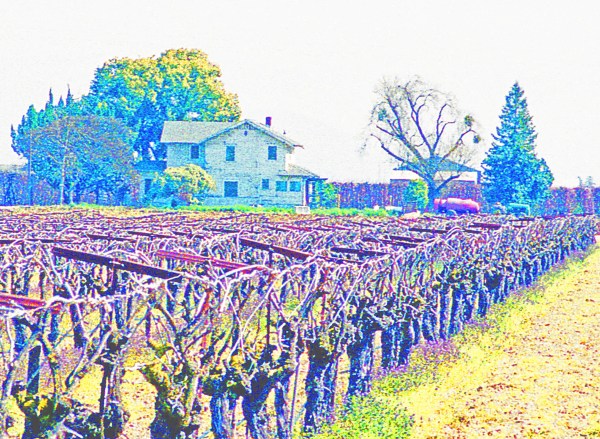
House With Wintering Grape Vines