Don’t Read This: An email exchange (of sorts) with Ivan Oransky, MD, of “Retraction Watch”
I tried to have an email exchange with Dr Oransky but I couldn’t seem to get my thoughts in a succinct fashion. I don’t want to send him a long email that he’s not going to really read because it sounds like a rant from some old fart who’s got a bug in his beard. So I’ll publish it here where no-one will even see it. Like sending a message in a bottle.
Here is what I wrote, but didn’t send, with his note to me: (you can see that it’s way too long to read easily. I got burned by writing too long of a paper in college and I’ve never forgotten it. That’s why this blog. I can spout all I want without ever worrying about who’s going to have to take the time to read it.)
My comment, on his blog about Retractions, to a post about a controversy over whether the manufacturer of Risperdal tried to tailor a research paper to hide side effects:
In my opinion, Risperdal’s side effects are intolerable in all but the worst cases of acute psychosis. Prescribing it to children or adolescents is unwise, especially for long periods. I say this having had professional experience with this drug: acute akathisia is far more common than Janssen claims, and long term side effects are also prominent and troublesome (to use common psychiatric euphemisms). Elevated prolactin, weight gain, apathy, dystonias, etc. I have tried this drug (experimentally, not clinically) and you would not wish to have this experience. I am not surprised that Janssen tries to downplay side effects, with good reason; if psychiatrists knew what their patients were experiencing, they wouldn’t prescribe it.
The letter I didn’t send and Oransky’s letter:
I said that the side effects I had noted in my practice were my personal experience and my opinion. There’s no way you can verify that unless you prescribe it or take it yourself. Or take a close look at the literature.
On Fri, Jul 8, 2016 at 7:54 AM, Ivan Oransky <ivansciam@gmail.com> wrote:
Hi Conrad, your comment was not approved because it contains verifiable claims and facts that we’d need to verify. Please review our comments policy: http://retractionwatch.com/the-retraction-watch-faq/
Ivan Oransky, MD
Vice President and Global Editorial Director, MedPage Today http://medpagetoday.com
Distinguished Writer in Residence, New York University’s Arthur Carter Journalism InstituteCo-Founder, Retraction Watch http://retractionwatch.com
Vice President, Association of Health Care Journalists
Clinical Assistant Professor of Medicine, New York University School of Medicine———- Forwarded message ———-
From: WordPress<wordpress@retractionwatch.com>
Date: Fri, Jul 8, 2016 at 9:43 AM
Subject: [Retraction Watch] Please moderate: “Drugmaker accused of omitting side effect data from 2003 Risperdal paper”
To: ivansciam@gmail.comA new comment on the post “Drugmaker accused of omitting side effect data from 2003 Risperdal paper” is waiting for your approval
http://retractionwatch.com/2015/08/12/drugmaker-accused-of-omitting-side-effect-data-from-2003-risperdal-paper/Author: Conrad Seitz MD (IP: 70.211.70.120, 120.sub-70-211-70.myvzw.com)
Email: conradseitz@gmail.com
URL: http://conradseitz.com
Comment:
Wondering why my comment is still “awaiting moderation” after nearly a year?Approve it: http://retractionwatch.com/wp-admin/comment.php?action=approve&c=1067622#wpbody-content
Trash it: http://retractionwatch.com/wp-admin/comment.php?action=trash&c=1067622#wpbody-content
Spam it: http://retractionwatch.com/wp-admin/comment.php?action=spam&c=1067622#wpbody-content
Currently 2,797 comments are waiting for approval. Please visit the moderation panel:
http://retractionwatch.com/wp-admin/edit-comments.php?comment_status=moderated#wpbody-contentThe letter I DID send:
Respectfully, I have two problems:1) I never got an email saying that my comment wasn’t approved. I don’t know what the tag “awaiting moderation” really means: does it mean the comment is invisible to everyone but me, or is it just a tag to tell others that you don’t approve it? Or that you haven’t yet approved it?2) If you don’t want to hear about my personal experience even when I’m sure it’s true and it’s highly relevant to the subject at hand (the manufacturer’s dissembling about side effects) then I can publish it in my own blog under my own responsibility.It’s not clear whether you think I’m wrong or just can’t prove I’m right.
Hi Conrad
It appears to me that your staff is overwhelmed by the volume of comments, because there is a line at the end of the email that you sent me that states “Currently 2,797 comments are waiting for approval. Please visit the moderation panel:”
 And here’s what else I wrote, after reflection:
Dear Ivan,
Wall Tiles, Slightly Cracked

Details are sketchy, but it is known that five police officers were killed, seven were wounded, and two civilians also were hit. The attack occurred at the end of a peaceful rally and march in downtown Dallas, about 8:58 PM, according to the New York Times (NYT.) About 800 demonstrators and 100 police were at the rally, which was otherwise completely peaceful. Police said four snipers participated in the attack; one was killed by a remote-controlled bomb after a standoff, but three others were taken into custody.
The NYT says that this is the worst attack on police since the 9/11/2001 incident. Police should not feel especially endangered as the score so far this year is some 123 black people shot dead by police, while there are over 300 million firearms in private and police hands in this country. The presence of so many firearms makes everyone unsafe, and the police are relatively less affected by this violence although they surely feel under siege. While incidents such as this small massacre shock the community, massive incidents in places such as Baghdad receive little notice: some 250 people were killed in a bombing in the capital of Iraq just a few days ago, with little comment from officials in this country.
This escalation of violence by civilians is shocking and disgusting but there is nothing surprising about it. There are so many firearms available that anyone with a grudge will have easy access to the right weapon for an ambush. What makes this massacre so disturbing is that the police will use it as an excuse to violate the civil rights of every American whom they encounter. Prior experience leads us to conclude that the police will think everyone who is not lily white is a suspect.
This tragedy will only lead to more tragedies. The risk of a spiral of violence is very real. Everyone who is affected by this should step back and try to de-escalate their violent feelings. Anyone who owns a weapon should put it in the closet. There is no need for anyone to carry a weapon for protection and there is little possibility of being able to use it for appropriate self-defense. It is much more likely that you will mistakenly perceive a threat and respond inappropriately.
Just having a weapon in your hand makes everyone around you suspect and everything you encounter translates into a threat. The hammer analogy is fitting here: if the only tool you have is a hammer, everything around you looks like a nail. This is part of the policeman’s problem: just having a handgun makes a policeman feel threatened. Now policemen will demand automatic weapons because they “need” them for self-defense, and police shootings will only increase.
The only way to stop this cycle of violence is for basic training of policemen to change dramatically. The police must be taught not to approach ordinary citizens with their guns drawn, expecting a fight. It is not appropriate to be on maximum alert when approaching a citizen who is not displaying any aggressive signs. Surely a policeman can be prepared to defend himself without being on a hair-trigger.
For example, in the incident a couple of days ago where a black man was shot in his car after being stopped for a broken tail-light, the police approached the man’s car with their weapons drawn and immediately demanded that the car’s occupants raise their hands and keep them in the air. At the same time, they demanded that the driver produce his license and registration. Before they even got to the car, they were in a heightened state of alert and paranoia. When the driver mentioned that he had a legal gun, they misinterpreted this as an emergent threat because they were already paranoid. When he reached for his license, they thought he was going for his gun, even though they were the ones who demanded that he produce his license.
I think that just telling the policemen that he had a gun got him killed, because he was black and they were paranoid about black men. This is inexcusable and the shooter should face jail time for his murderous act. If the policeman is not prosecuted, this will only prove to the black community (and to many whites) that the justice system is broken.
At the same time, people who lash out at the police are only making matters worse for ordinary law-abiding citizens, who will bear the brunt of a crackdown on everyone. Lawful protest is necessary and appropriate, but shooting people is murder no matter who does it.
Cactus Flower

Another police shooting. In this case, a man was stopped for a broken tail-light in a suburb of St. Paul, Minnesota. He told the policeman he was licensed to carry a gun, then reached for his license. The policeman shot him to death. The immediate aftermath to the shooting was recorded by his girlfriend and posted to Facebook on a video that has been viewed many times.
This policeman’s behavior is typical of the way nonwhite people are treated by police whenever there is the slightest apprehension, or even without provocation. Another man was shot by a policeman while reaching for his driver’s license, in a similar incident, without provocation, but fortunately the man survived. That incident has been forgotten in the crush of other incidents that seem to occur on a daily basis.
This is the United States: a gun-saturated culture, a trigger-happy culture. Mass shootings by civilians occur almost every day. Policemen shoot unarmed, unresisting black and brown men almost every day. Young men in the inner cities, men of color, shoot each other multiple times every day. It’s not just the guns in the hands of ordinary people; it’s the guns in the hands of the people, policemen, who are supposed to know how (and how not) to use them.
This is a tragic state of affairs and it could have been avoided. The education and training needed to prevent these occurrences is lacking in almost every police department in the country. The mind-set of those who enter into police work is abnormal and the level of police prejudice against people of color is alarming.
Worse, there is a mind-set, especially among young men of color, that says that everyone who disagrees with you is dangerous and the only defense is to carry a pistol. This mind-set is apparent among men of all colors and every age who see life as a deadly struggle and firearms as the only protection for one’s manhood and personal space.
I know I’m a lonely voice crying out in the wilderness but still I say: Why can’t we all just get along?
Texas Attorney General Warren Paxton Subject of SEC Complaint for Fraudulently Promoting Investments
Texas’ new Attorney General is Warren Paxton, said to be a Tea Party- aligned politician; he previously served in the Texas House for ten years and in the State Senate for two years. He received contributions of nearly $1 million from oil and gas companies when he ran for office in the Texas House and Senate.
Mr. Paxton made the news when he successfully sued a Virgin Islands Attorney General for sending a subpoena to Exxon Mobil demanding internal documents regarding its knowledge, and denial of, anthropogenic global warming. The premise of the subpoena was that Exxon was committing fraud by attempting to profit from its denial of AGW. The subpoena was withdrawn, a victory for Paxton, but this has brought unwelcome attention to Mr. Paxton himself.
It seems that, starting in 2011, Mr. Paxton promoted the sale of stock in a company called Servergy, which was developing a computer server that it claimed was a direct competitor to servers produced by such giants as Dell. Unfortunately, this server was already obsolete ( a 32-bit model when all new servers are 64-bit.) To make it a perfect fraud, Mr. Paxton never disclosed to his prospective investors that he was being compensated for his work, and he knew (or should have known) that Servergy was creating pre-orders for its server out of whole cloth.
In April, the Securities and Exchange Commission filed a complaint against Mr. Paxton and others for fraud. The complaint makes for interesting reading and shows what a grimy, two-bit hustler Mr. Paxton really is. His (temporarily) successful lawsuit against the Attorney General of the Virgin Islands was filed at the behest of his corporate paymasters, including Exxon. He twists his mandate as a State Attorney General when he involves himself in a suit by another AG against a private company.
We can only hope that the proceedings against Exxon by several State Attorneys General will continue, as there is considerable evidence that Exxon knew (or should have known) that its oil products were contributing to AGW and that it deliberately deceived its customers about the risks of global warming. Read about Exxon’s fight for the right to deny global warming in Wired.

A Baton Rouge man is dead after two policemen tackled him, held him down, and shot him five times. He was said to have been selling bootleg discs in front of a convenience store, and someone claimed that he had brandished a gun. The linked video from Twitter is blurry and only shows the beginning of the “confrontation” but what is clear is that two policemen tackle a man and hold him down. Then, a few seconds after they grab him and appear to have him under control on the ground, one of the officers draws his weapon, holds it over his chest, says something, and then shoots twice. The video goes blank, but a few seconds later, three further shots are heard. The video is certainly blurry and shaky, but it is apparent that two policemen tackle the man and hold him face up on the ground. The man collides with a parked car on the way down. A moment later, the video shows that while one of the policemen is holding the man down with another policeman, he draws his weapon. It is clear that the man is held motionless on the ground by the two policemen. Also clearly, there is a delay after the policeman draws his weapon while something is shouted.
Note from the video that the policemen appear to be extremely aggressive when they are taking the man to the ground, almost like they were playing football and swarming over an opposing player. Then, after the policeman draws his gun, what he says sounds very hostile and profane. Perhaps the man said or did something that was provocative to the police, but that doesn’t explain their sudden, overwhelming attack on the man.
It is clear that the man is held on the ground by two policemen for several seconds before he is shot. There doesn’t appear to be any reason for the policeman to shoot.
No charges have yet been filed, but federal law enforcement authorities are investigating. This incident is consistent with the way Baton Rouge police handle encounters with nonwhite citizens who appear to be, in their eyes, violating some law, although not personally threatening to the police (there is no evidence that the man who was shot was pointing a gun at the police or anyone else, although apparently the police were called because someone said the man had waved a gun at them.)
This is typical of the overly aggressive behavior of policemen in Baton Rouge, in fact all over the United States. The police need to be retrained to be less aggressive and less confrontational. There is no excuse for shooting a man who is already under control and lying on the ground. Many police shootings appear to be related to the casual way in which policemen brandish their weapons in confrontations with nonwhite people. This is wrong, and must be stopped, or else nonwhite people will never regain their respect for policemen or authority in general.
I grieve for the lack of respect that people in authority, especially in the United States, show for other people, mainly people who lack status. Before people in authority can command respect from the people over whom they exercise control, they must demonstrate respect for those people. There is no legitimate authority without respect for the people.
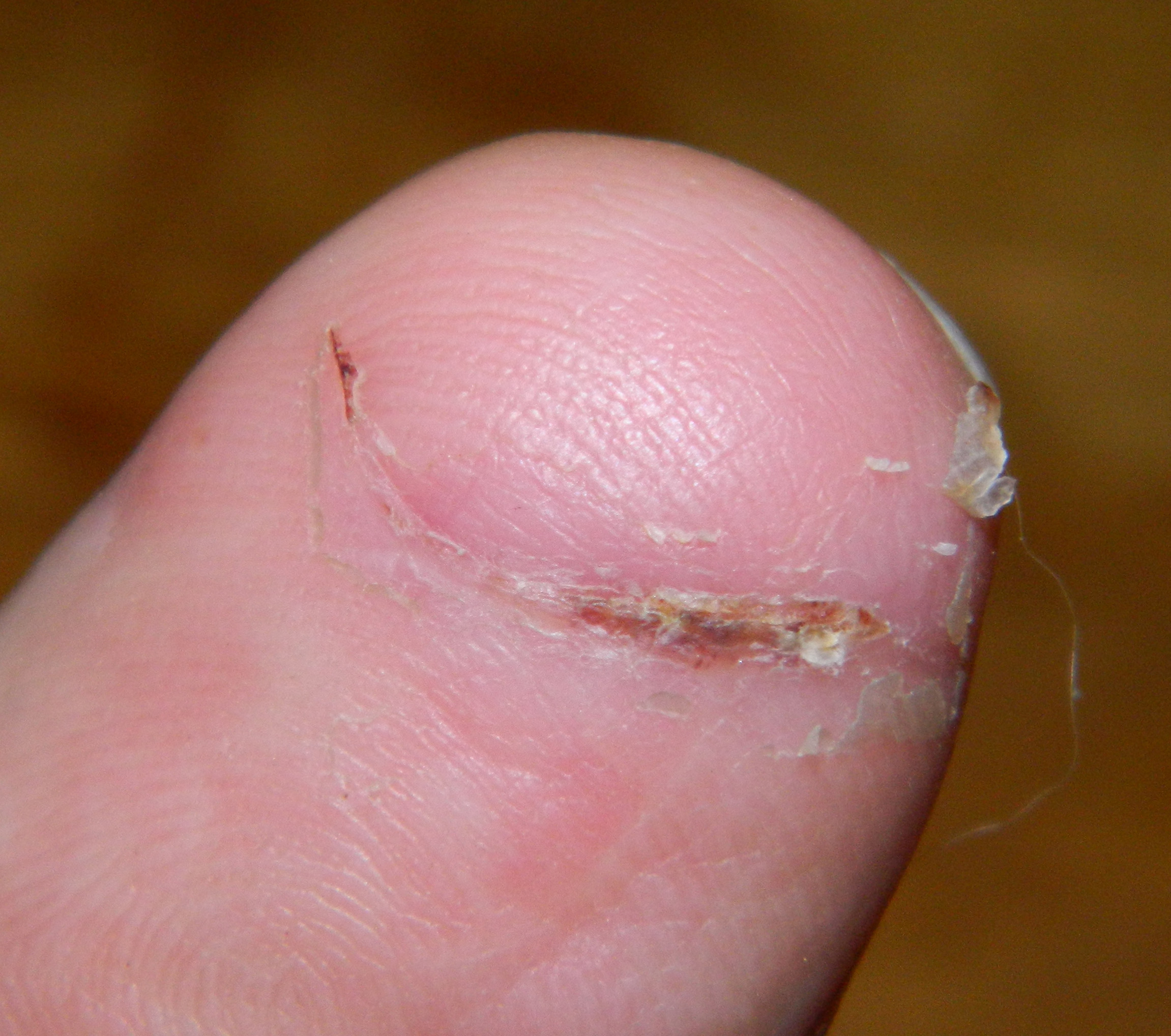
Left 2nd Finger
Name That Dog

This dog showed up in our yard, in a rural area surrounded by peach trees five miles west of Sanger and and twelve miles southeast of Fresno. He came here a week ago, got food, and now won’t leave. We gave him a collar off an old belt so that if he got run over people would know he had a home. We tie him up when we feed the cats, of whom we have thirteen. Some of the cats, the most friendly in fact, are strays. We do get them operated on when they’re two or three months old to neuter them.
This kind of thing (having multiple cats) is unusual, I understand.
The dog does not yet have a name; “Aladdin” and “Billy” have been suggested. Any more suggestions for the dog’s name (other than Spot)?
A report from the Fair Punishment Project details the records of the five most prolific district attorneys in sentencing people to death. These five were personally responsible for a disproportionate number of death sentences, and in the process a disproportionate number of misconduct violations: from one-third to one-half of all death sentences were marred by misconduct, and half of death penalties were reversed.
After four of these five left office (the fifth retires this year), the number of death sentences dealt by their departments dropped by more than ninety percent. The report makes for grisly reading, but it makes clear that sadistic, unprincipled prosecutors are responsible for most death sentences in the United States.
The report also comments on three currently active prosecutors who are vying to replace these retired miscreants as top killers. The imposition of the death penalty is an anomaly today, and mostly depends upon the active if not obsessive pressure of the prosecutor. If it were not for the state of mind of these sadistic prosecutors, there would be even fewer death penalty cases then there are now.
If you are interested in anti-death penalty activism, this report provides you with ample ammunition for your arguments. Go for it.

