A five-year, rigorous medical study of 956 women published in the Journal of the American Medical Association (JAMA) Psychiatry concluded that women who received an abortion had similar or better mental health than women who were denied an abortion for the full five years afterwards.
In fact, women who were refused an abortion had higher levels of anxiety, lower self-esteem, and lower life satisfaction (but not higher depression) eight days after the procedure was denied than women who did have an abortion.
The National Right to Life organization made this statement, which completely denies the outcome of the study:
“We know that some women do eventually have serious negative psychological responses to their abortions, some within a year or two but most several years down the road.”
They neglected to mention that the same number of women who did NOT have an abortion had serious negative psychological responses, given that more than 30 percent of ALL people have an anxiety disorder and 20 percent have a mood disorder at some point in their lives (thanks to Snopes.com.)
Mortality in the US, 2015

The age-adjusted death rate in the United States rose 1.2% and the life expectancy decreased by 0.1 year in 2015, according to the National Center for Health Statistics report issued December 8, 2016. The infant mortality rate was unsignificantly changed from 2014 at 589.5 infant deaths per 100,000 live births (just over 0.5%) versus 2014’s 582.1 deaths per 100,000; again, that was insignificant, but an increase of 7.4 deaths per 100,000. There was a significant increase of 11.3% in infant deaths from unintentional injuries (accidents.)
This was the first time since 1999 that the death rate increased significantly. Incidentally, the age-adjusted death rates for black males were more than twice the rates for Hispanic females. The life expectancy at age 65 was 19.4 years, unchanged from 2014. The five leading causes of death were heart disease, cancer, chronic lower respiratory diseases (“emphysema”), unintentional injuries (“accidents”), and stroke. Suicide, the tenth cause of death, increased from 13.0 per 100,000 to 13.3.

Texas Governor Rick Perry was picked to head a major government department. In 2011, during a presidential debate, he pledged to eliminate three government departments, including one for which he couldn’t remember the name. That department is the Department of Energy. Now Donald’s plan is clear: he intends to have people running departments which they intended to eliminate, or at least dramatically change.
(photo: crashed Porsche Boxster in Tehran)
The updates to Microsoft’s User Agreements include separate terms for users who live in China, Taiwan, Hong Kong, and Singapore (as well as other countries). These specify different terms, for example:
For customers living in Taiwan, we’ve clarified that all purchases pertaining to digital content are final and non-refundable when such content or service has been provided online, and that there may be certain circumstances when you are entitled to a refund for subscription Services.
And in a following section:
For customers residing in China, in the Contracting Entity, Choice of Law, & Place to Resolve Disputes section, we’ve added that if you are using MSN, Bing or the Windows Maps App, you are contracting with Microsoft Mobile Alliance Internet Service Co., Ltd., and if you are using Xbox Store on Xbox ONE, you are contracting with Shanghai Oriental Pearl Media Co., Ltd.
The “Summary of Changes to Microsoft Services Agreement” describes several such changes depending on where you live. It does not explain what “Shanghai Oriental Pearl Media Ltd” is, nor what “Microsoft Mobile Alliance Internet Service Co. Ltd” is, but the presence of “Ltd” in these names suggests that these are special-purpose corporations that handle business in these areas in a completely different way. Just how these differences affect customers in China is not specified and it would be inappropriate to speculate. Nonetheless, it is clear that terms are different and that these terms relate to the differences in governance in these areas.
This would be a productive area of investigation if it were possible to discover just what these differences were.
Donald and Kanye
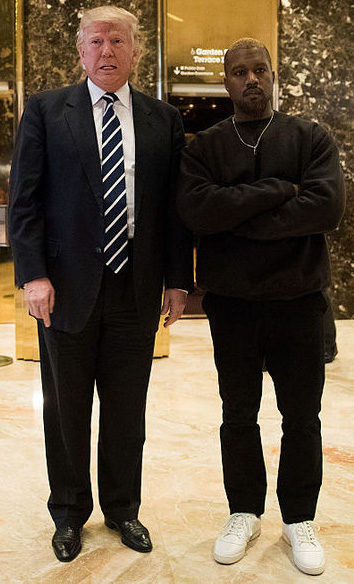

Question: what does Donald’s expression say about him? Is it something to do with Kanye West? Or is he having a bad day? He tweeted that he was too busy to hold his previously announced press conference today in which he was to explain how he was going to distance himself from his business ventures during his presidency. Instead, he announced that his son and son-in-law would be handling his businesses. Perhaps not a fully satisfactory explanation, but it allows him to avoid taking questions from the press (who are sure to be out to get him after the “secret” tongue-lashing he gave them the other day that they weren’t allowed to report on.)
I have been arguing with myself ( a sure sign of incipient schizophrenia ) as to whether every post from now on should be about the “orange jackal” or whether I should just ignore him altogether and return to just posting flower photographs. Any guidance from my three regular readers would be appreciated.
(photo credit: Getty Images)
One in Six Adults Takes Psychiatric Meds

The news: one in six adults in the United States filled at least one prescription for a psychiatric drug in the year 2013, according to LiveScience clickbait (those daily, or more frequent, stories with exciting titles– that turn out to be poor descriptors for the stories.)
The article continued:
Antidepressants were the most common type of psychiatric drug in the survey, with 12 percent of adults reporting that they filled prescriptions for these drugs, the study said. In addition, 8.3 percent of adults were prescribed drugs from a group that included sedatives, hypnotics and anti-anxiety drugs, and 1.6 percent of adults were given antipsychotics, the researchers found.
One reason for the predominance of antidepressants is that they are not “scheduled” drugs (that is, there are no restrictions on prescribing them other than the need to have an active medical license in the state.) The estimate that 6.9% of adults have had a depressive episode fits roughly with the 12 percent who filled prescriptions, when one accounts for the fact that antidepressants are not “scheduled.”
The point is that antidepressants can be readily prescribed with minimal restrictions, and depression is one of the most common symptoms or diagnoses that doctors encounter. Patients with difficult to diagnose symptoms are often suspected of harboring depression without being able to express it or not understanding its presence.
These figures on medication use are in good agreement with the estimates widely disseminated that one in five adults in America “experience mental illness” in the course of any year. About seven percent of adults suffer from depression, or to put it technically, “had at least one major depressive episode in the past year.” A “major depressive episode” is defined as:
“[P]rimarily depressed mood for two weeks or more, and a loss of interest or pleasure in everyday activities, accompanied by other symptoms such as feelings of emptiness, hopelessness, anxiety, worthlessness, guilt and/or irritability, changes in appetite, problems concentrating, remembering details or making decisions, and thoughts of or attempts at suicide.” (Wikipedia.)
Maybe you didn’t want to know that, but I’m including it because it is a very important problem to which enough attention is not paid. People tend to deny that they are depressed because they are ashamed of it and perceive it as a weakness. Someone who denies that they are depressed to others tends to become, and feel, more isolated; isolation is a major risk factor for attempted suicide.
The figures for antipsychotic prescriptions also agree with estimates of the prevalence of psychotic disorders (at least the well-known types like schizophrenia.) According to NAMI, about 1.1% of adults have schizophrenia, close to the scripts for antipsychotic drugs at 1.6%; of course, other types of psychotic disorder that are less-well characterized are not so well represented in prescription numbers.
The estimate that 18% of adults have had an anxiety disorder does not fit so well with the prescription numbers, possibly because anti-anxiety drugs are generally scheduled at least at the lowest level, Schedule Five, and frequently at Schedule Four or above (more restrictions are placed on older anxiety drugs like barbiturates, which are more dangerous and less well tolerated.)
Other estimates that make one pause to think include the following: one in 25 adults experience a serious mental disorder over the course of a year. Of the 20 million who use or abuse drugs (including prescribed drugs), roughly half suffer from a concomitant mental disorder. More importantly in relation to prescriptions, only about 41% of adults with mental disorders receive any kind of treatment during a typical year, and about 62% of those with serious mental illness are treated.
That means that roughly 38% of adults (more than a third) in the United States who suffer from a serious mental illness receive no treatment. Some of this may be blamed on the lack of medical “insurance” or on the lack of specific mental health coverage in typical “insurance” packages. Another large factor is the stigma associated with recognition and therapy and the aversive nature of severe mental illness which makes victims avoid psychiatrists and drug treatment.
This post is not intended to present suggested treatment options or ways to improve this situation. It is intended to draw attention to the situation and allow readers to think about options. In future posts, potential methods of improving the situation will be presented.
The US intelligence services have come out with a firm charge that the Russian intelligence services hacked into both the Democratic National Committee and the Republican National Committee, as well as important persons involved in both campaigns. More importantly, our intelligence people have concluded that Russia tried to interfere in our presidential election in favor of the Republican presidential candidate. In other words, the Russians helped Donald get elected.
The orange jackal had a bizarre response to this charge: he completely denied it, and claimed that it was purely politically motivated sour grapes. In other words, he denied that our intelligence services know what they are doing, and claimed that they are biased in favor of the Democratic Party. What is worse is that he has stated that he does not need the daily intelligence briefings that presidents normally get, and that he will have his vice president receive the routine briefings. He has said that he will only accept briefings when the intelligence community has something really new to tell him. He said that the briefings are repetitive, or in other words, boring.
He even equated the information about Russia’s hacking to the erroneous claims made about Saddam Hussein’s weapons of mass destruction, saying that they came from the same people– which is absurd. In fact, the claims about weapons of mass destruction were made by a few operators who were especially implanted in our intelligence services by Dick Cheney; they were not the professionals who normally perform our secret investigative work.
The arrogance and vanity of these statements is truly shocking and bizarre coming from a president-elect who has never had any experience with classified information nor any prior knowledge of how our intelligence services operate, nor what secret information to which they are privy. Even the Republican senators have found his statements shocking. If this is any indication of how the orange one is going to operate in relation to the secret intelligence services that we have used successfully for years, we are in for some serious problems in the near future.
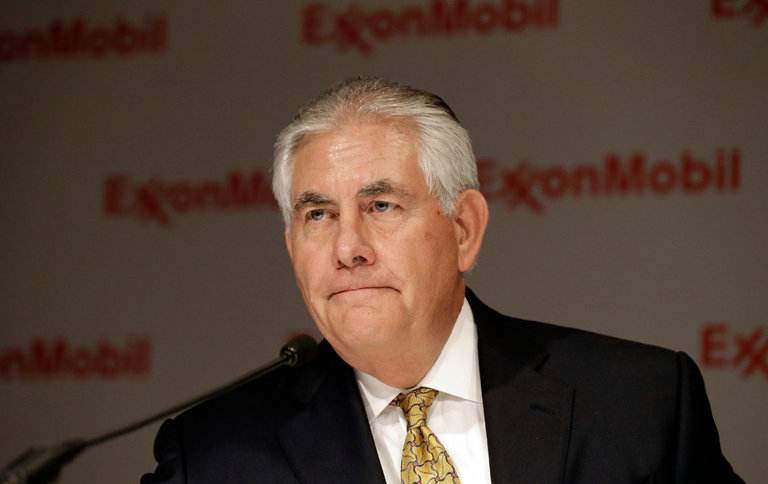
An unusual choice for Secretary of State: Rex Tillerson, a man with no experience in government but an extensive corporate history. More interesting than just his nominal position as CEO of Exxon-Mobil is the fact that he was assigned a supervisory role over Exxon’s holdings in Russia in 1998 as Vice President of Exxon Ventures and President of Exxon Neftigas Limited. In 2001, he was promoted to Senior Vice President of Exxon Mobil Corporation; in 2006, he became CEO. ABC News summarized the recent history of Exxon’s relationship with Russia:
In 2011, Exxon Mobil forged a deal with Russian oil company Rosneft, which, at that time, was 75% owned by the Russian government. The deal gave Exxon Mobil access to arctic oil deposits, and Putin attended the signing ceremony. In 2013, the two companies expandedtheir partnership. That same year, Tillerson received the Order of Friendship award from Vladimir Putin.
The relationship was impaired in 2014, when the US placed sanctions on Rosneft because Russia invaded and annexed Crimea. Tillerson was quoted as saying that the sanctions were ineffective at Exxon’s 2014 shareholder’s meeting. Tillerson’s relationship with Russia will raise questions at his confirmation hearings, according to Senator John McCain.
The odd relationship of Rex Tillerson to government service in the role of Secretary of State raises questions about the orange jackal’s intentions and understanding. Why does he consider Rex Tillerson to be an appropriate choice for Secretary of State? What role will Mr. Tillerson’s prior experience with Exxon and with Russia play in his work as Secretary of State? What about the Secretary’s work with the rest of the world?
Equally important is the role of the confirmation hearings. What does the orange one expect from the hearings? Does he expect probing questions to be asked of Mr. Tillerson at the hearings? Or does he expect the Senate to rubber-stamp his choices?
photo credit: LM Otero, AP
Self Portrait in a Rest Area

Cat on a Hot Tin Roof