
According to The Hill’s state watch news, and the Joe Reedy of the Associated Press, the Florida House of Representatives passed by voice vote a bill that declares that pornography is “a public health risk” shortly after defeating a bill to ban the AR-15 assault rifle by a two-thirds majority.
The author of the resolution, who is running for attorney general, claims that
there’s research showing a connection between pornography use and mental and physical illnesses, forming and maintaining intimate relationships and deviant sexual behavior.
Unfortunately, under hostile questioning, the author was unable to cite any deaths or injuries due to pornography, nor any instances of first responders seeking counseling– unlike the consequences of using AR-15’s.
(photo courtesy of pixabay.com and Bru-nO)

Several news outlets have reported that Special Prosecutor Mueller has additional evidence against Trump’s ex-campaign chief Paul Manafort related to his new home mortgages obtained during and after the campaign in 2016. Apparently, Manafort made false statements on his applications for mortgages on some homes that he owned, including overstating his income from his consulting business. The Hill also reported that Manafort may have promised a banker a Trump administration job in exchange for loans. The banker in question served on Trump’s council of economic advisers but did not get an administration job. One loan administrator felt “pressured” to approve the loans.
(Legos courtesy of pixabay.com)
A year later, the President accuses the FBI of anti-Trump bias; but before the election, most observers say FBI agents hated Clinton and thought she was corrupt. While they weren’t uniformly pro-Trump, they were certainly anti-Clinton. A Guardian article from before the election, on November 4, 2016, said:
The currently serving FBI agent said Clinton is “the antichrist personified to a large swath of FBI personnel,” and that “the reason why they’re leaking is they’re pro-Trump.”. . .
“There are lots of people who don’t think Trump is qualified, but also believe Clinton is corrupt. What you hear a lot is that it’s a bad choice, between an incompetent and a corrupt politician,” said a former FBI official. . . .
Justice department officials – another current target of FBI dissatisfaction – have said the bureau disregarded longstanding rules against perceived or actual electoral interference when Comey wrote to Congress to say it was reviewing newly discovered emails relating to Clinton’s personal server.
Comey’s vague letter to Congress, promptly leaked by Republican congressman Jason Chaffetz, said the bureau would evaluate communications – subsequently identified as coming from a device used by disgraced ex-congressman Anthony Weiner, whose estranged wife Huma Abedin is a Clinton aide – for connections to the Clinton server.
In other words, while not uniformly in Trump’s camp before the election, FBI agents and administrators generally were virulently anti-Clinton for several reasons: she was perceived as “liberal”, while FBI agents generally are conservative; the head of the New York FBI office ran a military charity that received large donations from Trump; Rudy Giuliani (a conservative politician) was close to members of the New York FBI.
In other news of December 2016, reported by the Guardian:
The revelation gives further credence to the CIA’s finding last week that the Kremlin deliberately intervened in the US presidential election to help Donald Trump. The president-elect has angrily denied the CIA’s assessment, calling it “ridiculous”.
As has been widely reported, the “president-elect” has never said anything negative about Vladimir Putin or the Russian government generally, despite his penchant for bad-mouthing all and sundry. He has responded to criticism with crude insults and angry denials, so it is somewhat surprising that he has never had a bad word for Vlad “the Impaler.” There is a certain consistency, however, in his remarks about world leaders: he lauds autocrats and despots, but has put-downs for democratic leaders, even conservative ones like Australia’s Malcolm Turnbull.
The president has been highly disruptive to the FBI, despite their apparent favoritism towards him before the election. His attacks have appeared after the agency persisted in its investigation of his first national security adviser, Michael Flynn, and continued to investigate Russian interference in the presidential election. He has attacked them despite the fact that there have been no substantial findings yet of coordination between his campaign and the Russian disruption efforts. It is possible that there was no extensive effort by the campaign to assist Russia in its meddling and that Trump’s attacks are merely reflexive defenses in response to perceived threats.
Nonetheless, it is clear that there was an intense Russian effort to stir up discord within the American electorate and that they attempted to tilt the election towards Trump even before they realized that he would be the Republican candidate. The Russians made covert efforts to encourage Americans to vote against Clinton and for any opposition candidate, even Jill Stein, but their efforts in Trump’s behalf were most extensive. The effort, geared towards swing states in particular, had an effect on the election (although not a very large one) which was sufficient to cause Clinton to lose and Trump to win.
The argument which is made by some, that Russian sabotage of the election did not have a significant effect, is refuted by the following thought experiment. Suppose the Russians had not made any effort to sabotage the election? In that case, the demonstrator made up to look like Clinton dressed up as a prisoner behind bars would not have appeared at Republican events, because that demonstrator was paid for and arranged by Russian agents. The Facebook ad showing a vote for Clinton as being a vote for the Devil and a vote for Trump as being a vote for Jesus would not have been produced, because it was done by Russian agents. A number of other publicity stunts would not have happened, and we don’t really know how many. If it were not for such incidents, especially Russian support for Jill Stein, the likelihood that Clinton would have been elected would have increased.
Therefore, were it not for Russian sabotage, Hillary Clinton might have been elected President of the United States in November 2016 despite the hostility of the FBI– with a greater probability. The fact that Clinton never visited Wisconsin during the campaign might not have made any difference to the outcome.
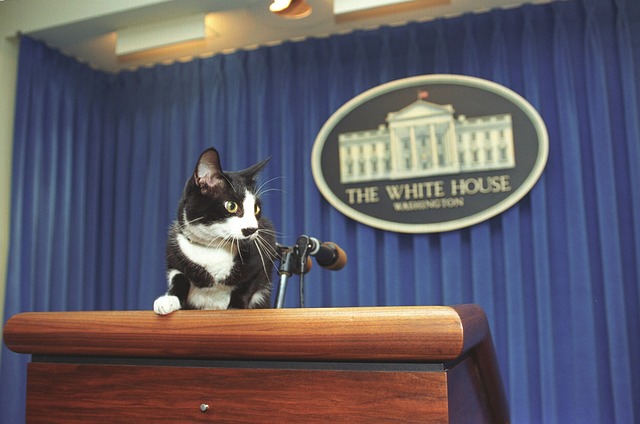
(photo of socks the cat courtesy of pixabay.com and skeeze)

Automation is a two-edged sword. On the one hand, it is making more garments faster and more precisely. It is even making it possible to one day have personal, single garments made to order by placing an online request with individual measurements. On the other hand, it is putting millions of garment workers out of jobs and livelihoods.
Automation of garment production has a long history, going back to steam-powered weaving mills in the early nineteenth century, pioneered by a Frenchman named Jacquard. The newest machines can make garments from start to finish, including delicate, complex work such as sewing on belt loops and making fashionable holes in jeans. The newest machines coming into use in the last few years are capable of doing work previously possible only by hand, which puts myriads of garment workers out of jobs. The only jobs left are supervising the machines, cleaning them, and fixing jams or repairing them when they (rarely) break down.
The effect on workers in third-world countries such as Bangladesh has been catastrophic. According to a Wall Street Journal report:
A 2016 International Labor Organization (ILO) study predicted some Asian nations could lose more than 80% of their garment, textile and apparel manufacturing jobs as automation spreads.
( The ILO is a United Nations organization.)
Suddenly, the garment industry in the third world, which has provided millions of jobs and lifted Bangladesh and other countries out of extreme poverty over the last thirty or forty years, is collapsing because of mass layoffs. Automated garment production is wiping out millions of jobs with no replacements other than a few machine tenders and repairmen.
The benefits of automation are all accruing to the owners of the companies that have bought these new automatic garment-producing machines, while the ill effects fall on the workers. No-one has asked why the owners should receive all the benefits of these advances. Do the owners not have any responsibility to the workers displaced by this new machinery?
It seems to me that there should be laws protecting workers potentially put out of work by machines. Only if all workers and companies are equally included in laws that encompass the entire industry and all other industries potentially affected by automation would it be possible to fairly distribute the benefits of new technology. As it is, with each company fending for itself, the owners feel they have to buy the new machines to keep up with the competition, and once they have the machines, each company is forced to pare its workers to make a profit and compete with other companies doing the same.
It is not fair for the benefits of progress to fall to the owners exclusively, and for all the ill effects to be dumped on the workers at the bottom. The only way to make it fair is for laws to make the companies responsible for the welfare of the workers. Vast profits are to be had in embracing progress, and a share of those profits should be distributed to each person in proportion to his contribution to the new and his place in the hierarchy of the production system.
Workers are not discardable pieces of machinery, to be thrown on the dust heap when their efforts are no longer required. They are the essential consumers of products made as well as cogs, however small, in the machinery of production. If vast quantities of product can be cheaply made, then vast numbers of consumers are needed to buy the product made. Factories cannot exist in isolation without consumers; machines can’t wear sweaters and have no need to buy them.
There are many different ways to “spread the wealth” but the simplest situation, that of laissez-faire, results in a vastly unequal distribution for the benefits of progress. This inequality leads to societal disruption, as without income, the lower people in society have no way to buy and consume the cheap products streaming from the new, more efficient, automated factories. This ever-increasing inequality of wealth distribution has been building since the beginning of the Industrial Revolution three centuries ago.
Before that, there was already structural inequality because of the ability of wealthy persons to charge “rent” or interest for the use of properties, means of production, or money that they own. This inequality grew without effort on the part of the wealthy people; the rent simply accrues as time passes. In fact, it takes effort for the wealthy person to spend the money accumulated rather than banking it. Thus, the luxury industry grows; it is specialized to provide more costly products and services that are designed to use up the extra money on hand.
The rise of more efficient manufacturing methods (the Industrial Revolution) has multiplied the effects of rent by providing more money to owners of the means of production. Larger quantities of product at lower prices are available, and these result in more money accruing to the owners. There results a surplus of product, which encourages exportation.
A solution to this new epidemic of mass unemployment must be found or there will be enormous popular problems. Left to itself, the situation will become very painful to millions of people and disruptive to society. The fairest way to address this problem is to give workers an ownership stake in the automated factories so that some of the profits will accrue to them, allowing them to purchase some of the new products.
(photo courtesy of pixabay.com and kalhh)

I have a modest proposal that will ensure at least 4% GDP growth. The full power of all available citizens can be harnessed with a jobs program that brings in all the chronically unemployed but potentially able workers.
For example, day care centers to enable young mothers to go back to work or start working. Raise the minimum wage to $15 now, and back it up with a jobs program that creates at least a million new jobs a year (and keeps the old jobs going.) Create jobs cleaning up parts of cities that need cleaning. Pick up trash, repaint, repair, anything that is required, as long as it keeps the workers busy. A hierarchy of workers and supervisors with super-supervisors is also needed. The supervisor’s job is to keep the workers busy: think up new things for them to do if they run out of old ones. The super-supervisor’s job is to encourage the supervisors to do a good job of supervising.
Plans for repair of bridges, causeways, dams, and so on can be brought forward as many things are on the drawing board and need only to be rescheduled for now. New construction for needed transportation and other public structures can be speeded up as they have already been worked out years in advance. New York City alone could use subway repair and tunnels that were planned years ago to the tune of trillions of dollars.
All of this is done in a nearly military way: workers are brought on, prepared, tested for skills, and assigned to jobs based on their abilities. Everyone who applies is hired, and paid at least a base salary: those with dependents are paid more for maintenance of their children or disabled parents. Transportation to work is provided in the most efficient manner possible so that not everyone need buy a car– a sort of super-Uber.
The point is that any activity which shows a measurable improvement in the environment is a payable occupation if one’s overall strategy is to keep everyone working and develop new jobs as needed to grow the GDP. When the percentage of people working rises, there will be more money in circulation to buy things, and this increase in demand will stimulate an increase in supply.
The point is that stimulation of the economy must be done in a very sophisticated way. You cannot stimulate the economy in a balanced way and increase the well-being of society without providing money at the very base of the pyramid to seed growth. Inflation can be anticipated and controlled by encouraging supply of goods from other countries with low or no tariffs. It is not necessary to have people in this country work in manufacturing when it can be done more cheaply in other countries. People here can work in building and repair of infrastructure if the government would just provide the funds.
The funds will have to be raised by a slight increase in taxes, that is, on those who can afford it. This may sound politically impossible, but if we emphasize the massive economic growth that is possible with a relatively small stimulus in the right place, we may be able to get the point across. Get rich people to buy more Treasury bonds with an offer of a good rate. It can be done if the will is there.
(photo courtesy of pixabay.com and FotografieLink)
Gun Violence and Gun Control

This solution to gun violence is only a partial one, but it is practical and able to go under the radar on this controversial subject. The trouble is that, practically speaking, we as concerned citizens with children in school cannot force the entrenched Second Amendment fanatics to change gun laws or confiscate all guns (as was done in Australia.) The Second Amendment fanatics are just too strong. About a quarter of all Americans own guns, and there are about 300 million of them in circulation. What we can accomplish, with sufficient money from the government, is an attempt to protect all of the students most of the time in a practical way.
The solution, partial and temporary, is to hire former Special Forces soldiers who have children of their own to protect the schools. Use the carrot of good pay and retirement benefits to obtain highly skilled and experienced ex-soldiers. Bring them home from Afghanistan and Libya to protect their own children. Give them an alternative to working for Blackwater protecting rich scumbags in foreign countries. Post them, armed, one to a school; and put metal detectors at the entrances to every school.
The advantages of this plan are that, first, it is possible to quickly implement and there is a pool of experienced candidates for the post; second, it fits in with the prejudices of the Second Amendment fanatics: this is the plan they would have chosen if they were to decide what to do. The only question is a practical one: are there enough experienced ex-soldiers to guard every school?
According to Google, there are a total of 90,000 elementary schools and 36,000 high schools, both public and private, in America. There are currently 1.2 million service members and 800,000 reservists in the US armed forces. Therefore, obtaining at least 126,000 experienced, recently retired soldiers with children is conceivable if perhaps a slight stretch. Arming them would not be a problem. Installing metal detectors would present the most complex and difficult part of this plan.
The alternatives are either unacceptable or extremely problematic. Attempting to confiscate all guns would be a logistical nightmare that would only incite violent resentment among fanatics. Australia was able to confiscate all guns because there weren’t that many in the country to begin with.
Increasing mental health services and surveilling the susceptible population would be a huge endeavor and would likely involve additional infringements on personal privacy, possibly without providing any protection. The latest psychological analysis of the critical question “who will be next?” indicates that the process of incitement to violence among schoolchildren is already far advanced. Those who may be provoked have many examples to draw from, the most famous being such alternative “heroes” as Dylan Klebold. Thus, the next shooter is likely to come from a minimally disturbed background without major incitements such as being physically or sexually abused or alienated. Surveillance, therefore, would be difficult.
An example from the literature shows that the next shooter is probably a victim of Asperger’s Syndrome and so minimally disturbed that he or she would fit in readily. A sixteen or seventeen year old boy was apprehended with large quantities of incendiary and explosive materials and advanced, written and video plans to create mayhem. The boy had never gone through with his plans despite multiple opportunities. He fit in well in his school, had loving parents who were strict but gentle, and showed minimal signs of disturbance. He had a variety of Asperger’s Syndrome, which is like autism but much less obvious. He was sentenced to probation and psychiatric treatment.
Examples like this show that there is already a subculture of apocalyptic school violence in this country that goes back twenty years and has been getting worse steadily. A rapid, temporary response of providing armed, experienced guards to all schools could be followed by an extensive, long-term psychiatric surveillance program that eventually detects all the minimally disturbed children (as well as the seriously ill few) and puts them under treatment.
The only requirements for this plan are sufficient money to pay the guards and the will and experience to carry it out.
(photo courtesy of pixabay.com and volfdrag)
Hummingbirds at the Feeder

Hummingbirds are gathering at the feeder on my porch now. They start coming as soon as it gets light, and they stay all day. They come and go, spending more and more time at the feeder– sometimes as long as thirty seconds or more. Some of them are drab and grayish color, others have iridescent red patches on their throats, heads, and chests. They chase each other around and around the bare branches of the trees. They chirp and twitter angrily at one another.
When they drink at the feeder, they are fearless; I can stand next to it and, if I hold still, they will continue to come and go as if I were a rock that happened to be there. Standing there, I can see their throats rise and fall as they drink the nectar. I can’t be sure, but it seems as if they particularly like the new type of nectar. It has trace elements like calcium and vitamin A, and a flower coloring is used to make it red. I could be imagining things thinking that they like it better, but they certainly are drinking a lot of it.
Why Can’t Government Do Good Things?

Mr. Trump and his ilk bemoan the cost of taxes, although at least fifteen countries (advanced countries) in the world pay a larger percent of their income in taxes than we do. I won’t recite the benefits that those countries supply to their citizens. The point is that the men Trump employs consistently are trying to destroy what the average man would consider good government. They are always the villains, destroying caches of water left in the desert for exhausted refugees fleeing on foot ( ICE is responsible for this atrocity. )
Government is capable of good things. For example, we will take a historical incident– the emergency that the country faced after Pearl Harbor, in December 1941 (and secretly, before that) was a military emergency but it justified a complete mobilization of our country’s energy. This involved using the labor of every person available. Propaganda films made at the time showed a psychologist testing a group of men and putting every one of them into a job that fitted his abilities and particular needs, rather than rejecting some and employing others. This type of policy is unthinkable in a capitalist entity because there is an apparent loss of profit involved in employing everyone who applies.
This (capitalist) type of thinking is short-sighted, however. First, the advantages gained in testing each applicant and determining their most efficient operating modes, so to speak, will easily overwhelm the cost of hiring every applicant. It is axiomatic that a happy employee is an efficient employee. What could make one happier than going to a job that one is most efficient at?
In addition, the priorities of a government in war are different from those of a capitalist company. At war, one would want the greatest power regardless of profit, whereas in capitalist competition, the greatest profit is the goal. Thus, using the labor of every person who wants to work is the way to maximum overall power but only using the most efficient applicants will yield maximum relative profit.
It is these qualities which make the situation of present-day national governments so marginal. Many nation-states are failing, have failed, or are on the verge of failing– in part because they have been forced to accept loans from banks or other countries and the obligation to service those loans is beyond their power to support. There have arisen a group of capitalist companies that rival in size and power national governments. These companies are “too big to fail” partly because they have become bigger than governments.
The issue in our current government is that the business men who have taken over are attempting to dismantle the entire government (aside from the military) because of their interest in profit rather than national power. They are ham-stringing government because it is to their competitive advantage to do so.
Democrats everywhere must mobilize to prevent the destruction of good government! It is time to stop paying attention to the distraction that is Mr. Trump’s personal behavior (past and present) and Twitter attacks. The true issue is the business men in power who are trying to dismantle good government.
(the photo is from yesterday and shows an almond tree in blossom across the road from our house– spring is already here in the San Joaquin Valley)

Developed by Banyan Biomarkers, the Brain Trauma Indicator test is a quantitative assay for ubiquitin carboxy-terminal hydrolase L1 and glial fibrillary acidic protein, which are released into the blood following neural injury. The test should be performed within 12 hours of injury; results are available in 3-4 hours, the FDA said.
Trial data involving nearly 2,000 individuals with with suspected concussion or mild traumatic brain injury (mTBI) showed that the test was 97.5% accurate in identifying those with visible lesions on CT scans, and 99.6% accurate in predicting those who did not show such lesions.
The above is a quote from a “Medpage Today” article (medpagetoday.com)– an online medical news summary site that sends daily links to new stories by email.
The news is an exciting advance that will allow emergency room and acute care physicians to avoid performing CT scans on every patient with closed-head trauma and suspected concussion, a brain injury that, if repeated several times in quick succession (say, in a month) can lead to chronic traumatic brain degeneration (chronic traumatic encephalopathy or CTE). This syndrome entails personality changes, memory loss, and difficulty concentrating, among other serious long-term complications. The high specific sensitivity for ruling out visible CT lesions is particularly helpful in decision making. However, regardless of the presence or absence of this marker, patients should still be warned not to expose themselves to further injury for a significant period of time after being seen.
Football players are especially at risk for this very serious disorder– many professional football players have had their lives destroyed by first, the condition, and second, the National Football League’s denials that they were responsible (the NFL has recently reversed its position on this issue). Football players who commit suicide by gunshot wound have lately taken to shooting themselves in the chest and requesting autopsies of their brains to disclose the presence of this condition– something that may at least bring closure to their families. Imagine being suicidal and choosing such a method to show that your suspicions about the cause of your self-lethality are correct. Not a pleasant prospect.
(photo courtesy of pixabay.com and KeithJJ)

The real problem with allegations of sexual abuse is that the act of abuse is symptomatic of an attitude which is at its heart inhumane. Thus we are shocked by allegations of abuse against a person who shows caring for others in other actions, but not shocked by such allegations against a person who is generally abusive in other ways. Don the Con, to use an effete example, is abusive towards women just as he is abusive towards other people in general; he hates women just as he hates black people, Mexicans, and the poor. Bill Cosby, on the other hand, has been credibly accused of behavior that is completely out of character for his fatherly, loving persona.
What should we do to someone who has been accused of sexual impropriety ( or any other kind of impropriety, for that matter? ) We should reserve judgement until we receive credible information, for starters. Let that caveat not prevent us from calling out hateful words or policies, nor from endorsing loving action. A person’s career should not be held hostage to mere allegations but if one’s career is already damaging others before allegations have surfaced, there is no need to hold back.
Let us take former Judge Roy Moore for an example. Here is a man who, as a judge, twice defied precedence and the specific orders of judges from higher courts. Such actions, which prompted his removal from the bench, should disqualify him from holding public office, yet he made a credible and nearly successful run for the Senate from his home state– because the endorsement of a man who should never have been elected ( and should have been impeached immediately after taking office ) was considered probative by a large segment of his constituency.
I do not know what is the best remedy for these situations.
Here is the comment of the day, in response to a New York Times article about Robert Porter, the White House staffer under John Kelly who was recently removed after the accusations of his two ex-wives became public:
Carl hammerdorfer
Kosovo 2 hours ago
Every person compartmentalizes, loving the parent who perhaps hit or otherwise abused them, loving the child who lied or bullied, loving the self that is imperfect and sometimes even rotten or mean. But we feel better about it – far better! – when there’s honesty, contrition, maybe even restitution. But when the transgression is hidden, denied, or wantonly devalued, that’s when we should question the decency of the loved one, when we should withhold forbearance, forgiveness…and votes! If there’s anything good coming from the Trump administration, it may be that we have begun a gigantic truth and reconciliation effort. Trump and his people will be the last to join that.

