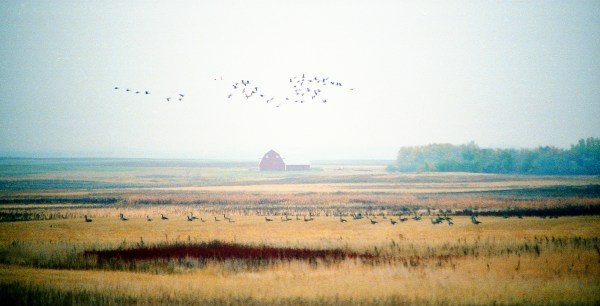
Geese, Red Barn, Foggy Day
Said to be my Mother’s Father

In uniform of WW I American Infantry

I posted this on my blog in 2013:
Here is a nice blog post from the New York Times online that explains why there is no such thing as “Free Market Morality.” :: http://opinionator.blogs.nytimes.com/2013/10/20/questions-for-free-market-moralists/
The point of the blog piece is that there are many circumstances where free markets fail abysmally in creating moral, or even minimally acceptable, outcomes. For example, some people are in possession of lands and properties that were bequeathed to them by their parents and grandparents. The possession of these lands allows them to be rented out for the production of crops or livestock. When there is a shortage of such land, high rents can be charged and a tenant farmer can be in the position of paying almost as much in rent as he/she will receive in value of crops produced.
Is it fair for a person to work for a year and receive next to nothing in return, just because there is very little land available? At the same time, landowners could be making a nice profit on their crops because they don’t have to pay anyone rent. Is the owner a better person because he/she has inherited the land used to make a living?
Here are the questions to ask yourself, if you think “free markets” are truly just
1. Is any exchange between two people in the absence of direct physical compulsion by one party against the other (or the threat thereof) necessarily free?
2. Is any free (not physically compelled) exchange morally permissible?
3. Do people deserve all they are able, and only what they are able, to get through free exchange?
4. Are people under no obligation to do anything they don’t freely want to do or freely commit themselves to doing?
It is clear that some people are born, or are placed into, a position in which they are more advantaged than other people. Such people are morally obligated (in my book) to share some of their advantage with others. Notice that I said SOME of their advantage: a part of one’s advantages are due to circumstances beyond their control– thus a portion of their rewards is fairly meant to be shared with others.
In addition, some people are smarter and/or more talented than others. Such bright people are free to use their abilities to create and to sell their works, but it is not fair for them to cheat or misguide people and gain advantage over them in that way. This applies particularly to charging higher interest rates or making contracts with hidden clauses because you can fool people into doing so. While someone with a brilliant singing voice may fairly claim their rewards, a portion of their payback is related to sharp dealings by clever lawyers. Not all of this is fair, and some should be shared.
Finally, if you perceive a danger and have the opportunity to rescue others or warn them in time, you are morally obligated to take whatever measures you can reasonably perform. However, there is no legal requirement to do this and there are certain legal complications that appear when one tries to save another and fails (despite their best efforts in many cases.)
There are legal fences around a person’s ability to give away one’s work product (and freedoms) to another which prevent a person, despite all exigencies, from giving away what little freedom one has in order to survive. These legal rules can be circumvented in most cases with clever language that, in practice, can reduce a person low in status to near-vassalage to a person or corporation with high status.
For example, non-disclosure agreements (a near-universal piece of contract language for underlings to He who must not be named) [this sentence added today] can abrogate a person’s right of free speech in exchange for employment.
In the extreme case, it is not possible to sign oneself into slavery. This should make it clear that there is a basic principle of fairness, that applies to almost everything. It is also reciprocity. Anything that you don’t want done to yourself, you shouldn’t do to anyone else. And anything that you want done to yourself should also be done to everyone else. (Almost everything.)
Grape Harvester, Front View

Grape Harvesting Under a Full Moon

Here’s a quote from a recent New York Times article online that is worth repeating:
“From a budget perspective, that means ending and reversing the misguided focus on the deficit. It was never wise or necessary to cut the deficit while the economy remained weak. The political imperative to do so, driven by Republicans and clumsily adopted by Democrats, has had devastating results. Over the past three years, the depth and pace of federal spending cuts have reduced growth by about 0.7 percentage point, equivalent to over $300 billion in lost output and roughly 2 million fewer jobs than would otherwise have been the case. That so-called fiscal drag has been the single biggest weight on economic growth.”
In other words, the Republican screaming about deficits and how horrible they are has caused a loss of two million jobs by preventing the passage of stimulus bills like infrastructure spending. What is the most important thing that we need in the USA right now? Jobs. Once again, we see demonstrated the Republican anti-reality focus. They complain about the deficit when the real problem is a lack of jobs.
The deficit is manageable, if the economy grows. Cutting spending to avoid deficit spending right now costs jobs and is a drag on the economy. It is necessary to spend money to live, and in all historical cases, we have been able to “spend our way out of a recession.” The best example is the US economy after WW II. We had a deficit of over 120% of our GDP, and in twenty years, we reduced that to below 50%. The deficit as a percent of GDP continued to drop until 1981, when Ronald Reagan became President; it was well under 40% by then. Under Reagan and the first Bush, debt rose above 60%. under Clinton, the ratio dropped a bit, but under the second Bush it climbed rapidly, ballooning (as of 2009) to over 100%, before dropping again under Obama. These are facts, and we must not let Republican lies get in the way of reasonable living and reasonable responses to economic problems.
The reason our deficit was so high in 1945 was that we had to pay for a war. The reason the deficit is so high now is that we had to pay for the wars in Afghanistan and Iraq (on top of an excessive deficit inherited from Reagan), and the bank bailout (for all of which Bush, and not Obama, is solely responsible.) If we had followed good economic policy after the crash of 2008, our recession would not have been so bad, and economic growth would have rebounded to easily 4% by now. With reasonable economic growth, tax receipts would go up dramatically, and the deficit would rapidly recede. There would be no more talk of the deficit being a ball and chain for future generations by anyone but Rand Paul and a few nuts in Arkansas.
To solve the rest of the country’s problems in one paragraph: we can prevent Medicare from going broke by adopting European medicine (which cuts the bills in half) and encouraging the immigration of young, hardworking Mexicans and South Americans who will pay in to the insurance pool. We can prevent Social Security solvency problems by raising the cap on contributions and making the contributions progressive, like regular income tax; and by encouraging the immigration of young, etc. who will pay in to the Social Security pool. End of economic problems for the foreseeable future.
A Stone Church in Winslow, AZ

This church, made of local sandstone, shines red in the evening light.
At The Beach

This photo was taken on the beach near Venice or San Pedro. Despite the lack of surf, there are two surfers in the water. Houses can be seen further down the beach.
Snowy Road

Abandoned Stone Cabin near Meteor Crater

These ruins from a stone cabin are on the East side of Meteor Crater, near the circumference trail.

