Overlook on a Dirt Road in the Forest

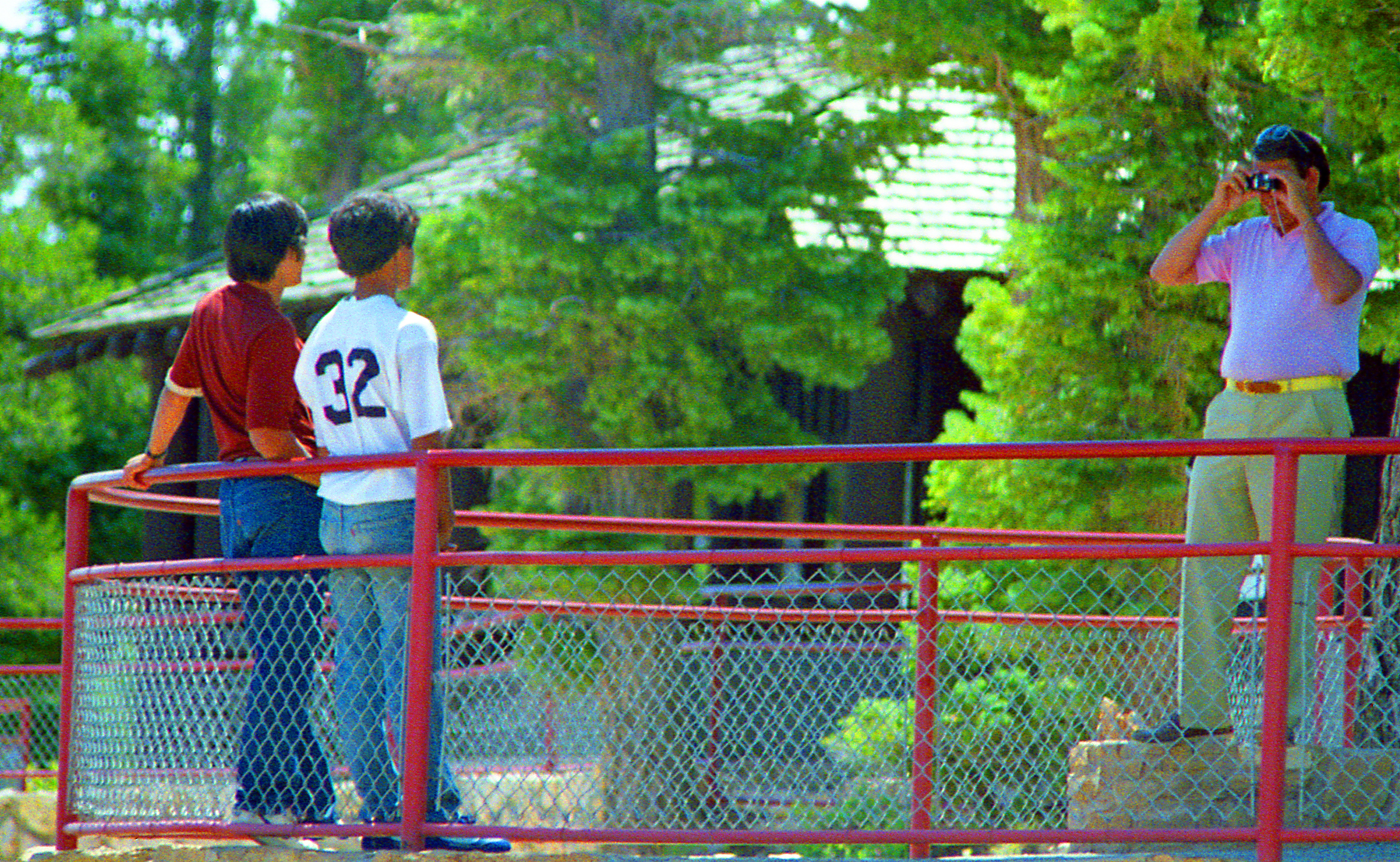
Taking a Snapshot of the Kids at the Zoo
Americans are Big, Fat Bullies
I’m reprinting this comment from an article in the NYT online about the government’s surveillance of the mails, although it is somewhat ungrammatical, because it makes an important point:
We are a nation of bullies. Think about it for a minute. The police are among the worst offenders but everyone is encouraged to bully those who are weaker. By “bullying”, I mean exploitation, humiliation, and just plain taking advantage of people. This comment is written in relation to an article that tells how the government has kept track of people’s mails both with and without official sanction. Specifically, there is a program that collects images of the outside of all mail to and from a given subject under investigation. This commenter feels that there are ways to inspect the content of a piece of mail without opening it.
ESP
CA
“Yes, it is not opening it and reading it. But I can tell you as an engineer doing inspections on aircraft, rocket motors, missiles, ect. There is only half a dozen ways to image what is in side.
But lets go back and ask why are we being terrorized? Because we are a nation of bullies. Not just the government, but corporations too. In the 80’s and 90’s I’ve read many reports of American Arrogance.
And our government, in the invasion of Iraq for weapons of mass distruction.
That generated a lot of hate toads America. The Americans and it allies gave chemical weapons (American plans, allies supplies) given to them year ago. 10 or 15 years before we invaded.
If you don’t think all those actions in the middle east, is not going to get a group of people mad at America. More so because and join a group of terrorist, you fooling yourself.
America, particularity our government is arrogant. That generates terrorism and a need for security, which generates spying on American citizens by our government.”
This comment is misspelled in places, and there are also confusing passages, but the point is clear.
The Republicans (and some Democrats), of course, are among the worst bullies on the North American continent. They favor restrictions on voting rights, they are reluctant to protect poor people against the depredations of the medical care system, they insist that rich people pay less taxes, they block infrastructure repair and improvement projects at a time when increasing such projects would be the best thing for the economy, they are unwilling to let the government borrow money to relieve the sufferings of poor people at a time when they could borrow at a ridiculously low interest rate, etc. etc.
The Republicans (and cowardly Democrats) have exploited, humiliated, and stepped upon those who could not fight back: they are literally bullies.
Pale Sunset
Rain Shower Over Lake

Ebola in New York City
A physician who was in Guinea treating Ebola patients until October 14 reported a fever on Thursday morning and was hospitalized at Bellevue. In the two or three days prior to feeling ill, he was travelling around New York by subway and cab, and even went bowlingccccc . One story said that he “started feeling sluggish” on Tuesday but had no fever until Thursday morning. His fiancee, who lived with him, was placed in quarantine at the same time. A few other close contacts are being monitored, but it is not believed that his subway travels posed any risk. The bowling alley likewise has not been scheduled for cleaning, although it may lose some patrons temporarily.
While the appearance of a fatal infectious disease in New York City might be cause for panic among the uninformed and hysterical, many serious infections have passed through the city without a breakdown in social order: tuberculosis, HIV, influenza (which could easily infect an entire subway car if one passenger started coughing), and typhoid, among others. New Yorkers seem to take this type of risk into consideration without undue concern. Those who are faint of heart tend to avoid New York anyway.
So far, the intensive monitoring and contact tracing that have proceeded after each Ebola patient appears have not yielded any new infections among casual contacts. The two nurses who fell ill after treating the Dallas patient were exposed to large amounts of infectious body fluids and using an inadequate protection protocol that the CDC has since changed. Without additional information, there seems no cause to panic over casual contact with patients who are not yet showing signs of disease.
There is a Vaccine for Ebola Virus
Some ten years ago, a vaccine that produced 100 percent protection against Ebola virus infection in monkeys was produced and patented by the Canadian government. The vaccine was produced by the Canadian Public Health Agency, and between 800 and 1,000 vials were manufactured. It was created by removing a gene from the vesicular stomatitis virus (which infects cattle and rarely, people) and inserting an Ebola surface protein gene. This protein stimulated effective immunity in monkeys. Safety tests of this vaccine have recently begun in humans.
The development of a vaccine may cost only a few million dollars, but bringing a human vaccine to market can cost up to 1.5 billion dollars. Until recently, there was simply no market for this vaccine that could afford to pay for it.
If this vaccine works out as well as expected, it will make it possible to stop Ebola in West Africa.
A vaccine would provide powerful protection to health workers exposed to the virus; so far, more than 400 workers have fallen ill, and 233 have died.
Specialists at Emory University have learned that the virus is present on patient’s skin after symptoms have developed, making contact with sick patients even more dangerous. The virus can survive for several hours on dry surfaces and several days in pools of fluid. It is readily killed with bleach.
Symptoms of Ebola initially match those of flu: headache, fever, aches and pains, prostration. Onset is usually eight to ten days but up to three weeks after exposure. There is some apprehension because not all patients are reported to develop fever, only about 85 percent. Sometimes a rash appears. Then vomiting and diarrhea follow. In about half the cases, after several days of worsening, bleeding begins, in vomitus, urine, or from the eyes and mouth and under the skin. Bleeding (or rather leakage from deep internal vessels) eventually causes collapse of blood pressure and organ failure.
It is currently thought that bats are the natural reservoir for the Ebola virus, and that gorillas and humans are infected by contact with surfaces contaminated by bat droppings. At first, it was thought that gorillas were the source, but with the current outbreak, the first cases came from a village where bat hunting is popular.
Rock, Cloud, and Sky


The Dallas, Texas hospital that treated the first Ebola victim in the United States had a full page apology printed in the major local newspapers on Sunday for its errors in diagnosis, treatment, and infection control. They apologized for failing to diagnose his Ebola on his first visit to the emergency room. They additionally apologized for “mistakes” made in the patient’s treatment. They are also responsible for the infections of two of their nurses during the patient’s stay, due to errors in infection control protocol that were ultimately the responsibility of the Centers for Disease Control.
The Ebola case has been a public relations disaster for the hospital, and there has been reduced patient traffic as well.
The National Institutes of Health has changed its procedures for protective clothing: “It became clear that we needed to modify that protocol where no part of the body is exposed…” sad Dr. Anthony Fauci, clinical director of the NIH’s National Institute of Allergy and Infectious Disease. Full-body suits, hoods, goggles, protective aprons, and rubber boots are used by the Doctors Without Borders teams, with a chlorine spray during de-gowning.
The reason for such intensive protection is that patients are constantly contaminating themselves with vomitus and diarrhea, and close contact is frequently required. In this outfit, a person can work only two hours before succumbing to heat exhaustion. In conditions of heat and stress, mistakes are frequent; workers are assigned to monitor one another for breaches in protocol.
These are the monstrous conditions under which a patient suffers from Ebola, with a fifty-fifty chance of succumbing to the disease.

