The historic increases in productivity, only partially related to automation, has resulted in imposed poverty instead of distributed benefits partially related to automation. Productivity improvements have resulted in the production of a larger quantity and better quality of finished goods with less labor. Instead of distributing productivity improvements by shortening worker’s hours and keeping the same number of workers, owners have kept the hours the same and reduced the number of workers, creating unemployment instead of prosperity, and hijacking the worker’s gains.
The important issue is one of distribution of productivity improvements. If the improvements in productivity were distributed in the form of shorter hours spent producing the same or better product, then the workers would benefit by the time saved. Instead, the employer receives all the benefit when the workers’ hours are kept the same and the number of workers needed to produce the same amount of product is reduced.
The attraction of using each worker to the maximum extent of which they are capable is obvious to the employer. The workers are kept working as much as possible and paid the same, while more product is realized. Otherwise they might start thinking too much during their rest periods. The workers who are dismissed become poorer and resent their former employer but there is nothing they can do (except commit workplace violence, which occasionally happens.) This is inequitable and exploitative.
There are indications that productivity improvements have not been reflected in increased pay or other compensation since 1973.
“The fundamental understanding that ISIS/ISIL is a barbaric enterprise is enough to know, in many ways. I spent nearly a year and a half working in the Middle East. Over that time, I often experienced a level of deceit, cowardice, and illogical thinking from my hosts and their Middle Eastern advisors that was the most baffling thing I’ve ever seen, and which thwarted progress on many fronts. And this was all coming from people whose intentions were often, or at least started out as good. ”
”
My best friend in Lamu, Kenya, a Swahili-speaking Yemeni, once told me that I should be killed because I had inadvertently left a Quran on the floor and that the only reason why he or someone from the local mosque would not do it was that he was trying to protect his best friend. Twisted logic?
”
These are comments from people who have worked in areas that are majority Muslim and Arab. What does this mean for the struggle against the Islamic State?
Driving to Jacksonville: Second Draft
This is a Second draft. Anyone with comments or who has personal knowledge that can contribute to this story, please send your comments here.
Driving to Jacksonville
I was about eight years old in 1962 when my father (Theodore) drove me (Conrad) to Jacksonville, Illinois from Denver, Colorado. We were living in Denver with my sister (Cathy), me, and my mother (Greta) when my father came back from a trip. Unbeknownst to me, my father was dating a woman named Vicki, who would soon become my stepmother (he had met her when they were both taking a course in graduate psychology; she was several years his junior, perhaps 21 years old).
By this time, he had me living with him part of the time at his bachelor apartment with a closed-in porch that I slept in. One day, he threw out some old magazines, Playboys, and left a pile of them on the stoop. I came in, saw the magazines, and sat down to start reading them. He noticed that I was reading them, but he didn’t say anything, just let me keep on reading. I didn’t understand at that time what it was all about, or why there were so many pictures of naked women (with their pubic areas discreetly obscured.)
This was part of my desensitization to pornography and other shocking things. My father didn’t know it at the time, but he was making the pornography uninteresting to me by not reacting to my reading it. Maybe he did realize that not reacting was the best way to deal with it.
Another day, he stacked some milk cartons (at that time, they were made of waxed cardboard), crushing them and putting several crushed cartons inside another one. Then he set them on the sidewalk and lit them. They burned, slowly, for an hour, as the wax melted and contributed to the fire. I was impressed that so much energy could be obtained from old wax milk cartons.
He had an old Nash car, which was on its last legs, but it ran and got us where we wanted to go. Nash automobiles were last produced in 1957; I don’t know what year this car was, but it had to have been at least five years old or more in 1962. Here is a picture of a 1946 Nash four-door sedan from Wikipedia:

The three of us, mother, me, and my sister, were living in the student apartments, a group of three-story dormitory-like buildings of brick with basement common rooms. Our apartment had two bedrooms and my sister and I slept in one, on a bunk bed. My mother slept in the other bedroom.
The kitchen had a window that looked out over the yard between the buildings. During that time, I had many friends among the children who lived there while their parents were studying at the university. We played hide and seek, even at night, and met in the common rooms.
One day I was playing with matches in the window well of a basement common room. There were bushes around the window well so it was hard to see in. I wanted to strike a match and see what it looked like. The ground in the window well was wet and slippery, and I pitched over backwards onto the glass. I hit the glass with the back of my head, broke the glass, and cut myself in the occipital area of my head.
I stumbled out of the window well, ignoring the broken window behind me. My first concern was that my brains would fall out. Crying and screaming, I ran to the nearest first floor apartment and banged on the door. Blood was pouring out of the back of my head onto my shirt. The lady who answered must have been shocked, by her expression, and she helped me to my parents.
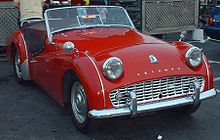
They took me to a hospital, and the doctor put thirteen stitches on the back of my head. My father took me home in his friend’s sports car after that; I think it was a Triumph TR-3. I stayed with my father more at his apartment. Here is a picture of a Triumph TR-3A, the most popular TR-3 model:
Later, we spent the summer in a resort town called Crystal Lake, up in the mountains above Denver. It had a lake that was eight hundred feet deep, with freezing water. I fished there for the first time that I can remember, and caught some little rainbow trout that they made me throw back. I had a little sailboat that I puttered around the marina with. We would go swimming, but that involved a ten- to fifteen-second dip with an immediate bound out of the water, which must have been about forty degrees Fahrenheit.
My father came to visit, driving his friend’s Triumph. I loved riding in that car; you could reach out from the passenger seat and touch the road while the car was in motion. There was a deep tunnel under the dashboard where I put my feet and legs, and I could scrunch down inside there and not be seen from outside with the top up. I didn’t understand that it was his friend’s car, but I enjoyed it anyway.
At first, my mother and I stayed with some well-to-do friends that had a boy my age; he had a tackle box full of pennies that we played with. We had read an advertisement in a comic book that said that pennies dated before 1932 could be worth “as much as $200” so we found all the old pennies and counted up our riches as if each was worth the full $200. We were terribly disappointed when his mother explained to us that “as much as $200” really meant that a rare one or two of those coins might be worth that much, but most were still only worth a penny.
I had some kind of quarrel with the other little boy, I don’t know what it involved. I just remember that he was terribly spoiled and his mother cut the crusts off the bread she served him in his sandwiches. So my mother, my sister, and I moved to a small summer cabin in the town of Crystal Lake. It was primitive, with a real “ice box” and a propane stove and a fireplace. It only had two rooms and an outhouse.
I was confused and upset by my parent’s separation; I didn’t know what was going on, and they didn’t explain it to me. I knew that they had been arguing a lot, but that seemed to have stopped after they were separated.
I began to act out in odd little ways; I would shoplift small items, like a plastic lemon (full of lemon juice, which I liked) and a miniature paper stapler. I tortured the kitten we had, but only in a minor way, by tying it up. I also tortured my sister’s Barbie doll; bondage and discipline were on my twisted little mind.
I tried to set fire to the field behind the house, but I didn’t get anywhere with that; the grass was too green. That fall we drove to Jacksonville.
We had been living in Hawaii; I was four when we moved there, and six when we went back to California. We flew to San Francisco, and my mother, my sister, and I moved in with her mother. I didn’t know where my father was at that time. My mother argued a lot with her mother.
We moved to Davis, where my mother enrolled in the University of California, Davis for graduate school. I learned how to ride a bicycle in Davis, but other than that nothing happened. I still didn’t know where my father was; I only saw him once in a while. One day, I was riding my bicycle when I accidentally steered through a group of older boys playing basketball on an outdoor court. I was paralyzed; I couldn’t stop, slow down, or turn, and I just went right through the group of kids on the basketball court without hitting any of them, although they were angry with me at the time. It was very quiet in Davis. I learned to eat malted milk tablets, which I don’t think are made any more.
We moved to Denver, and that was where I started seeing a lot more of my father. Apparently he had been working and going to school at the University of Denver the entire time. My mother, my sister, and I first lived in a nice brick house which had a basement; at Christmas I got an Erector set.
My mother stitched a large number of stuffed animals while we were living in that house; my sister arranged them all on her bed so that there was just room for her to lie down surrounded by stuffed animals.
One day my father told me that we were going to move to a new place, that it would be good for me. I had already had a number of tests of intelligence and creativity, part of his thesis for his doctorate in psychology. He was studying at the University of Denver to get his PhD in psychology, and his thesis was a research study of gifted children. He told me that because he was getting a doctorate, he would be able to take this really good job in Jacksonville.
It was only when we were in the car, the Nash, that I started asking questions about my sister and my mother. He told me that he and my mother had gotten a divorce, and that Cathy was going with her and I was going with him. I told him I didn’t like the fact that he had gotten a divorce. He said to me, “She was the one who asked for a divorce. It wasn’t my idea.”
I only found out years later that my father had told my mother that he had gone to a judge and had gotten custody of me and left my sister in my mother’s custody. He said the judge had ordered him to pay child support to my mother for my sister. He really wanted to avoid paying child support to my mother for me; that was part of his motivation for taking me with him when he moved to Jacksonville.
The part about going to a judge was all a lie; he had never gone to a judge, but he felt that telling her that would make it easier for her to comply with what he thought was right.
He also felt that my mother wouldn’t raise me right and that I would be intellectually stunted if he left me with her. For example, my mother told me that I didn’t have to memorize the multiplication tables, that I was too smart for that, and I should be studying other things. In fact, I finally did learn to memorize the multiplication tables and it took just a few minutes of study, well worth the time. Now, after memorizing the tables, I was able to do all those things, multiplication and division, in my head.
I also had terrible penmanship, and when I started doing math problems, the numbers would wander all over the page. My father had Vicki work with me to straighten up the numbers into columns so that the mathematics problems would be easier to understand; without the straight columns, it was difficult to do multiplication and division problems on paper (this was before calculators replaced doing these things with a pencil and paper.)
I said I wanted to see my mother and my sister again and my father said that they would come and visit us. I didn’t like it but there was nothing I could do. Later when I was really upset, after we had been in Jacksonville for a few months, I started thinking about how I could get back to Denver. I knew it was eight hundred miles, but I thought, “If I start walking now, maybe someone will pick me up and take me along.” I thought of all the cold and snow on the way, but I was so upset I just wanted to get up and start walking back to Denver.
I got sick and had a fever, and I wanted to see my mother, but she couldn’t come. I felt really small, like a bug on the bedspread, and everything was as big as mountains. I walked and walked along the spread, and I was still in the same place. Then everything reversed and I felt vertiginous as the scale seemed to slide back in place.
On the way to Jacksonville, it was dark as we drove down the highway; there was no moon, and the headlights of passing cars were the only things we could see, white in front of us and red behind us. Not driving, being a passenger, just looking out the side window, I could see nothing in the darkness.
We ran out of gas a mile before reaching a town. The dawn light was already full on us when he came trudging slowly back. After cranking the starter for a while, the engine fired again, and we set off into town to the gas station for a fill. I slept for a while. Then it got cold; my father fiddled with the heater controls but no warm air came through the vents. This was unusual because the Nash was famous for its advanced cabin heating system.
We finally reached Jacksonville after driving straight for eight hundred miles, stopping only for gas. As a faculty member, my father was allotted housing, a first floor apartment in a three story building; the second floor was occupied by a language laboratory, where students listened to taped lessons in their chosen language.
The first thing I noticed when I lay down in bed was that the sounds from the language laboratory could be heard through the ventilator shafts, which were commodious and made of sheet metal. Even at night, it seemed, I could hear people talking in French, Spanish, German, Russian, or unintelligibly in some unknown language.
I wanted to get a cat, but my father said no, you can’t have a cat. I suspected later that he didn’t want me to have a cat because he was afraid it would make me gay. So we went to a farm outside of town and he got me a puppy, a beagle. We tried to keep him in the house, but he couldn’t be paper-trained. Nothing would induce him to poop in the right place.
One day the dog pooped on the floor right in front of the front door. My father came in from class and stepped right into it, almost slipping on it. That was the last of the dog. My father gave the dog to our neighbors across the alley, who kept it tied up in the back yard.
My father got me two hamsters, a boy and a girl, and I played with them a little bit. Sometimes they got out of their cages and I had to go looking for them under the sofa.
Before we drove to Jacksonville, my father began dating a woman that he met in his psychology class (they were both in the graduate psychology program, he already having his master’s degree.) After he got the job in Jacksonville, he proposed marriage to her (although he had already made sure of her by taking her to bed.) She was very taken with him and accepted.
Her most important function, to him, was that she was an expert typist. She had been clocked at over a hundred words a minute on an IBM Selectric. She typed his entire PhD thesis on that IBM Selectric, and she actually wrote most of it as well. I learned to type on that same IBM Selectric, and I soon became a typing whiz. I loved the space age look of the rotating ball that held the letters the Selectric typed. Little did I know that the daisy wheel typing system was faster, simpler, and more reliable; that system caught on a few years later.
During the Christmas vacation, they got married while I stayed with my mother and sister. My mother was crying and I didn’t know what had gone wrong, but much later I realized that she was crying because she still loved him and didn’t want him to get married again. She couldn’t live with him because of the arguments so she had asked for a divorce; but she couldn’t avoid him completely, depending on him for money, for one thing. After the divorce, she only asked for child support for myself and my sister. Even so, it was hard on him.
We drove back to Jacksonville, the three of us, after Christmas. I had met Vicki, my new stepmother, before, and I had thought she was very nice; in fact, I preferred her over the other girl that my father had suggested to me for a new mother. I’m not sure, but I think he was pleased with my choice because he preferred Vicki too.
Many years later, Vicki told me that Ted had laid down some rules for her to follow. She told me that he had said that she should never touch me, not even a hug or a kiss. I was to be kept in the dark as much as possible with regards to her and she was to stay fully dressed whenever she was around me. I never saw that she was particularly good-looking, but some of my friends when I was in junior high school told me that, to them, she looked really beautiful.
Nonetheless, Vicki and I developed a close friendship and we played word games and other little amusements. I don’t remember exactly what we did but it was like playing with codes or something. Vicki served as a substitute for both my mother and my sister, and she managed to fill the job well after some practice.
When we got back to Jacksonville after Vicki and my father had gotten married, we opened the front door to find the rooms completely filled with steam and water all over the floor. The pipes in the bathroom had frozen and burst, and there was a natural ice sculpture in the bathroom with icicles hanging from the ceiling. Apparently the heat had been left off while we were gone and it got so cold that the water in the pipes froze. When it thawed, the pipes that had broken open started spurting water everywhere.
When I went to school, I found that classes had already started, and I was a few days behind. Everyone stared at me. I was not surprised to see a few black faces in the class, although I had never seen a Negro before. My father had told me that there would be black people here and explained that they were exactly the same as everyone else except that their skin color was darker. As a result of his talking to me, I developed a positive attitude towards black people, seeing them as being unfairly beaten down by whites with status.
He told me to treat everyone the same. I didn’t understand at first what he meant, but later I realized that not everyone thinks the same way. I got into trouble one day when I passed a note to Stuart Freiburg that had a naughty word in it, “shit” or something like that. The teacher sent me home with a note and I had to explain to my father.
He said that there are several words that people don’t want to have heard in public, and it was just a social convention. He said that I should not use those words with other people, but when I was grown up, it wouldn’t matter so much.
At first, I thought my father was a fount of wisdom, but after several years I began to question his judgement. The place where he succeeded the most was in making me get good grades. He paid me, for example, ten cents for every “outstanding”; if I got a “satisfactory” I got nothing. If I got a “needs improvement” then I lost ten cents. We got report cards every six weeks and there were some thirty or forty marks on each card. There was a chance I could get as much as three dollars on a single report card.
After he instituted this system, my grades picked up rapidly. Within six months, I was making two dollars or more on every report card.
My best friend when I was in fourth through eighth grade was Lynn Ruby. He was also ostracized by some of the other students. I was teased just for being different, but I stood up for myself and fought back whenever I was attacked. A few times I was ganged up upon by several other kids, but that happened rarely.
Lynn and I did a lot together. One of the last times I visited his house, he had a set of drums that he was playing on and we talked about starting a band. I even wrote a few lyrics, like “She’s as cold as a Frigid-Aire.” Later on, he started a band and played at night, being so tired during the day that he fell asleep in class. He told me later that he had been suspected of using drugs but he was really just tired from late-night jam sessions.
Lynn and I had a nemesis: Stuart Freiburg. He had some strange ideas. One day he chased both of us home from school. I escaped but he caught up with Lynn. Lynn told me that Stuart didn’t want to beat us up, he just wanted to be friends with us. Stuart was very confused. His father was a member of the college faculty, a physics professor. My father and his father didn’t get along, and would have arguments in faculty meetings. My father offered me money to punch Stuart in the face. Every time Stuart started fighting with me, I would try to punch him in the face. I broke his glasses, and my father gave me a dollar. He said he would give me five dollars if I broke his nose. That was a fortune for me at the time, but I couldn’t bring myself to hit him that hard.
Later on, Stuart did become involved with “drugs”– he used LSD a number of times and was hospitalized for two weeks because of it. He became a shoplifter and did a number of other things; I can imagine what he might have done but didn’t have any contact with him after I graduated from high school.
This is a Second draft. Anyone with comments or who has personal knowledge that can contribute to this story, please send your comments here.
Researchers caught a rooster doing a hen’s job: passing on mitochondrial DNA to his chicks. Mitochondria, the energy-generating organelles inside cells, carry a circular chromosome containing genes needed to make the mitochondria and keep them running. The long-held rule was that these powerhouses of the cell are inherited only from the mother. But some birds in a 50-generation family of White Plymouth Rock chickens at Virginia Tech broke that rule.
via Roosters run afoul of genetic rules | Science News.
The extent to which male animals pass on mitochondrial DNA to their offspring is not completely known, but if it is a major transfer, then all bets on mitochondrial inheritance are off. My guess is that this is a minor pathway for inheritance but that it will require a complete rethinking of the mechanisms of mitochondrial inheritance.
Expect a major reshuffling of the accepted rules for mitochondrial DNA; this will take time but will completely change the inheritance patterns that we expect and change the conclusions drawn from the previous assumption of female-only mitochondrial inheritance.
Aware that irja is its theological antidote, the Islamic State presents it as a lack of religious piety. It is, however, true piety combined with humility — the humility that comes from honoring God as the only judge of men. On the other hand, the Islamic State’s zeal to dictate, which it presents as piety, seems to be driven by arrogance — the arrogance of judging all other men, and claiming power over them, in the name of God.
via A Medieval Antidote to ISIS – The New York Times.
If there is a moderate form of Islam, this is it. I recommend this article to all open-minded people who know that there are almost as many Muslims as Christians in the world and know that we all have to live together, or we will all die together.
Driving to Jacksonville
This is a first draft. Anyone with comments or who has personal knowledge that can contribute to this story, please send your comments here.
Driving to Jacksonville
I was about eight years old in 1962 when my father (Theodore) drove me (Conrad) to Jacksonville, Illinois from Denver, Colorado. We were living in Denver with my sister (Cathy), me, and my mother (Greta) when my father came back from a trip. Unbeknownst to me, my father was dating a woman named Vicki, who would soon become my stepmother.
By this time, he had me living with him part of the time at his bachelor apartment with a closed-in porch that I slept in. One day, he threw out some old magazines, Playboys, and left a pile of them on the stoop. I came in, saw the magazines, and sat down to start reading them. He noticed that I was reading them, but he didn’t say anything, just let me keep on reading. I didn’t understand at that time what it was all about, or why there were so many pictures of naked women (with their pubic areas discreetly obscured.)
This was part of my desensitization to pornography and other shocking things. My father didn’t know it at the time, but he was making the pornography uninteresting to me by not reacting to my reading it. Maybe he did realize that not reacting was the best way to deal with it.
Another day, he stacked some milk cartons (at that time, they were made of waxed cardboard), crushing them and putting several crushed cartons inside another one. Then he set them on the sidewalk and lit them. They burned, slowly, for an hour, as the wax melted and contributed to the fire. I was impressed that so much energy could be obtained from old wax milk cartons.
He had an old Nash car, which was on its last legs, but it ran and got us where we wanted to go. Nash automobiles were last produced in 1957; I don’t know what year this car was, but it had to have been at least five years old or more in 1962. Here is a picture of a 1946 Nash four-door sedan from Wikipedia:
The three of us, mother, me, and my sister, were living in the student apartments, a group of three-story dormitory-like buildings of brick with basement common rooms. Our apartment had two bedrooms and my sister and I slept in one, on a bunk bed. My mother slept in the other bedroom.
The kitchen had a window that looked out over the yard between the buildings. During that time, I had many friends among the children who lived there while their parents were studying at the university. We played hide and seek, even at night, and met in the common rooms.
One day I was playing with matches in the window well of a basement common room. There were bushes around the window well so it was hard to see in. I wanted to strike a match and see what it looked like. The ground in the window well was wet and slippery, and I pitched over backwards onto the glass. I hit the glass with the back of my head, broke the glass, and cut myself in the occipital area of my head.
I stumbled out of the window well, ignoring the broken window behind me. My first concern was that my brains would fall out. Crying and screaming, I ran to the nearest first floor apartment and banged on the door. Blood was pouring out of the back of my head onto my shirt. The lady who answered must have been shocked, by her expression, and she helped me to my parents.
They took me to a hospital, and the doctor put thirteen stitches on the back of my head. My father took me home in his friend’s sports car after that; I think it was a Triumph TR-3. I stayed with my father more at his apartment. Here is a picture of a Triumph TR-3A, the most popular TR-3 model:
I was confused and upset by my parent’s separation; I didn’t know what was going on, and they didn’t explain it to me. I knew that they had been arguing a lot, but that seemed to have stopped after they were separated.
We had been living in Hawaii; I was four when we moved there, and six when we went back to California. We flew to San Francisco, and my mother, my sister, and I moved in with her mother. I don’t know where my father was at that time. My mother argued a lot with her mother.
We moved to Davis, where my mother enrolled in the University of California, Davis for graduate school. I learned how to ride a bicycle in Davis, but other than that nothing happened. I still didn’t know where my father was; I only saw him once in a while.
We moved to Denver, and that was where I started seeing a lot more of my father. Apparently he had been working and going to school at the University of Denver the entire time. My mother, my sister, and I first lived in a nice brick house which had a basement; at Christmas I got an Erector set.
My mother stitched a large number of stuffed animals while we were living in that house; my sister arranged them all on her bed so that there was just room for her to lie down surrounded by stuffed animals.
One day my father told me that we were going to move to a new place, that it would be good for me. I had already had a number of tests of intelligence and creativity, part of his thesis for his doctorate in psychology. He was studying at the University of Denver to get his PhD in psychology. He said that because he was getting a doctorate, he would be able to take this really good job in Jacksonville.
It was only when we were in the car, the Nash, that I started asking questions about my sister and my mother. He told me that he and my mother had gotten a divorce, and that Cathy was going with her and I was going with him. I told him I didn’t like the fact that he had gotten a divorce. He said to me, “She was the one who asked for a divorce. It wasn’t my idea.”
I only found out years later that my father had told my mother that he had gone to a judge and had gotten custody of me and left my sister in my mother’s custody. He said the judge had ordered him to pay child support to my mother for my sister. He really wanted to avoid paying child support to my mother for me; that was part of his motivation for taking me with him when he moved to Jacksonville.
The part about going to a judge was all a lie; he had never gone to a judge, but he felt that telling her that would make it easier for her to comply with what he thought was right.
He also felt that my mother wouldn’t raise me right and that I would be intellectually stunted if he left me with her. For example, my mother told me that I didn’t have to memorize the multiplication tables, that I was too smart for that, and I should be studying other things. In fact, I finally did learn to memorize the multiplication tables and it took just a few minutes of study, well worth the time. Now, after memorizing the tables, I was able to do all those things, multiplication and division, in my head, and that made shopping, for example, a lot easier.
I also had terrible penmanship, and when I started doing math problems, the numbers would wander all over the page. My father had Vicki work with me to straighten up the numbers into columns so that the mathematics problems would be easier to understand; without the straight columns, it was difficult to do multiplication and division problems on paper (this was before calculators replaced doing these things with a pencil and paper.)
I said I wanted to see my mother and my sister again and my father said that they would come and visit us. I didn’t like it but there was nothing I could do. Later when I was really upset, after we had been in Jacksonville for a few months, I started thinking about how I could get back to Denver. I knew it was eight hundred miles, but I thought, “If I start walking now, maybe someone will pick me up and take me along.” I thought of all the cold and snow on the way, but I was so upset I just wanted to get up and start walking back to Denver.
I got sick and had a fever, and I wanted to see my mother, but she couldn’t come. I felt really small, like a bug on the bedspread, and everything was as big as mountains. I walked and walked along the spread, and I was still in the same place. Then everything reversed and I felt vertiginous as the scale seemed to slide back in place.
It was dark as we drove down the highway, there was no moon, and the headlights of passing cars were the only things we could see, white in front of us and red behind us. Not driving, being a passenger, just looking out the side window, I could see nothing in the darkness.
We ran out of gas a mile before reaching a town, and the dawn light was already full on us when he came trudging slowly back. After cranking the starter for a while, the engine fired again, and we set off into town to the gas station for a fill. I slept for a while. Then it got cold; my father fiddled with the heater controls but no warm air came through the vents.
We finally reached Jacksonville after driving straight for eight hundred miles, stopping only for gas. As a faculty member, my father was allotted housing, a first floor apartment; the second floor was occupied by a language laboratory, where students listened to taped lessons in their chosen language.
The first thing I noticed when I lay down in bed was that the sounds from the language laboratory could be heard through the ventilator shafts, which were commodious and made of sheet metal. Even at night, it seemed, I could hear people talking in French, Spanish, German, Russian, or unintelligibly in some unknown language.
I wanted to get a cat, but my father said no, you can’t have a cat. I suspected later that he didn’t want me to have a cat because he was afraid it would make me gay. So we went to a farm outside of town and he got me a puppy, a beagle. We tried to keep him in the house, but he couldn’t be paper-trained. Nothing would induce him to poop in the right place.
One day the dog pooped on the floor right in front of the front door. My father came in from class and stepped right into it, almost slipping on it. That was the last of the dog. My father gave the dog to our neighbors across the alley, who kept the dog tied up in the back yard.
My father got me two hamsters, a boy and a girl, and I played with them a little bit. Sometimes they got out of their cages and I had to go looking for them under the sofa.
Before we drove to Jacksonville, my father began dating a woman that he met in his psychology class (he was a student instructor, already having his master’s degree.) After he got the job in Jacksonville, he proposed marriage to her (although he had already made sure of her by taking her to bed.) She was very taken with him and accepted.
During the Christmas vacation, they got married while I stayed with my mother and sister. My mother was crying and I didn’t know what had gone wrong, but much later I realized that she was crying because she still loved him and didn’t want him to get married again. She couldn’t live with him because of the arguments so she had asked for a divorce; but she couldn’t avoid him completely, depending on him for money, for one thing. After the divorce, she only asked for child support for myself and my sister. Even so, it was hard on him.
We drove back to Jacksonville, the three of us, after Christmas. I had met Vicki, my new stepmother, before, and I had thought she was very nice; in fact, I preferred her over the other girl that my father had suggested to me for a new mother. I’m not sure, but I think he was pleased with my choice because he preferred Vicki too.
Many years later, Vicki told me that Ted had laid down some rules for her to follow. She told me that he had said that she should never touch me, not even a hug or a kiss. I was to be kept in the dark as much as possible with regards to her and she was to stay fully dressed whenever she was around me.
Nonetheless, Vicki and I developed a close friendship and we played word games and other little amusements. I don’t remember exactly what we did but it was like playing with codes or something.
When we got back to Jacksonville after Vicki and my father had gotten married, we opened the front door to find the rooms completely filled with steam and water all over the floor. The pipes in the bathroom had frozen and burst, and there was a natural ice sculpture in the bathroom with icicles hanging from the ceiling. Apparently the heat had been left off while we were gone and it got so cold that the water in the pipes froze. When it thawed, the pipes that had broken open started spurting water everywhere.
When I went to school, I found that classes had already started, and I was a few days behind. Everyone stared at me. I was not surprised to see a few black faces in the class, although I had never seen a Negro before. My father had told me that there would be black people here and explained that they were exactly the same as everyone else except that their skin color was darker.
He told me to treat everyone the same. I didn’t understand at first what he meant, but later I realized that not everyone thinks the same way. I got into trouble one day when I passed a note to Stuart Freiburg that had a naughty word in it, “shit” or something like that. The teacher sent me home with a note and I had to explain to my father.
He said that there are several words that people don’t want to have heard in public, and it was just a social convention. He said that I should not use those words with other people, but when I was grown up, it wouldn’t matter so much.
At first, I thought my father was a fount of wisdom, but after several years I began to question his judgement. The place where he succeeded the most was in making me get good grades. He paid me, for example, ten cents for every “outstanding”; if I got a “satisfactory” I got nothing. If I got a “needs improvement” then I lost ten cents. We got report cards every six weeks and there were some thirty or forty marks on each card. There was a chance I could get as much as three dollars on a single report card.
After he instituted this system, my grades picked up rapidly. Within six months, I was making two dollars or more on every report card.
This is a first draft. Anyone with comments or who has personal knowledge that can contribute to this story, please send your comments here.
Cuban Doctors Come to US
via U.S. and Cuba at Odds Over Exodus of the Island’s Doctors – The New York Times.
Since 2006, the US has had a program under which Cuban medical doctors are offered permanent residency in the US– no strings attached. Once they are here, however, they face many obstacles to gaining the right to practice medicine in an American state.
This program, whatever its intentions, has resulted in a loss of medical professionals to the Cuban public, which needs medical care more acutely because of its poverty and the prevalence of certain chronic infectious diseases endemic to the area.
For many years, Cuba has offered temporary medical doctors to other impoverished countries, especially in South America. This has greatly improved the health care in these countries and provided the doctors with valuable experience in the field.
The new US program is called the Cuban Medical Professional Parole Program and is administered by the Department of Homeland Security. The program normally takes six weeks from application to departure, but because of a dramatic increase in applicants, it has stretched out to almost six months.
Many doctors have suddenly decided to apply for the program because thawing relations between the US and Cuba are likely to close down this “loophole.” Some of these doctors are already posted in foreign countries and are stuck there waiting for their visas.
The Cuban health system is one of the best in the Southern tier of countries of both North and South America. Training is free, and all residents of Cuba are guaranteed free medical care– although it is not as well-developed as in the US, it is free and comprehensive.
Even the Obama administration lauded the Cuban medical relief system, which sends medical teams to other countries, particularly during natural disasters.
Cuba benefits financially from this medical aid system because the countries that need aid often are willing to provide commodities that Cuba needs and are in surplus elsewhere– particularly oil.
The doctors receive inadequate salaries and work under desperate conditions at times. They feel that they are being exploited, and this is one more reason to defect.
One doctor described the medical aid system as “modern-day slavery.”
The program of expediting doctor defections was described as “an exploding cigar left over by the Bush administration” (that’s the second Bush) by Robert Muse, a Washington lawyer who specializes in the laws of the two countries.
More than seven thousand medical professionals have come in through the program since it began in 2006. In the fiscal year of 2015, 1663 people came in. This was a 32 percent increase, and represents a tripling of admittances since 2011.
The US program is apparently so popular that some applicants have presented fraudulent credentials to get in. The Cuban government has restricted specialists from travelling abroad without permission, starting December 7.
The US program to bring doctors in is in parallel with US laws that make it possible for almost any Cuban who reaches American soil to be granted asylum and permanent residency.
One surgeon in Havana said that the only doctors who haven’t left are only here because they can’t afford the price of a plane ticket, given the low salaries they are paid by the Cuban government.
Doctors who come to the US frequently find that their credentials are inadequate and that it is extremely difficult to pass the examinations required to obtain a license. The examination for foreign doctors covers the entire medical curriculum at once, while the exam for native doctors only covers the latter, clinical part of their training.
Some foreign doctors, daunted by the examination, have instead become physician assistants or nurses. Their talents are underused in these positions, and they are not paid nearly as much. Nonetheless, they are happy to be here and enjoy their new jobs. I have personally communicated with several doctors from South America who have become physician assistants and have done well, with accommodating doctors as their supervisors.
Some doctors miss their country of origin and feel homesick, but they appreciate the freedom and opportunities they have in the US.
Most of the above is sourced from the NYT article noted at the head of this post.
A book, a woman, and a flask of wine:
The three make heaven for me;
via Inspirational Omar Khayyam Quotes – Daily Inspiration.
This is one of Omar’s most well-known quotations, but it is only a small part of a very long poem, which is in full on this webpage. It is a beautiful poem, with or without that line, and I recommend it for peace of mind and inspiration.
There is much more than just this poem on this webpage, but I will leave it to you to explore. Enjoy!
There is no Calligraphy but Calligraphy
A Virginia school district closed its schools on Friday amid an angry backlash, including a possible “risk of harm to school officials,” over an assignment that asked high school students to copy a Muslim creed in Arabic calligraphy.
Students in a world geography class at Riverheads High School in Staunton, Va., had been asked to try their hands at copying a passage known as the Shahada, or declaration of faith in Islam. The work sheet distributed to students on Dec. 11 said: “This should give you an idea of the artistic complexity of calligraphy.”
But some parents accused the teacher of trying to convert their children to Islam, inciting an angry outcry in the largely rural district nestled in the Shenandoah Valley. The Shahada is recited as part of daily prayer, and translates to, “There is no God but God, and Muhammad is the messenger of God.” Speaking the Shahada before witnesses is an important step in converting to Islam.
The complaints were further fueled by the teacher inviting female students to wear a head scarf, as many Muslim women do. The number of angry calls and emails to the district increased sharply as this week wore on, fueled by growing media coverage of the controversy.
via Lesson on Islam Shuts Down Virginia School District – The New York Times.
This is another example of how the best-laid and most-sincere plans can go awry. There’s nothing wrong with practicing calligraphy– even in Arabic. But to ask students to write, “There is no Allah but Allah, and Muhammad is the messenger of Allah” even if they don’t know what it means, is state-sanctioning of religion, in this case, the Islamic religion.
Get a clue, folks. Try practicing, “See Spot Run” in Arabic calligraphy. That way, you will exercise their devilish little minds without forcing them to recite the central creed of Islam, not even knowing what they’re writing.
Epicurus in so many Words
The politics of writing blog has a good post today, which I recommend. It gives the birth date of Epicurus as 341 BCE, in Samos, an island off the coast of Greece. Epicurus’ most famous saying, I believe, is a four-parter: “Don’t fear G-d, don’t worry about death, what is good is easy to get, and what is terrible is easy to endure.” Epicurus is known as the father of the Epicurean philosophy, which has received a lot of bad press, but which, along with atomism, is one of classical Greece’s most lasting contributions to the happiness (or unhappiness) of mankind. Did I mention democracy?

