Another Hilarious Cartoon About Science
[Sad little siblings being belted in, unhappy about having to go home…]
Follow this link to an hilarious cartoon about how Gavin Smythe (and so many other commenters on so many sites) broke science with a simple five-second thought exercise. I saw this link in a comment to a Science News article about LIGO– responding to one of those commenters who thinks he knows better than Einstein and all those other frauds…
An item about the Miss Universe pageant in Moscow caught my eye– it was from the Washington Post, one of the media outlets that Donald has banned from his press box– and the Post laid bare Donald’s cozy relationship with Russia’s strong man. It’s no wonder Donald doesn’t like the Post.
Here’s an excerpt from the piece that explains why Donald loves Putin so much:
The dynamic illustrates the extent to which Trump’s worldview has been formed through the lens of commerce rather than the think tanks, government deliberations and international diplomatic conferences that typically shape the foreign policy positions of presidential candidates.
It also reflects Trump’s willingness to see other world leaders through his own personal connections. In a Republican Party in which an ability to stand up to Putin has been seen as a test of toughness, Trump’s relationship with the Russian leader is instead one of mutual flattery. Putin said in December that Trump was a “colorful and talented” person, a compliment that Trump said at the time was an “honor.”
The back-and-forth has continued. In a rally Thursday night, Trump cited those comments as the reason he will not reject the Russian leader. “A guy calls me a genius and I’m going to renounce?” Trump said. “I’m not going to renounce him.” On Friday in St. Petersburg, Putin again called Trump a “colorful person” and said he welcomed Trump’s proposal for a “full-scale resumption” of U.S.-Russian ties.
On the campaign trail, Trump has called for a new partnership with Moscow. He has called for overhauling NATO, the allied military force seen as the chief protector of pro-Western nations near Russia. And Trump has surrounded himself with a team of advisers who have had financial ties to Russia.
It’s simple: Donald loves Putin because Putin gave him money and flattered him. What could be simpler? A financial tie, a bribe if you will. The only reason the Supreme Court believes that judges should recuse themselves from court cases: because they have money to gain or lose from the relationship.
There’s nothing complicated about Donald. He loves money, almost as much as he loves beautiful women, maybe even more.
Would you want someone so easily swayed by flattery and cash advances to be your president? No, I didn’t think so. In fact, there’s something slimy about the whole business. There’s something slimy about an electoral process that costs six billion dollars (the estimated total expenditure, by both sides, in the 2016 elections.) How could anyone believe in the moral probity, the courage, or the selflessness of a candidate who paid his way into office?
Fortunately for the free world, Donald doesn’t have enough money to buy his way into the presidency. In fact, he doesn’t have enough money to be anything more than mayor of New York, and I don’t think even if he saturated the City with ads and canvassers, that he would have a chance. New Yorkers know him too well.
I’m not a New Yorker (I was born in San Francisco) but I admire the courage of anyone who could live in the Big Apple. That’s why I read the New York Times, which Donald hasn’t yet banned from his press entourage (although it is close, as Donald personally told a NYT reporter.) The fact that Donald lives there is just one of the risks that you have to take if you want to live in one of the two or three biggest cities in the world.
Something Very Funny From PopeHat
Go to this address for a very funny parody of a Parma Police Department press release.
Man Falls Onto Subway Tracks, Is Rescued
I’ve reposted stories about falling onto the subway tracks before, so this item stood out for me: a man fell onto the subway tracks on June 10 and was immediately rescued by three men who jumped down and lifted him up. These men were in turn helped up onto the platform by others. There was a bystander with a cellphone who recorded video of the entire incident so it is easy to see exactly what happened.
These stories are charming, heroic, heartwarming and romantic, part of a world unique to the underground trains of big cities like New York.
The story was originally reported in Gothamist, a blog obviously for issues related to the city of “Gotham” (Batman’s pseudonymous home). The New York Times copied the report.
The above is a picture from the video taken by the bystander, Sumeja Tulic, who was also interviewed by the NYT.
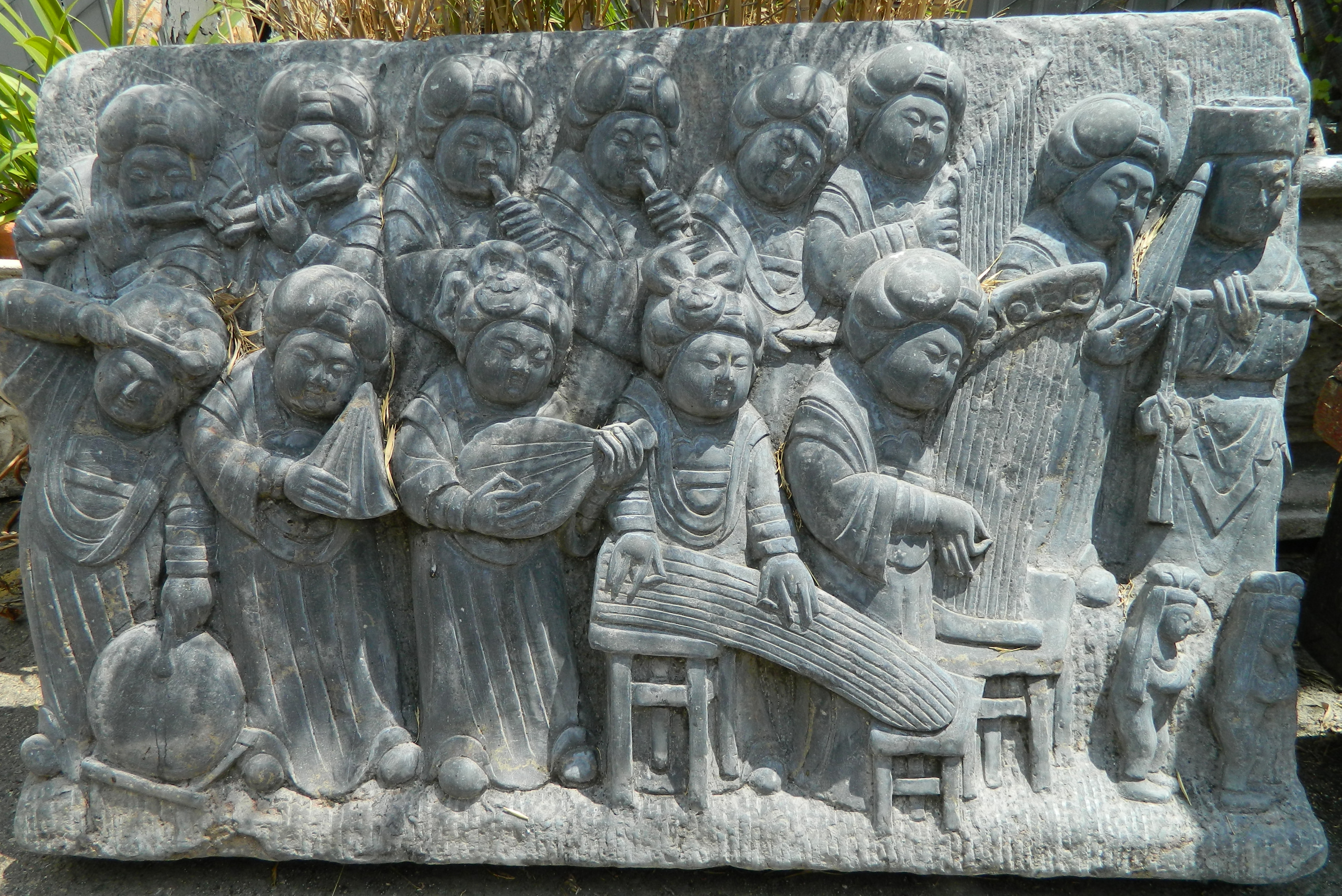
A Stele in an Antique Shop
Violet Flowers on a Tree
Here he is again: the businessman who was the “best”, ripping off casinos and regulatory agencies to bankrupt casinos. The story, in the New York Times and elsewhere, is an old and sordid one, and Donald made big money by cheating everyone who trusted him. Three casinos were in Atlantic City: the Trump Marina Hotel Casino (now the Golden Nugget), the Trump Taj Mahal (now under new ownership), and the Trump Plaza Casino and Hotel (now closed.) The Trump Marina was sold at a heavy loss five years ago; the Trump Plaza was closed; and the Trump Taj Mahal is still operating, under new managers.
Donald started with the Trump Plaza, a casino financed by Harrah’s on Trump property, in 1984. The next year, Trump opened another casino, based on a Hilton project and financed with $352 million in bonds; this one he called Trump Castle. The second casino was in direct competition with the first. In 1986, Harrah’s sold its stake in Trump Plaza to Donald for $220 million. The third and biggest casino, the Taj Mahal, was based on a Resorts International property; even before it opened, in 1988, the New Jersey Casino Control Commission expressed concern over the “rapidly escalating” costs of building.
Donald told the Commission that he abhorred junk bonds, then went out and financed final construction with just such bonds. He issued $675 million in bonds at 14% interest, and total debt on the Taj Mahal exceeded $820 million. Donald has admitted that with each financing, he extracted money to invest in Manhattan real estate. As a result, a casino analyst at a famous investment firm predicted that the Taj would have to take in $1.3 million a day (an unheard of sum) to keep up the interest payments. Donald had the analyst fired, but that same analyst sued and won large settlements from both Donald and the investment firm.
In August 1990, with another recession pinching gambling revenue and real estate values, Donald owed some $3.4 billion on his real estate holdings, including $1.3 billion on the casinos and over $800 million he had personally guaranteed. Donald failed to make debt payments in November, and in December Donald’s father made him a quietly illegal loan of $3.3 million in cash (for which the father was fined $65,000 by the Casino Control Commission.) In 1991 the casinos went into bankruptcy court and Donald was forced to sell his airline, his yacht, and his stake in the New York City Plaza Hotel (among other items). Most humiliating of all, Donald was placed on a $450,000 a month personal budget.
A number of small businesses that contracted to build parts of these casinos didn’t get paid for their work, or were forced to accept as little as 30 cents on the dollar. As a result, some were forced into bankruptcy themselves. Donald didn’t suffer. In 1993 and 1995, he sold more junk bonds, and in 1995 turned the Plaza into a publicly traded company by selling 10 million shares at $14 each. Since he was the largest shareholder, he was able to use most of the money raised to eliminate some of his personally-guaranteed debt.
In 1996, Donald’s public company sold $1.1 billion more in junk bonds. His company (based on the Plaza) bought out the Taj Mahal and the Castle (renamed the Marina.) His shareholders sued after Donald used much of the money to pay off his personal loans. The lawsuits were settled after Donald paid back some of the money. In any case, he received a salary from his company as well as bonuses. This pattern continued for years, with Donald repeatedly talking the company’s board into giving him control of assets or cash which he then used to pay off his personally-guaranteed debts.
The company went into bankruptcy four times under Donald’s control; in 2009, he walked away from it after the board refused to allow him to buy it back. In 2014, the company went into bankruptcy a fifth time.
A small investor summed up the performance of Donald’s management over the years:
“People underestimated Donald Trump’s ability to pillage the company,” said Sebastian Pignatello, a private investor who at one time held stock in the Trump casinos worth more than $500,000. “He drove these companies into bankruptcy by his mismanagement, the debt and his pillaging.”
[Judge Gonzalo Curiel, second from right–(with thanks to New York Times)]
I just can’t resist putting down Donald J. Drumpf (Trump). He’s such a fat target, it is so easy, it is just impossible to resist. Now he’s insulting the judge who is presiding over the class action case against his “Trump University”– a fraudulent “educational institution” which charged enormous fees for pep talks. These talks were advertised to feature his personal explanation of his signature “deal-making skills”, but in reality featured at best a life-sized cardboard cut-out representing the “guru of real estate.” Over 5,000 people paid as much as $35,000 or more for lectures on “the art of the deal.”
I would like to point out again that Mr. Drumpf is not, as he claims, a financial or deal-making wizard. As a commenter explained earlier, if he had just invested his money (his inheritance from his father) in an index fund, he would be worth something like twenty billion dollars now instead of considerably less than his claimed ten billion. In fact, there are dark rumors floating about that claim that his fortune is well south of a billion dollars. Even if he had everything he claims to have, he would not be able to self-fund his campaign for president– estimates of the total cost of this year’s election are well over six billion dollars.
This explains why he has enlisted the reactionary Zionist casino magnate Sheldon Adelson (and many others who prefer to remain anonymous) to help fund his campaign. The Koch brothers have decided, wisely, to concentrate their funding efforts on Congressional elections– where their money is more likely to pay for successful candidates whom they can then control, to the benefit of their coal and oil businesses.
To continue with my main put-down of Donald: There was, for a time (2004-10), an entity known as “Trump University” (also named “Trump Wealth Institute” and “Trump Entrepeneur Initiative.”) This entity changed its name because, in New York State, the use of the term “university” is limited to accredited institutions. The charges for attending this non-accredited and non-credit conferring institution generally ranged from $1,500 to $35,000, although one individual was said to have spent $80,000. In 2013, the New York Attorney General filed a lawsuit against Drumpf (Trump) for “illegal business practices.” “In October 2014, a New York judge found Trump [Drumpf] personally liable for operating the company without the required business license.” (Wikipedia.) (For a more complete picture of these lawsuits, check Wikipedia’s entry for “Trump University.”)
Two federal class action lawsuits are also pending. The judge presiding over these cases, Alonzo Curiel of the Circuit Court for Southern California, has set a hearing for July 22, 2016. Donald filed a defamation suit against the lead plaintiff, which has been dismissed, in part because “Trump University is a limited-purpose public figure” and his lawyers could not show “actual malice.” Donald has also repeatedly accused the judge in public speeches of being “a hater” and biased against him because he (the judge) is “Spanish” or “Mexican.” He has said that the judge should recuse himself, although his lawyers have not formally asked for a recusal. (Wikipedia.)
For some unknown reason, Donald Drumpf thinks that the judge’s Mexican parents (the judge himself is a natural-born American) disqualify him from making judgments about Drumpf’s fraudulent behavior. It is true that Drumpf has repeatedly insulted Mexicans by claiming that he would build a wall at the border between Mexico and the US when he is elected president. Apparently he (Drumpf) thinks that because of this insult (and many other, worse insults and animadversions), anyone with Mexican parents (even if the parents are legal immigrants) is unqualified to judge whether Drumpf’s obviously fraudulent “university” is breaking any laws or liable for civil damages.
From the context of Donald’s speeches, it appears that he just looked at the judge’s name and simply jumped to the conclusion that he could accuse him of bias because he was “Spanish” (untrue) or “Mexican” (also technically untrue: in fact, he is at most Mexican-American.) This appears to be Donald’s standard operating procedure: he has repeatedly re-Tweeted statements that are inflammatory and untrue, without checking on their accuracy, simply because they looked good to him. What is worse, Donald has stuck to his guns even when the falsity of the statements have been pointed out to him.
Judges have universally refused to recuse themselves because of ethnic or racial potential biases. Their reasoning has been that, once you recuse yourself for one case, there is no end to recusals. If you allowed recusals on this basis, you would have to allow a recusal on virtually any basis. You could argue that a judge was biased against you because he looked at you funny.
This is not to say that judges are not biased against defendants for racial or religious reasons. This bias certainly exists, and operates on a daily basis. However, to acknowledge such a potential basis in any case would lead to allowing it in every case, making it impossible to find a suitable judge for any defendant. One would have to select a judge who was the same age, sex, race/ethnicity, religion, and had the same political leanings as the defendant (among many other potential sources of bias.)
There are other, more essential reasons for a judge to recuse himself, most importantly, when the judge has a personal interest in the case. For example, a judge who was elected to his post (in a state that held judicial elections) with the help of an enormous contribution to his election campaign by a coal company failed to recuse himself from a case in which the coal company was a defendant (making the campaign contribution a highly profitable one for the coal company.) The Federal Supreme Court decided that this failure to recuse for conflict of interest made the judgement for the coal company invalid.
Thus, a monetary conflict of interest is a cause for recusal according to the Supreme Court. A “conflict of interest” due to insults delivered by the defendant is not, no matter what Donald says. If it was, all the defendant would have to do to get a recusal would be to observe the judge’s ethnicity and make insults about it. Donald Drumpf is the most narcissistic, thin-skinned candidate for president since Andrew Jackson. You’ll recall that Mr. Jackson reacted negatively to aspersions on his wife’s character; he won election anyway, and is now memorialized with his face on our currency. Just think: someday Donald Drumpf could have his picture on our paper money.
Neo-fascism
From yesterday:
The results of this travesty of democracy have been a complete loss of confidence for the American people in the political system. Lacking confidence that the system will support them, they vote for the candidates who promise to “Make America Great Again.” They don’t care about democracy and the protection of human rights as much as they care about government that works.
To continue:
What part of government does the destabilized American still trust? Social Security and Medicare. The average American in his or her sixties takes Social Security as an earned right, not a favor; a part of one’s life savings built up over years of working and paying taxes.
A new factor brought into the analysis: a long post in VOX [a political website? orientation uncertain]
Feldman developed what has since become widely accepted as the definitive measurement of authoritarianism: four simple questions that appear to ask about parenting but are in fact designed to reveal how highly the respondent values hierarchy, order, and conformity over other values.
- Please tell me which one you think is more important for a child to have: independence or respect for elders?
- Please tell me which one you think is more important for a child to have: obedience or self-reliance?
- Please tell me which one you think is more important for a child to have: to be considerate or to be well-behaved?
- Please tell me which one you think is more important for a child to have: curiosity or good manners?
Feldman’s test proved to be very reliable. There was now a way to identify people who fit the authoritarian profile, by prizing order and conformity, for example, and desiring the imposition of those values.
The first was Hetherington and Weiler’s insight into partisan polarization. In the 1960s, the Republican Party had reinvented itself as the party of law, order, and traditional values…
The second [insight] was Stenner’s theory of “activation.” In an influential 2005 book called The Authoritarian Dynamic, Stenner argued that many authoritarians might be latent — that they might not necessarily support authoritarian leaders or policies until their authoritarianism had been “activated.”…
The third insight came from Hetherington and American University professor Elizabeth Suhay, who found that when non-authoritarians feel sufficiently scared, they also start to behave, politically, like authoritarians.
The VOX article points out that, with the survey questions quoted, it is possible to reliably measure the number of people with “authoritarian” attitudes without having the measurement contaminated by political issues because the questions are frankly nonpolitical.
The article points out three insights that explain, in part, the rise of Republican ideologies recently. The first is the Republican painting itself as being on the side of law and order in the late 1960’s, the police union, traditional moral values, and the status quo in general (while in fact they are not in favor of laws that restrict them from plundering and defrauding ordinary citizens, or moral values that include charity and benevolence.)
The second insight involves the activation, over the last twenty years, of a number of people with authoritarian personality types that have been latent up until now. Activation occurs when a latent authoritarian feels threatened by social changes. The third insight is closely related to the second: people with non-authoritarian basic personalities, when they are sufficiently frightened, act out in authoritarian ways. There is a distinction between physical threats, such as terror attacks, and psychological threats, such as social changes. The non-authoritarian types are not changed by psychological threats, but they become authoritarian in practice when they are sufficiently frightened by physical threats.
The authors used the questions above as part of a survey study shortly after Trump was in the New Hampshire Republican presidential primary and scored a victory. The results were shocking, but not surprising. Fully 44 percent of the nationwide white respondents came out as “authoritarian” or very much so, and 19 percent were highly authoritarian. These findings lined up well with those of other studies of authoritarian tendencies. More than 65 percent of those who scored high or very high as authoritarians were signed on as Republicans; more than 55 percent of Republicans scored high or very high in authoritarian thinking. On the opposite side of the spectrum, almost 75 percent of those who scored as most non-authoritarian were Democrats.
It hasn’t always been that way. In the 1960’s, the Republican Party made a shift in policy to attract disaffected Democrats who opposed the civil rights bills pushed by President Johnson (who was committed to follow President Kennedy’s path.) Republican party officials positioned themselves as pro-law and order and against social change, that is, against integration. The Republicans backed those who opposed the changes demanded by African-Americans for social justice and placed themselves as in favor of “law and order” against the disruptions promised by “uppity niggers.” The Democrats became associated with social change, disruption of the established order, and elevation of African-Americans to positions of responsibility. This distinction between the two parties did not begin until after Eisenhower’s presidency; the fight between Kennedy and Nixon marked the onset of this right/left demarcation and the Johnson/Goldwater fight in 1964 made the line between left and right clear.
The work of Johnson to pass Kennedy’s civil rights bill and to inaugurate “the Great Society” threatened some poor whites as well as Ku Klux Klan supporters and incited a fierce rear guard reaction.
During the early 1960’s, radical changes were taking place, partly due to the US government’s efforts. First, NASA was working to send a man to the moon. Second, the Army, Navy, and Air Force were committed to overpowering the Viet Cong and the “North Vietnamese” after the French military had been beaten by the same Vietnamese patriotic force. NASA was successful; the American military was not.
Johnson gave up the fight against Vietnam in March 1968 as a result of great personal distress from the losses; at almost the same time, McNamara quit the fight when he saw a protester setting himself on fire in front of the Pentagon. After this realization by American leaders, the secret strategy of the US was simply to get out of Vietnam as quietly as possible. Nixon’s bombing of North Vietnam was purely a cover to force the North into a truce during the American withdrawal.
The election between Nixon and Humphrey was decided at the Democratic Convention; the demonstrations were a partial factor in this debacle. The Democratic Party was in a shambles after the convention, making it relatively easy for Nixon to beat Humphrey in the general election. Ever since Nixon consolidated his control of the Republican Party, it has been one dirty trick after another, beginning with the identification of the Republican Party with the status quo and traditional morality as well as fiscal prudence, reduced taxes and reduced spending. Whether any of those identifications were true or not was a matter of debate.
Democratic presidents have in fact been associated with greater economic growth and prosperity than Republican presidents, and only one presidency is associated with a reduction to zero of our yearly deficit: Clinton. Republican presidents have tended to reduce taxes on wealthy people and increase the yearly deficit, while Democratic presidents have reduced the yearly deficit, including President Obama, who has reduced the deficit every year from over a trillion dollars to less than five hundred million dollars.
The greater and greater infusion of money into elections has reduced voter’s perception of their influence on who is voted into office and led to a more authoritarian mindset. This is the basic influence that has created the popularity of Trump and Trumpism. There is an acute danger that Trump will be elected president on the basis of American’s feeling that they have lost control over their elected representatives.
Donald Drumpf says “There is no drought.”
No kidding. He really said it, right here in Fresno. I was so shocked I was speechless for a week.
Drumpf claims that the State of California is sending water out to sea to save “a three inch fish” (the critically endangered smelt)… well, yes, we are not sucking the Sacramento River dry because there is this problem with the environment. It seems that we cannot both irrigate large tracts of salty land in the Central Valley of California and still have a flow of water in the Sacramento River sufficient to sustain river life.
A hundred and fifty years ago there was a huge run of salmon down the Sacramento River every year. Then farmers started diverting the river water to irrigate their farms in the Central Valley. After years of greater and greater diversions, the river has nearly dried up and there are no more salmon runs. The desert land that was irrigated has become salty due to over-irrigation and in many places won’t support productive crops any more (this is true mainly of the west side of the Central Valley, where hundreds of thousands of acres has become too salty and has had to be taken out of production.)
Fortunately, the East Side has been sustainably irrigated and is still highly productive. Water drawn from the underground aquifers is too high in mineral content to be used exclusively for irrigation, but surface water from the rivers is “soft”, that is, low in minerals and is effective for irrigation. Rain water is very low in minerals and is preferable for agriculture, but the average rainfall in the Central Valley is about ten inches a year, too little to support year-round crop growth. Snow in the Sierra Nevada mountains melts into the rivers that supply the Central Valley with relatively soft water: the Sacramento River, the San Joaquin River, the American River, and so on. It is the water in these rivers that Californians fight over.
Environmental laws require that at least half of the water that normally flowed out to sea at the San Joaquin-Sacramento Delta continue to flow to preserve the habitat of the smelt, but that still isn’t enough to rescue them. Taking any more of the water, as Drumpf demands, would reduce water quality as well as destroying the habitat. Dealing with the drought requires more dams, more sensible use of the irrigation water available, and more careful human use of water.
Large quantities of water are diverted from Mono Lake in the Sierras to flow down aqueducts into Los Angeles. Water that used to flow in the Los Angeles River is diverted far upstream, so that the river is dry long before it reaches the city. There is indeed an ongoing drought; this past winter has seen adequate rainfall but not enough to make up for four years of record drought. Unless El Nino persists for at least another year, the drought will not be broken.
Here’s a Grist article on the real story of the smelt, a needed corrective for Drumpf’s lies. Another post from Wired explains that there are complex water laws unrelated to the smelt that restrict water delivery because the delta needs the pressure of fresh water coming down the river to prevent salt intrusion. Taking too much water will destroy the ecology of the the delta.
It’s too late to save the Delta Smelt. Let’s hope it’s not too late for the human race.


