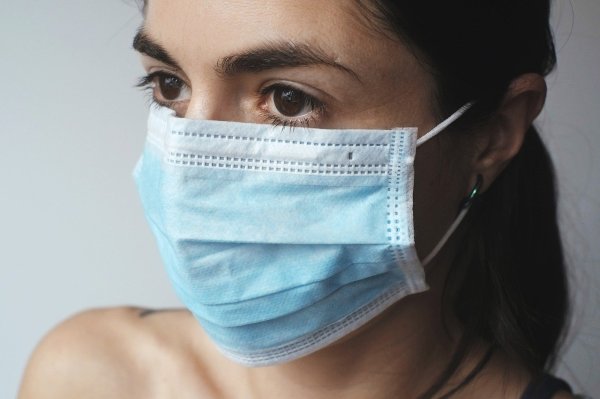
photo by Juraj Varga courtesy of pixabay.com
From the article, published May 27 (bolding added for emphasis):
Respiratory infections occur through the transmission of virus-containing droplets (>5 to 10 μm) and aerosols (≤5 μm) exhaled from infected individuals during breathing, speaking, coughing, and sneezing. Traditional respiratory disease control measures are designed to reduce transmission by droplets produced in the sneezes and coughs of infected individuals. However, a large proportion of the spread of coronavirus disease 2019 (COVID-19) appears to be occurring through airborne transmission of aerosols produced by asymptomatic individuals during breathing and speaking (1–3). Aerosols can accumulate, remain infectious in indoor air for hours, and be easily inhaled deep into the lungs. For society to resume, measures designed to reduce aerosol transmission must be implemented, including universal masking and regular, widespread testing to identify and isolate infected asymptomatic individuals.
Identifying infected individuals to curb SARS-CoV-2 transmission is more challenging compared to SARS and other respiratory viruses because infected individuals can be highly contagious for several days, peaking on or before symptoms occur (2, 7). These “silent shedders” could be critical drivers of the enhanced spread of SARS-CoV-2. In Wuhan, China, it has been estimated that undiagnosed cases of COVID-19 infection, who were presumably asymptomatic, were responsible for up to 79% of viral infections (3). Therefore, regular, widespread testing is essential to identify and isolate infected asymptomatic individuals.
The World Health Organization (WHO) recommendations for social distancing of 6 ft and hand washing to reduce the spread of SARS-CoV-2 are based on studies of respiratory droplets carried out in the 1930s. These studies showed that large, ~100 μm droplets produced in coughs and sneezes quickly underwent gravitational settling (1). However, when these studies were conducted, the technology did not exist for detecting submicron aerosols. As a comparison, calculations predict that in still air, a 100-μm droplet will settle to the ground from 8 ft in 4.6 s whereas a 1-μm aerosol particle will take 12.4 hours (4). Measurements now show that intense coughs and sneezes that propel larger droplets more than 20 ft can also create thousands of aerosols that can travel even further (1). Increasing evidence for SARS-CoV-2 suggests the 6 ft WHO recommendation is likely not enough under many indoor conditions where aerosols can remain airborne for hours, accumulate over time, and follow air flows over distances further than 6 ft (5, 10).
…
Airborne spread from undiagnosed infections will continuously undermine the effectiveness of even the most vigorous testing, tracing, and social distancing programs. After evidence revealed that airborne transmission by asymptomatic individuals might be a key driver in the global spread of COVID-19, the WHO recommended universal use of face masks. Masks provide a critical barrier, reducing the number of infectious viruses in exhaled breath, especially of asymptomatic people and those with mild symptoms (12) (see the figure). Surgical mask material reduces the likelihood and severity of COVID-19 by substantially reducing airborne viral concentrations (13). Masks also protect uninfected individuals from SARS-CoV-2 aerosols (12, 13). Thus, it is particularly important to wear masks in locations with conditions that can accumulate high concentrations of viruses, such as health care settings, airplanes, restaurants, and other crowded places with reduced ventilation. The aerosol filtering efficiency of different materials, thicknesses, and layers used in properly fitted homemade masks was recently found to be similar to that of the medical masks that were tested (14). Thus, the option of universal masking is no longer held back by shortages.
To illustrate the perniciousness of ignorance, a recent news story claimed that, in a telephone conversation between the governor of the State of North Carolina and the president regarding the possibility of holding a Republican National nominating convention in that state, the president demanded that the convention be held with a full hall and that no masks be worn by attendees. This situation would present the most infectious possible setting for a national meeting, yet it is what the president demands in order to whip up the enthusiasm of his base. What would happen if his demands were accepted? A few asymptomatic people could have infected the entire hall, possibly resulting in spread of cases nationwide after the attendees returned home. Such a “superspreader” event would be a tragedy for Republicans nationally but a “victory” for the president. What price ignorance and narcissism?
photo by Wynn Pointaux courtesy of pixabay.com
I have blogged in the past about police brutality incidents, when black people have been shot dead or brutalized. I got sick and tired of seeing the same thing happen day in and day out. I gave up posting about it because nothing ever changed, not after Philando Castile was shot while sitting in his car after a traffic stop by a policeman who was acquitted at trial, nor after Eric Garner was suffocated for selling untaxed single cigarettes by another policeman, who was never indicted.
I have seen estimates that police shoot dead about a thousand people a year, mostly black people. The only time a policeman was punished recently was when he shot a white woman– he went to prison for 12 years. The United States still has a major problem with race, 400 years after the first slave was imported to the New World.
Race is a problem in other countries, but it’s worse here. We fought a Civil War over the issue. Five days after the North was victorious, Lincoln was assassinated, and in his place, his vice president reversed all the gains of the war. Reconstruction was a disaster, brought on by Johnson, who was a virulent white racist, and who terminated the Northern Army’s occupation of the South under the worst possible terms.
Former slave-holders again took power to terrorize the freedmen and the promise of “forty acres and a mule” was never realized. We are still paying the price for the encouragement of white racial domination over the freed slaves and the failure to re-integrate the former slaves into society as equals. The gilded age was raised on the backs of blacks and poor whites.
Our prison system is packed (the most per capita in the world by several times over) with black people who were railroaded on plea bargains by overcharging into long terms for minor offenses. They are housed and barely coexist with whites who were primarily imprisoned for extremely violent acts (as opposed to relatively lesser crimes by the blacks.) They are warehouses for hate, with solitary confinement destroying minds and guards abusing prisoners at a disgusting rate. With the pandemic, they are now pesthouses with no opportunity for “social distancing” and no right to wear face masks.
Now our cities are wracked with protests and rioting, six days after a black man was murdered by asphyxiation for passing a counterfeit $20 bill to buy cigarettes (which would have killed him in a few years anyway.) I don’t believe in violence and I think that some people are using this moment to go out and destroy everything that has been built up in these neighborhoods at risk. I think maybe right-wingers (not just the police) are using this as a reason to commit violent crimes against protesters as well. Who knows how many (left wing) “anti-fascists” are out there breaking windows and fanning the flames?
I am deeply saddened by the brutality of our police, which persists despite major community efforts at control. I am disgusted by the video of a policeman kneeling on the neck of an arrestee for eight minutes and forty-five seconds, including two and a half minutes after he stopped breathing and moving.
This policeman appears to have acted with willful disregard for human life, if not intent to murder, knowing that it takes a long time to effectively strangle a person to death. How did he know to persist in his act for so long? Did he read somewhere, or does he know from personal experience that a strangulated person can be revived if you don’t keep the pressure on long enough? Was he trained to know that?
Half of the policemen in the US should be summarily fired, and the rest retrained and restrained. New policemen should be hired from a group of men and women nonviolent by nature (the opposite of the current procedure) and trained from the outset in violence prevention, not “killology” (a real thing, see Milwaukee police training.)
The autopsy: as if the fact that this 46 year old black man had hypertensive heart disease and coronary artery disease could be an excuse for his strangulation. He could have lived another ten years or more with those conditions, especially if he had been given the privilege of medical treatment (not in this country– no medical insurance!) and smoking cessation.
The coroner speculated that the effects of some drug(s) for which he had no evidence yet pending toxicology could have contributed. No physical evidence for strangulation? Doesn’t he know that it takes extreme violence to leave tissue hemorrhages or fracture the hyoid bone from strangulation?
Half of the $100 billion spent on local police should be slashed. That half should be diverted to social services and mental health emergency services. The number of people in jail should be cut in half. Cash bail should be eliminated; those accused of violent crimes should be tried within six weeks and remain in jail until then. Those accused of nonviolent crimes should be released on their own recognizance and again, should be tried within a short period of time unless there are exigent circumstances.
I am appalled and disgusted by this act. Now that video of it has appeared on the nightly news for everyone to see, will anything change? I doubt it, because a willful indifference to reality characterizes those who swear by MAGA. The only thing that will really stop this is the dying off from old age of those born and bred to this denial of reality.
Why you should wear a mask to prevent transmission of SARS-COV-2 and infection with COVID-19
Coronavirus studies by Engin Akyurt via pixabay.com
Here is an article published in Arxiv, an e-print server for scientific articles of immediate interest: “Universal Masking is Urgent in the COVID-19 Pandemic: SEIR and Agent Based Models, Empirical Validation, Policy Recommendations”– which was made available on April 22. It contains a link: http://dek.ai/masks4all/ (not secure) which has a video and a lot of promotional material endorsing the idea that everyone should wear masks to cut down on the transmission of COVID-19. It says that even home-made cloth masks provide significant protection.
I’m impressed by this promotional material and I feel very badly that our leaders haven’t endorsed this idea more strongly. It is far better, since we can’t tolerate being locked down any longer, for everyone to wear a mask when they go outside. The shortage of masks that prevailed early in this pandemic seems to have eased; they are even available on those TV channels that sell gemstones, watches, knives, and the like.
So buy a mask, or make one, and go out there to celebrate the summer. We’re going to have a bad time this fall, so we should enjoy life while it lasts. Also, if you’re out there protesting, definitely wear a mask if you don’t have a gas mask.
Coronavirus studies by Engin Akyurt via pixabay.com
A new article gives additional evidence that NHC may be useful against novel coronaviruses in humans. Previously, in October 2019, the drug was tested against influenza with good results and the results published in Science Translational Medicine. The new article adds testing against Middle Eastern Respiratory Virus (MERS)
From a Science Translational Medicine article posted April 29:
In mice infected with SARS-CoV or MERS-CoV, both prophylactic and therapeutic administration of EIDD-2801, an orally bioavailable NHC prodrug (β-D-N4-hydroxycytidine-5′-isopropyl ester), improved pulmonary function and reduced virus titer and body weight loss. Decreased MERS-CoV yields in vitro and in vivo were associated with increased transition mutation frequency in viral, but not host cell RNA, supporting a mechanism of lethal mutagenesis in CoV. The potency of NHC/EIDD-2801 against multiple CoVs and oral bioavailability highlights its potential utility as an effective antiviral against SARS-CoV-2 and other future zoonotic CoVs.
NHC (β-D-N4-hydroxycytidine-5′-isopropyl ester) is an orally available prodrug which hydrolyzes to the active form, N-hydroxycytidine. It has been previously investigated against influenza virus. This study and review looks at NHC’s effects on SARS-CoV-2, MERS-CoV, SARS-CoV, and related zoonotic group 2b or 2c bat-CoVs. It works by incorporating into the growing RNA chain that is produced by the viral RNA-dependent RNA polymerase which creates new virus RNA (the genome of the infectious virus.) Once incorporated, it leads to mutations which make the new RNA highly abnormal and no longer infectious.
This mechanism is related to the effect of remdesivir (RDV), which is also incorporated into the growing RNA chain but leads to immediate termination of the chain and its inability to become a complete virus genome. NHC is also effective against mutations of coronavirus which are resistant to the effect of RDV.
Mice are resistant to SARS-COV-2 due to differences in the mouse cell surface receptor for ACE-2. Therefore, the study also evaluated the effects of NHC in human airway epithelium (HAE) cells grown in culture. NHC was highly effective against SARS-COV-2 in HAE cell cultures, as well as against SARS-COV-1 and MERS in mice. The effects of NHC were most pronounced when given prophylactically 2 hours before exposure to the virus, but it was also effective when given shortly after exposure to virus.
The authors point out that mice show a very rapid reaction to infection as compared to humans, and the expected result of treatment with NHC after humans develop symptoms would be seen at 5-7 days after infection, as compared to 12 hours after infection with mice. Therefore, as with oseltamivir treatment of influenza, which is only effective when given within 5 days after symptom development, NHC would be given as early as possible after infection with SARS-COV-2.
There is no known mouse model of the effects of human aging on the clinical picture of infection with SARS-COV-2. This limitation makes it harder to study the effectiveness of treatment with antivirals in humans, other than the tests done on cells in culture. In the meantime, we will have to do with the modeling studies done in rhesus macaque monkeys, which show a similar clinical picture as in human COVID-19. Fortunately, monkeys usually survive SARS-COV-2 infection even without treatment; they have been found to respond experimental vaccination well.
The authors state that NHC could be expected to have some effect in humans with severe COVID-19 later during the course of illness because virus shedding continues longer. The evidence in autopsies shows widespread thrombosis and angiogenesis (new, tiny blood vessel formation) in the lungs. The clinical picture in severe COVID-19 also appears to be dominated later in the course by “cytokine storm” so there is precedent for additional treatment to reduce the inflammatory response and thrombogenesis (production of blood clots) in late, severe disease.
In summary, the authors advise further development of NHC with human trials in COVID-19, in which the drug should be given as early as possible after infection. In addition, “NHC is broadly active against multiple genetically distinct viruses including VEEV, influenzas A and B, Ebola, and Chikungunya viruses.” Therefore, the drug should be evaluated against other epidemic viruses which may strike the human population in the future.
photo by Juraj Varga courtesy of pixabay.com
Engineers at Indiana University have tested a fabric that generates a 0.5 volt DC electrical field with small dots of silver and zinc on polyester that can inactivate coronaviruses by interfering with their electrostatic properties and ability to penetrate cells. The virus was shown to be noninfectious after exposure to the fabric by attempting to introduce it to cell cultures, where it failed to grow and lyse the cells. The novel fabric is described in a chemrxiv preprint published on May 14 and publicized in IEEE Spectrum on May 28.
The use of face masks to filter breathed air depends on trapping viruses in the fabric; such trapped viruses are not, however, inactivated. Applying a weak electrical field does appear to inactivate coronaviruses. Inactivating the virus will prevent it from causing problems when the mask is removed and the user is exposed. The only hurdle now is to ensure that the face mask will be moist, so that the battery properties of the zinc and silver dots are exploited. The wearer’s breath may provide enough moisture to complete the circuit.
This experiment is based on a gel wound dressing with the same electrical properties that treats infections caused by bacteria that live in biofilms on wounds. The wound dressing is commercially available from a company called Vomaris. The researchers plan to develop a washable face mask with a replaceable piece of electrical-field producing fabric. Protective gowns could also be practical with the same techniques.
From the IEEE Spectrum article:
In collaboration with IU [Indiana University] geneticist Kenneth Cornetta, who performed some of the initial virus experiments in his laboratory, the team exposed a pig respiratory coronavirus to the electroceutical fabric for 1 or 5 minutes. After one minute, they found evidence that the virus particles had begun to destabilize and aggregate, becoming larger than before exposure. That suggests the weak electric field was causing “damaging structural alterations to the virions,” the authors write.
The researchers also tested the fabric with the human cold coronavirus 229E, with the same results. They have not yet performed the same tests with the SARS-COV-2 coronavirus, but are suggesting that will be equally effective. They plan to submit an Emergency Use Authorization to FDA to produce face masks.

photo of skeptical person by Oleg Gamulinsky courtesy of pixabay.com
We have a tsunami of information, some real, some unreal, threatening to drag us under. First, some definitions: Nature magazine, May 27, titled “The epic battle against coronavirus misinformation and conspiracy theories” introduces us to the ocean of information washing over us and helps with terminology.
The story describes “infodemic” as follows: “The World Health Organization (WHO) has called the situation an infodemic: ‘An over-abundance of information — some accurate and some not — rendering it difficult to find trustworthy sources of information and reliable guidance.’ ” The story defines mis- and dis- information: ” ‘misinformation’ … is wrong but not deliberately misleading … ‘disinformation’ … [is] organized [deliberate] falsehoods … intended to deceive.”
From the Nature story, an example of disinformation:
On 19 March, the website Biohackinfo.com falsely claimed that [Bill] Gates planned to use a coronavirus vaccine as a ploy to monitor people through an injected microchip or quantum-dot spy software.
This false claim was picked up by a YouTube video, which eventually was viewed more than 2 million times. The notorious Roger Stone discussed it on a radio show and claimed he’d never take a vaccine “funded by Gates.” Then the New York Post (a dodgy right wing newspaper) picked up the story and repeated it without contradiction. The story spread to Facebook, where it got “more than a million” likes, comments, and shares. The whole story is ridiculous– first of all, there’s no such thing as quantum-dot spyware. Yet many people believe it or share it.
What has changed to make matters worse in recent decades? Not just the internet. Social media like Facebook (which started in 2004) is designed to maximize user “engagement” or “clicks”, and scary or shocking items make for increased interest. There is no filter on this kind of media, no moderator to stop errors and falsehoods.
Information spreads orders of magnitude faster than before, when print or radio were controlled by people with money and power. Now the average person can make statements that are potentially read worldwide. The more shocking the statement, the more likely it is to spread, and the more an advertiser will pay to append a message to it; this creates an incentive for people to exaggerate or even falsify to increase the impact of their statements.
In parallel to the spread of the internet, those who are dismissive of the power of government to do good have amplified their messages and their distortions. These people have spread the notion that “government is bad” (mostly because they don’t like progressive taxation) and, as Ronald Reagan said when he was inaugurated as president in 1981: “Government is not the solution to our problems. Government is the problem.”
From the story in the May 23 New York Times, titled: “Will the Coronavirus Kill What’s Left of Americans’ Faith in Washington?“: “Just 17 percent of Americans [in 2019] trusted the federal government to do the right thing “just about always” or “most of the time,” according to the Pew Research Center.”
In the 1950’s, when the question was first asked by pollsters, about three-quarters of people trusted the government implicitly. Then came the new “conservative” movement, spearheaded by the actor, paid spokesperson, and man of average intelligence, Ronald Reagan.
Now, in the pandemic, people have more faith in government, especially local. This is partly because many have received the federal $1200 stimulus checks into their checking accounts. It is also because people are looking to government to help protect them from the virus.
Confused messaging about face masks and reopening guidelines have impaired this newfound trust; daily briefings from the president have not helped. This distrust comes from both sides of the political spectrum. On the usual left, there are “science-based” people who distrust a president who uses a drug that, in studies, causes a higher death rate than taking nothing.
On the far right, there are many people who fear the “deep state” (which consists mainly of committed public servants who belong to no political party.) Most of those on the far right actually trust the president because of incessant propaganda, especially from talk radio and Fox “news”.
There is a small but vocal group of people who believe in conspiracies; this has been exemplified by the QAnon movement. Estimates of those who subscribe to these conspiratorial views range from 5% of adults to as high as 40% who agree with at least some statements from Q-Anon. Conspiracy theories from Q-Anon and others include the belief that the coronavirus was genetically engineered to eliminate the excess population, or that the response to the virus is designed to control people and prevent them from dissenting.
Some have claimed that bills now in Congress will allow the government to take children from their families or to place people in concentration camps for having contact with virus carriers. A particularly pernicious theory holds that contact tracers intend to delve into people’s phone contact lists (confusing phone contacts with personal contacts) and that the new 5G network system actually causes the virus. A few have tried to burn down cell phone towers.
The cultural conflict has naturally played out on social media. Attempts by moderators to take down posts that stoke conspiracy theories and false information about the virus have been only slightly successful. I previously posted about the conspiracy theories in the video “Plandemic”, which was erased from parts of the web; the video lives on in the dark web, inaccessible to moderators.
Many more than eight million people have viewed this video, and the number serves as a good starting point for estimates of how many people believe in this alternative to reality and other conspiracies. That number represents roughly two or three percent of Americans. It is this two or three percent who believe implicitly in every conspiracy theory they hear about who are most dangerous.
People who are predisposed to believe in these delusions will not be swayed, neither by logical arguments nor by events that would seem to contradict their beliefs. This is a dangerous group of people, and there is little that can be done to change their minds. The only recourse is vigilance against armed attacks by aggrieved and desperate individuals; repeated debunking of their theories is necessary but not sufficient to stop them.
One thing that will help in the long run is if the government is headed and directed by people who value the truth above all else and avoid any temptation to lie or hide the facts. Maybe if someone else is elected to lead the country in November, this will happen– but don’t relax even if the leadership does change. Conspiracy theorists and new “conservatives” (like the Tea Party) will continue to attack our notions of reality and responsible government.

power plant control room by Robert Balog courtesy of pixabay.com
We are blessed with loyal public servants for our inspectors general. Otherwise, these malcontents would be summarily fired for such infractions as: publishing reports that disclose hospital complaints about the dire shortage during a pandemic of personal protective equipment in hospitals, or referring complaints received to Congress about attempts by the president to force foreign countries to announce bogus investigations of political rivals by with-holding critical military assistance against Russian aggression.
By the way, the Inspector General’s Office (OIG) (of which there are currently 73, one for each major federal government agency) does the following: ” conducts and supervises independent audits, inspections, and investigations and recommends ways [for the inspected department] to carry out its vital responsibilities in the most effective, efficient, and economical manner possible.” What’s more, “The OIG is directly responsible for meeting the statutory mission of promoting economy, efficiency, and effectiveness in the administration of … programs and operations and to prevent and detect fraud, waste, abuse, and mismanagement in such programs and operations.”
To be clear, inspectors general expect to receive complaints like these: “The Allegations that should be reported to the OIG Hotline include, but are not limited to: Employee corruption, civil rights and civil liberties abuses, program fraud and financial crimes, and miscellaneous criminal and non-criminal activity associated with waste, abuse, mismanagement or misconduct “. To do his job, the IG has “Access to all relevant records, documents, and information … Authority to subpoena documents and, if necessary, to enforce that subpoena in the appropriate federal district court” and a number of other powers…
Here’s how to file a complaint with the IG: “Report Fraud Hotline Online: See form below. Call: (800) 424-9071. (For instructions on filing a tip on a CLASSIFIED matter, call 1-800-447-8477.) Email: hotline@oig.dot.gov. Mail: DOT Inspector General, 1200 New Jersey Ave SE, West Bldg 7th Floor, Washington, DC 20590. Contractors may also use our online FAR Disclosure Form to report criminal or civil violations in connection with a Federal contract.” Finally, the IG “is appointed by the President subject to Senate confirmation [and] reports to the Attorney General and Congress.” (from Google “snippets”; all of these are quotes from official federal government websites, but bolding is mine.)
The Inspector General is a contradiction: a federal employee who is supposed to be dedicated to rooting out malfeasance by other federal employees. As such, he or she or they, if they are doing their job, has to be the most hated person in government. They will step on toes, conduct embarrassing investigations, and reveal unwanted information about goings-on high and low. They are sure to make enemies, in particular, the guy at the top. Unless of course, they do nothing, which is what the IG of the DHS has chosen to do.
Recently, the muckraking online magazine Mother Jones published an expose of the weak credentials possessed by the unanimously confirmed IG for the DHS. We’ll get to that in a moment, but first, from the official DHS website, “About”: “Meet the Inspector General”:
Meet the IG
Joseph V. Cuffari was confirmed by the U.S. Senate as the Department of Homeland Security Inspector General on July 25, 2019. Dr. Cuffari previously served as the policy advisor for Military and Veterans Affairs for Governor Doug Ducey of Arizona, and previously for Governor Jan Brewer. He served more than 40 years in the United States Air Force, on active duty in the Reserves, and in the Arizona Air National Guard. He began his military service after graduating from high school and enlisting in the United States Air Force in 1977. He served in a variety of leadership positions with the Air Force Office of Special Investigations (AFOSI) as well as with the Department of Defense Office of the Inspector General (OIG). He was a Commander with the AFOSI at MacDill Air Force Base, Florida; England Air Force Base, Louisiana; and Naples, Italy, with the North Atlantic Treaty Organization. In 1989, he received the AFOSI Outstanding Officer of the Year Award. He also served for more than 20 years in the Department of Justice (DOJ) in a multitude of roles dating back to 1993. In 2013, he retired from his position as Assistant Special Agent in Charge for the Office of the Inspector General in Tucson, Arizona. In other capacities, he has augmented the United States Senate and House Intelligence Committees and the DOJ Office of Overseas Prosecutorial Development. Dr. Cuffari earned a Ph.D. in Management in 2002, an M.A in Management in 1995, and a B.S. in Business Administration and Management Information Systems in 1984.
Note that the degree-granting institutions for his MA, BS, and PhD are not shown; that’s because they reflect no credit on Joseph Cuffari. Per Mother Jones: “The DHS Inspector General Claimed to Have a Philosophy PhD. He Doesn’t.” The article, undated but apparently published today, goes on to state that, until Thursday (yesterday), Cuffari’s bio had him with a PhD in philosophy. It now states that his PhD is in management, but still does not give the location from which he received his degree.
That location is “California Coast University” and this occurred in 2002. Two years later, the General Accounting Office (GAO) described this “university” as a “diploma mill”, which it defines as one of the “nontraditional, unaccredited, postsecondary schools that offer degrees for a relatively low flat fee, promote the award of academic credits based on life experience, and do not require any classroom instruction.”
Seriously, “Dr.” Cuffari refers to himself as “Joseph Cuffari, PhD”, which would be reasonable if his diploma mill were accredited, but it was not. In fact, “California Coast University” was established in 1973 using a name (California Western University) that was the same as another well-known university (until 1968, when it changed its name). Its founder claimed in 1990 that a student could obtain their PhD in less than a year. The school was based in a small office building in Orange County that is now home to a 7-11 and a Subway sandwich shop. The school was not accredited until 2005– at which time the accrediting agency (the Distance Education Accrediting Commission) restricted it from offering doctoral programs at all. This damning paragraph from Mother Jones:
After I mentioned those details to Cuffari’s spokesperson, the inspector general’s office contacted California Coast University and then clarified that the school was “approved by the State of California to award degrees of higher education, including doctoral degrees” when Cuffari was enrolled. But that approval came from the now-defunct California Bureau for Private Postsecondary and Vocational Education, which okayed everything from barbering and bartending schools to a course in “Sexological Bodywork.” Officials at the bureau readily acknowledged to reporters in 2005 that they applied minimal standards, far less rigorous than accreditation. When Cuffari graduated, CCU’s degrees could not be legally used in neighboring Oregon, which was known for closely monitoring the quality of unaccredited schools.
California Coast University listed the “price of the management PhD at $4,575, a flat fee for up to five years of enrollment” and required the student to attend in person just once, to defend their dissertation. Required coursework could be satisfied by taking examinations and by completing “Accelerated Learning Guides” that factored in “independent reading experience.”
Thus, the Inspector General of the Department of Homeland Security got his PhD in philosophy/management (there’s little difference in this context) from a diploma mill for $4,575– a bargain considering the fees at traditional universities are well in excess of $10,000 a term and usually require three or more years of full-time attendance (possibly difficult when one is in the Air Force Reserve and serving as “policy advisor for Military and Veterans Affairs for [the] Governor [of Arizona]”)… The only thing missing from this picture is the title of Cuffari’s “dissertation”. We can imagine that it contains a number of large, multisyllabic words signifying nothing.
According to Mother Jones, the DHS has a budget of nearly $70 billion and includes the Secret Service, the Transportation Security Administration, and the Federal Emergency Management Agency (FEMA) and three immigration agencies. Cuffari was nominated in November 2018 and confirmed July 2019 by unanimous vote of the Senate. Senators referred to him as “Dr. Cuffari” during the confirmation hearings (despite the general rule of etiquette that says that only MDs are supposed to be referred to in this way, snark snark.)
A statement from the notorious Republican Senator Ron Johnson in support of Cuffari’s nomination claimed he has “decades of experience in government oversight and investigations” (except that he doesn’t, not as an actual investigator or manager.) There was no mention of any management positions in his resume or bio, anywhere in government, the military, or private business.
It is too much to ask for a high-level government employee from the Civil Service who has experience in an Inspector General’s Office who has actually done tough audits or is even an auditor. No one is available who oversees legally difficult investigations of a secretive branch of government. It is too much to ask that he perhaps have a real degree in law, actual experience in management of another branch of government, or experience conducting sensitive investigations, inspections, or audits of any kind.
There’s no one who has a position on anything other than loyalty to the Commander in Cheat. There are no Civil Service employees who are loyal and could step into the shoes of the retired IG. There’s no one available with either a law degree, still in good standing with their state Bar, or relevant managerial experience who still loves the Boss unreservedly and doesn’t have a paper trial of disloyal comments (or any statements at all, for that matter.)
Since I’m trapped at home with nothing better to do, I Googled “IG DHS Joseph V. Cuffari” and got a few hits, including a Wikipedia page (which is considerably shorter than this blog post.) This Washington Post article from March 17: “DHS watchdog nearly dormant as reports and audits plummet”… This complaint to the OIG from the San Diego American Civil Liberties Union on April 15 (.pdf file) : “Re: Separation of Families via CBP Detention and Processing, and the Agency’s Refusal to Implement a Detainee Locator System” (it seems that Customs and Border Control has no system for locating its detainees.) … a complaint by the chief counsel to the Transportation Security Agency (.pdf file of a complaint filed with a district court) that the OIG had violated her privacy and impugned her reputation by publishing an investigatory report publicly which contained implications of wrongdoing when she was found to have done nothing wrong and they found no problems (this is a good example of what an IG is NOT supposed to do to a chief counsel)… and so on. Finally, we learn that Cuffari is one of the IGs on the oversight board for pandemic relief funds.
Whatever his qualifications, we can be sure that Joseph Cuffari is a loyal servant of the president who would never actually sign off on critical reports about corruption, malfeasance, incompetence, or waste in the Department of Homeland Security, an agency created after 9/11/2001 to take care that no-one dares to attack our country. Nevermind about over a hundred thousand dead Americans sacrificed to the novel coronavirus– nothing to do with our security or our health or our economy. Let the Centers for Disease Control and Prevention handle that– oops, nevermind.
Sigh. Why do I get the feeling that I am talking into a cardboard box? This Cuffari is a nonentity who has been induced by money, money, and money to do nothing in his new job (he’s good at that, having done nothing most of his life) and have no opinions except to love He-who-must-not-be-named unreservedly. He will serve as a black hole for complaints about immigration enforcement, Secret Service spending on golf carts and hotel rooms while guarding the aforementioned, and so on and on. Why am I not surprised and how many thousands more just like him are there up there in Washington, DC right now?

Gandhara Buddha circa 1900 years ago, courtesy of wikimedia commons
Buddhism has something to do with COVID-19. Just what that is, is not clear. Perhaps the simplest lesson is that “all life is suffering.” We are born, we suffer, and then we die. What are we to do? Avoid harming other living things. This includes harm to animals as well as to other humans. We might have avoided this pandemic if we had not disturbed the habitats of the bats who carry coronaviruses.
Now that it is here, we should avoid further harm if possible. This means that we should realize that any one of us might carry the SARS-COV-2 virus, even if we are unaware of it. So simple contact, even just being close to other people and breathing on them, may transmit the virus to others without our realizing it. We must avoid close contact with people who are not already close to us: non-family members and those who are not already close friends at the time we realize the facts.
This means that we should wear masks whenever we are around people to whom we have not already become close. We should wash our hands after contacting surfaces outside of our homes. We should avoid large gatherings, even while wearing masks, because the masks are not foolproof.
Once a vaccine becomes available, we should endeavor to obtain the necessary dose or doses (some vaccines require two doses.) In the meantime, we should communicate as much as possible electronically– because this is an innovation that makes our lives better and safer, and we need personal and social contact for our mental health.
We should do these things, not because it is “politically correct” to do them (whatever that is), but because it comports with our basic values that include empathy and a desire not to harm others. If “political incorrectness” includes a lack of empathy and a lack of concern over the harm that one might do to others, then that is to be condemned by those who are Buddhists and those who admire at least some of the tenets of Buddhism. I would include “those who admire” among most Christians, Muslims, and Hindus, as well as atheists who believe that here and now is all we have and we should make the best of what we have.
Even if you don’t believe in any G-d, because you can’t find any evidence of Him, you should believe in the here and now. You should believe that you are only an infinitesimal part of the visible universe and it is presumptuous to be self-centered (narcissistic.) You should try to avoid harming others.
Even if you believe in god(s), you should not expect anything from it (or them.) As it says in the Dokkodo (the way I go alone), “Buddhas and Gods are worthy of adoration but I will ask them for nothing.”
Finally, “Even if I sacrifice my life I will not sacrifice my (good) name.”
photo by Juraj Varga courtesy of pixabay.com
Thorax from the British Medical Journal published a brief communication that has been picked up by the general news media. This communication describes the findings from a cruise ship to the Antarctic that departed in mid-March for what was to be a 21 day cruise. This cruise was to follow the route of the explorer Shackleton, who survived a years-long ordeal with his crew after wrecking on an exploration of the Antarctic in 1914-17.
Prior to departure, the 95-member crew and 128 passengers were all screened for symptoms of COVID-19. No-one who had transited through China, Macau, Hong Kong, Taiwan, Japan, South Korea, or Iran in the previous three weeks was allowed to board.
Additional precautions prior to departure included “hand hygiene stations” all over the ship. On the third day, the cruise was shortened because of travel restrictions that had been announced, and plans were made to return on day 14 to Ushuaia, Argentina. On the eighth day, one passenger developed a fever.
Isolation precautions were started, with masks for all and all passengers confined to their cabins. The crew wore N95 masks for contact with the passengers. Meal service to the cabins three times a day was continued but the rooms were not “serviced.” On the tenth day, three crew members had fever; on the next day, two passengers and crew had fever, and the day after that, three passengers developed fevers.
The ship sailed to Montevideo, Uruguay and arrived on the evening of the thirteenth day. Most of the patients with fever had improved by that time. Rapid testing kits for SARS-COV-2 antibodies were delivered and performed on six people who had fevers before, but came back negative on the fourteenth day.
Uruguayan officials refused permission to dock until nasal swab testing for COVID-19 by RT-PCR had been done. Three additional people developed fever that day with mild cough and lethargy. One passenger, a 68-y/o man, got worse and was evacuated to a hospital in Montevideo on the seventeenth day– he was intubated and tested positive by RT-PCR. A total of eight people were evacuated due to “impending respiratory failure.”
The first evacuation came on day 17, and the others happened on days 20, 21, 22, and 24. The seventh patient developed fever on day 23 and was evacuated on the 24th day. One of the two ship physicians was the final patient to be evacuated, on the 27th day. All of the evacuees tested positive.
All of the people on board were tested on day 20, the third of April. Out of 217 still on board, 128 people tested positive by RT-PCR, including the six who had negative antibody tests. In ten cases, two passengers sharing a cabin had discordant test results: one negative, the other positive.
Only 16 of the 128 who tested positive had any symptoms, all with fever and other “mild symptoms.” Another eight were evacuated, four of whom were intubated. One passed away. A total of 24 patients who were positive had symptoms, representing 19% of all positive results. 104 with positive results represented 81% of all patients being asymptomatic.
The arithmetic stated in the report doesn’t completely add up; there had been a total of 225 people on board, eight of whom were evacuated, leaving 217 to be tested. Only two had been evacuated by the date given for testing, the 20th.
But 16 of the 128 on board who tested positive, plus the eight who were evacuated, adds up to 24 with symptoms (as stated)– but eight plus 128 should be 136 total positives… perhaps it was only 120 positives of the 217 on board, plus eight positive evacuees. This remains to be clarified.
For 28 days, there had been no outside human contact with anyone on the ship (not counting the evacuations.) The Uruguayan government allowed 112 ANZAC (Australia and New Zealand) people to be repatriated on the 28th day, and all the rest on the 32nd day.
In this unusual and isolated situation, 81% of people who were infected by SARS-COV-2 were asymptomatic. Some of the RT-PCR tests may have been either false negative or false positive because ten cabins contained two passengers each who had mismatched test results. The rapid antibody test proved unreliable in the acute phase of illness, as all tests performed were negative less than six days after the earliest patient developed symptoms.
Some passengers developed symptoms late, especially because the first one occurred eight days after departure and the last were on the 24th day; this suggests that “there may have been cross contamination after cabin isolation.”
This remarkable report indicates that the number of asymptomatic infections with COVID-19 is much higher than has been previously suggested (estimates had ranged from 20 to 50%). Further evaluation of the routes of infection on this ship is a good idea; whether they occurred by contact, droplet, or aerosol transmission is unknown and could be puzzled out by interviews with the involved patients.
Coronavirus by Engin Akyurt via pixabay.com (open access)
A study from the Institut Pasteur in Paris was published on the preprint server MedRxiv on May 19 (full text .pdf file here). In this study, healthcare workers were recruited to assess antibodies to SARS-COV-2 (the spike protein) after they had recovered from mild COVID-19 confirmed by RT-PCR tests (nasopharyngeal swabs). None of the patients required hospitalization during their illnesses. Their median age was 32, and most were medical students, doctors, or nurses. Of the 160 participants, 74 had known contact with virus patients at work and 38 met virus-infected people away from a “health care setting”. The rest apparently had unknown contacts and may have been infected by asymptomatic carriers.
One hundred and fifty five (96.9%) had symptoms consistent with COVID-19 (dry cough, fever, dyspnea, anosmia or ageusia). The median time between onset of symptoms and PCR testing was 2 days (IQR:1-4), and the median time from onset of symptoms to blood sampling was 24 days (IQR: 21-28, range 13-39).
159 of the 160 participants had detectable antibodies to SARS-COV-2 spike protein, with higher levels noted later after the illness (the earliest sample was taken 13 days after onset.) The only participant who had no detectable antibodies was a 58 y/o man who had persistent symptoms 18 days after onset of illness, when blood was drawn for the test. 91% of the participants also had neutralizing antibodies to the virus, with a maximum of 97% after 28 days. In the discussion, the authors relate that other studies showed higher antibody titers with more severe disease; in this study, virtually all patients with mild disease developed antibodies.
This study demonstrates that patients who recover from mild COVID-19 will develop antibodies, most of them demonstrating neutralizing ability against the virus. In animal studies, neutralizing antibodies have shown immunity against re-infection; thus, even mild disease should confer protection. Additional findings:
Interestingly, in our study, individuals with factors associated with more severe disease (e.g., male sex, high body mass index and high blood pressure), were more likely to have high titers of neutralizing antibodies compared to others. This may be due to a higher antigenic burden in such individuals, which will generate a stronger humoral response, or may, on the contrary, suggest that some antibodies may play a deleterious role during infection [15]. Future studies are warranted to characterize the beneficial or detrimental role of specific antibodies in COVID-19 patients and the minimal titer required for protection.
This study was publicized in a story in the Guardian on May 27. The story states that the study was prompted by multiple illnesses reported after an evangelical retreat in Mulhouse, France in early March– what they described as a “super-spreader” event. The study was said to be focused on the 80% of people infected who develop mild disease. Earlier studies were conducted on patients after hospitalization for severe illness. “Early reports had suggested an absence or limited presence of antibodies in some individuals with mild symptoms.”
This contributes to our understanding that COVID-19 illness results in immunity for the vast majority of those affected, even with mild disease. Previous reports had questioned the development of antibodies in patients who were not severely ill. Based on prior experience with SARS-COV-1, immunity is expected to last at least two years.
 Conrad Theodore Seitz