
This is a first for fossils– a cancer (specifically an osteosarcoma) located on the fibula of a Centrosaurus apertus. That probably doesn’t strike you as interesting, but I thought it was.
This was reported in ReachMD, based on a paper published in Lancet Oncology, which is unfortunately behind a paywall. The report does have a picture of the fossil, however.
The point is that cancer has never been found in a dinosaur before. This means that cancer is an ancient disease that has affected animals throughout the history of life on our planet. So it’s unlikely that anyone is ever going to find a way to eliminate cancer in humans.
Elephants, by the way, very rarely get cancer, despite their enormous size. They have evolved genetic mechanisms that detect cancer cells early and eliminate them before they have a chance to cause trouble. So maybe, just maybe, it might be possible to develop a genetic way to reduce (but not eliminate) cancer in future human populations. I’m just saying.
Symptoms of COVID-19: Acute vs persistent. A tally of acute and chronic effects of the virus.
Acute symptoms of COVID-19
CDC guidelines published July 17, 2020 state that 96 percent of laboratory-confirmed symptomatic cases of COVID-19 have one of these three symptoms: cough (84%), fever (80%), or shortness of breath (38% of patients not hospitalized.) 45 percent have all three.
Additional common acute symptoms: chills (63%), myalgia (muscle pain) (63%), headache (59%), fatigue (62%), rhinorrhea (runny nose) (51%), and sore throat. (Wired symptom guide, July 31, 2020.)
Less-common acute symptoms: congestion, runny nose, conjunctivitis (pink eye), and anosmia (loss of the sense of smell) (22%.) Gastrointestinal (GI) symptoms: nausea, vomiting (13%), diarrhea (38%), and abdominal pain. Skin symptoms: rash and discoloration of fingers or toes (“COVID toes”.)
Confusion was also reported by about 20% of patients (in the CDC article about persistent symptoms, below.) This may include such things as night-time delirium or nightmares, loss of orientation to time and place, and hallucinations. These symptoms were not included in many surveys but have been consistently reported by an unknown number of patients.
More serious symptoms: dyspnea (shortness of breath or difficulty breathing) (82% of hospitalized patients), cyanosis (bluish discoloration starting on lips), angina pectoris (chest pain or pressure), or paresis (weakness) and aphasia (inability to speak.)
In a “convenience sample” of 164 patients with symptoms, the CDC found the following percentages:
Each of the following symptoms was reported by >50% of patients: cough (84%), fever (80%), myalgia (63%), chills (63%), fatigue (62%), headache (59%), and shortness of breath (57%)… …. Approximately half of patients reported one or more GI symptoms; among these, diarrhea was reported most frequently (38%) and vomiting least frequently (13%). Among adult patients, shortness of breath was more commonly reported by hospitalized than by nonhospitalized patients (82% versus 38%). In contrast, new changes in smell and taste and rhinorrhea were reported by a higher percentage of nonhospitalized patients (22% and 51%, respectively) than hospitalized patients (7% and 21%, respectively).
https://www.cdc.gov/mmwr/volumes/69/wr/mm6928a2.htm
Symptoms lasting more than a week
These are acute symptoms, those that occur within about two weeks (averaging 5 days) after exposure to the virus (SARS-COV-2)– but what about chronic or persistent symptoms? A CDC report dated July 31, 2020 on persistent symptoms and “delayed return to health” found a number of persistent problems.
About 65% of patients reported “returning to their usual state of health” an average of a week after being tested. Younger and previously healthy patients were more likely to recover quickly. Obese patients and those with psychiatric conditions had more than double the odds of a “delayed return to health.”
Cough (43%) and fatigue (35%) were the symptoms least likely to have resolved, but “[a]mong respondents who reported returning to their usual state of health, 34% (59 of 175) still reported one or more of the 17 queried COVID-related symptoms at the time of the interview.” (That is, they thought they were well, but on questioning, a third of them still had one of the symptoms.)
This sentence has been widely paraphrased to point out that COVID-19 is much worse than the flu:
Even among young adults aged 18–34 years with no chronic medical conditions, nearly one in five reported that they had not returned to their usual state of health 14–21 days after testing. In contrast, over 90% of outpatients with influenza recover within approximately 2 weeks of having a positive test result.
https://www.cdc.gov/mmwr/volumes/69/wr/mm6930e1.htm
Symptoms lasting a month or more
Patients who are seriously ill and admitted to the hospital are in for months of illness and recovery. Being placed on a ventilator brings with it the side effects of being (therapeutically) paralyzed, in a (medically induced) coma, and not moving or being aware for however long is needed to recover one’s lung function.
These patients must go through extensive rehabilitation to regain muscle strength and re-develop mental capacities that are deeply impaired by the drugs needed to adapt the patient to ventilation.
We will leave aside these critically ill patients for a time, however, and concentrate on those who are merely sick enough to stay home and on the couch for a while. What about these patients?
The survey above only evaluated patients for three weeks after they had first been tested. What about really persistent symptoms? This article in worldneurologyonline.com talks about the phenomenon:
It is becoming increasingly apparent that many patients who recovered from the acute phase of the SARS-CoV-2 infection have persistent symptoms. This includes clouding of mentation, sleep disturbances, exercise intolerance, and autonomic symptoms. (See Tables 1 and 2 below) Some also complain of temperature dysregulation and lymphadenopathy.
https://worldneurologyonline.com/article/long-haul-covid/
Table 1: (general symptoms that persist)
- Insomnia or frequent awakenings
- Inability to concentrate and think clearly
- Easy fatiguability [sic] despite normal lung function
- Anorexia [loss of appetite] or increased appetite
- Temperature dysregulation [being hot or cold inappropriately]
- Lymphadenopathy [enlarged lymph nodes]
- Dysautonomia [see symptoms below]
Table 2: (autonomic symptoms)
- Tachycardia [rapid heartbeat] upon mild exercise or standing
- Night sweats
- Gastroparesis [loss of normal stomach contractions]
- Constipation
- Peripheral vasoconstriction [constriction of arteries and veins– resulting in cold hands and feet]
Most patients with persistent symptoms were not sick enough to be admitted to the hospital. Most had resolution of the more severe, acute symptoms mentioned above, but not all. Some are still sick more than 100 days after falling ill. Some are recovering and some are not.
Is this like myalgic encephalitis?
Some of the symptoms are reminiscent of another, poorly characterized syndrome called myalgic encephalitis or chronic fatigue syndrome (ME/CFS.) This syndrome has no known cause; most sufferers believe that the onset of their condition coincided with an acute viral infection, although it is difficult to pin this down since they usually aren’t diagnosed until months to years after their onset.
The “long haul” syndrome’s resemblance to ME/CFS may be purely coincidental, but the association with a viral illness is highly suggestive of some underlying causal similarity.
I have posted about the effects of the virus on the heart (more than 70% of mildly ill patients have hidden heart damage) and the brain (an unknown proportion of patients have hidden brain injuries.)
There may be additional, as yet untallied effects of the virus. These may relate to damage to the autonomic nervous system, the liver, kidneys, and gastrointestinal tract, and to other organs as well. No-one knows, but with the pandemic creating millions of patients, we are sure to find out over the coming months and years.

This article, published in February by inewsource, recounts the ordeal of a former Navy SEAL veteran who suffered a psychotic break after intensive treatment with a new and controversial therapy for post-traumatic stress disorder (PTSD.)
Magnetic Resonance Therapy (MRT) is based on the technique used to create medical images of body parts called magnetic resonance imaging (MRI.) The technique of MRT has been used for thirty or more years to treat depression, with some success.
Personalized MRT (PrMRT) uses magnetic energy synchronized with the patient’s electroencepahalogram (EEG– a recording of “brain waves” or brain electrical activity from scalp electrodes.) PrMRT is still in the research phase and has not been fully validated. Some doctors think it is effective for autism, PTSD, and other disorders.
This is a long, fascinating (to me) article about a man who suffered from severe PTSD as a result of his military training and experience that was followed by a serious car crash. The article also delves into the story of the treating physician who administered the PrMRT.
The article dissects the hubris of the treating physician, who is not a psychiatrist (as one would expect treating a patient with PTSD) but a neuro-oncologist. He is shown engaging in “research” (as he describes it, though it is more like fiddling around as I would describe it.)
He uses the new treatment modality, magnetic resonance therapy, and develops it into this personalized form (actually he learns it from a recognized clinic that is using it and then steals their research.) The doctor is shown receiving a $10 million grant to do the “research” from the estate of a patient he treated for brain dysfunction after chemotherapy for cancer.
The patient in the article– the former Navy SEAL– did not have cancer. He had (and still has) PTSD. He developed an acute manic episode after treatment, which is a known side effect of MRT. The doctor failed to recognize this and continued to apply the treatment, with tragic results.
Read the article when you have time, to get a nuanced picture of what happens when you have a manic episode and why doctors (who aren’t psychiatrists) can’t recognize mania when it interferes with their income stream.
Ordinary MRT is somewhat effective for depression, but it can sometimes cause mania. It should only be administered under the supervision of a psychiatrist. It is covered under Medicare.
If you have any thoughts or feelings about suicide that trouble you, there is help available through the National Suicide Prevention Lifeline 24 hours a day: 1-800-273-8255. Just saying, there is always help available and you don’t have to have electrodes stuck to your head to get it.
SalivaDirect COVID-19 test “really has potential” to speed diagnosis: FDA Deputy Commissioner
Anand Shah, MD, the Deputy Commissioner for Medical and Scientific Affairs at the Food and Drug Agency (FDA), said yesterday that a new test for COVID-19 called SalivaDirect “really has potential” to make testing more convenient and faster. He was speaking at a virtual press conference held Thursday morning and reported in Medpage Today this morning.
SalivaDirect, as its name implies, uses a sample of saliva from a person to test for the presence of RNA from the SARS-COV-2 virus. It requires only a sterile sample container. No ribonucleic acid (RNA) extraction step is needed to pull the virus’s genetic material from the sample. The test was created by the Yale School of Public Health in their Department of Epidemiology of Microbial Diseases. An Emergency Use Authorization was granted on August 15 by the FDA, and this news release describes the test.
The news release quotes Assistant Secretary for Health and COVID-19 Testing Coordinator Admiral Brett P. Giroir, M.D. as saying the test is an “innovation game changer that will reduce the demand for scarce testing resources.”
The test is not quite as sensitive as the currently standard nasopharyngeal swab, but it gives a big increase in convenience and reduced patient “discomfort” (gagging.) There is less time and fewer materials needed– due to skipping the RNA extraction step and the preservative in the vial. The test is inexpensive, with costs for all supplies running $1-$5. It is also validated for use with reagents obtained from multiple suppliers, making supply shortages less of a problem.
The test is described fully in this preprint published on MedRxiv on August 4. The article states that its detection limit is 6-12 SARS-CoV-2 copies per microliter. In direct comparison with the the Centers for Disease Control’s (CDC) test with saliva, it realized 93% sensitivity, missing 3 of 41 samples that tested positive otherwise– all three had extremely low levels of virus.
When compared with nasopharyngeal swabs tested from the same patient, saliva specimens tested with SalivaDirect showed 94% sensitivity and 100% specificity. A few specimens that tested negative with nasopharyngeal swabs were positive with saliva specimens, and this was confirmed with other tests– indicating that the nasopharyngeal swabs had missed a few truly positive patients.
The SalivaDirect test should be useful for outpatient testing and for asymptomatic people. It is thought to be less useful for sick patients in which blood and mucus can interfere with the test procedure due to the lack of RNA extraction.
If this test can be used as described for surveillance in asymptomatic people (a major shortcoming of the currently standard test, with its intrusive nature and the shortages of reagents) then it will surely be a big help in ramping up the number of examinations performed. Serial testing of people without symptoms is very important for making it possible to open up schools in particular.

The New York Times (NYT) had this article on the new reporting system for hospitals on August 12, describing a letter from members of the Healthcare Infection Control Practices Advisory Board that criticized the new system.
Just today, the Wall Street Journal (WSJ) reported that the reporting system is being returned to the CDC from HHS. (Behind a paywall…) This was an exclusive report but I picked it up on my iphone’s news feed. So here’s my quotes from the article, in a shameless bout of plagiarism: Apparently, the “federal government has reversed course” and is “returning the responsibility for data collection to the Centers for Disease Control and Prevention. (CDC)”
“Deborah Birx, the White House’s (WH) coronavirus coordinator, told hospital executives and government officials in Arkansas this week that the current system under which hospitals report new cases is “solely an interim system” and that the reporting would soon go back to the CDC.
“CDC is working with us right now to build a revolutionary new data system so it can be moved back to the CDC, and they can have that regular accountability with hospitals relevant to treatment and PPE,” Dr. Birx said, referring to personal protective equipment (PPE) used by doctors and nurses.”
“The reversal comes after increasing reports that the new system has been plagued by delays and inconsistencies in data since being implemented in July. Among other things, certain key statistics, such as inpatient beds occupied by COVID-19 patients, were updated only once a week, rather than daily or multiple times a week, as under the CDC system.”
“The CDC is collaborating with the US Digital Service, a small agency set up during the Obama administration [!!] to help improve HealthCare.gov, the website that administered the market for insurance plans as part of the Affordable Care Act, to “build a modernized automation process” for hospital data, said an HHS official in an emailed statement.”
“The HHS instructed hospitals last month to no longer report numbers on new cases, hospital capacity, inventories of key supplies and other data through the CDC’s National Health Safety Network. Instead, the facilities were directed to report daily numbers through the HHS Protect system using software provided by TeleTracking Technologies Inc., a hospital IT specialist that won a roughly $10 million contract with the HHS this year.”
“At the time, Michael Caputo, the HHS’s deputy secretary for public affairs, defended the decision, saying that the CDC’s data gathering system was inadequate…”
“…Twenty-two state attorneys general sent a letter to HHS Secretary Alex Azar demanding that the agency reverse the decision… A Congressional subcommittee said it was investigating whether the switch was politically motivated…”
“… Jose Arrieta, the HHS’s data chief, resigned abruptly last Friday, saying in a statement that he wanted to spend more time with his children…”
“… Also Friday, two top CDC officials who were appointed by the [redacted] administration resigned. Kyle McGowan, chief of staff, and Amanda Campbell, deputy chief of staff, left the CDC to start a consulting firm…”
‘I’m shocked, shocked I tell you, to learn that there’s gambling going on in here.’ (from “Casablanca”, as stated by the French chief of police after being instructed to shut down Rick’s saloon.)
Decline in new cases of COVID-19 is artifactual in Texas and Florida, perhaps the entire South: CNBC
Yesterday I posted a question: is the drop in new cases real or artifactual? I failed to look up some important articles, which I will summarize in this post. First, there is the CNBC article from August 12 which discloses daily testing and case counts for two states: Florida and Texas. From the article:
In Texas, for instance, new cases have fallen by 10% to an average of 7,381 a day from 8,203 two weeks ago, based on a seven-day moving average. Testing, however, is down by 53% over the same time frame. Meanwhile, the percentage of positive tests has doubled over the last two weeks to about 24%, according to Johns Hopkins University. That compares with a so-called positivity rate of less than 1% in New York state, which was once considered the epicenter of the outbreak in the U.S.
“I really have come to believe we have entered a real, new, emerging crisis with testing and it is making it hard to know where the pandemic is slowing down and where it’s not,” Dr. Ashish Jha, director of the Harvard Global Health Institute, said in an interview with CNBC. The Texas data, he said, is “very concerning.”
https://www.cnbc.com/2020/08/12/accuracy-of-us-coronavirus-data-thrown-into-question-as-decline-in-testing-skews-drop-in-new-cases.html
… Texas was testing an average of 66,400 people a day at its peak on July 23, based on a seven-day average. As of Aug. 11, that number has fallen by more than half to 29,145. Average daily new cases have declined by 23% over the same period.
https://www.cnbc.com/2020/08/12/accuracy-of-us-coronavirus-data-thrown-into-question-as-decline-in-testing-skews-drop-in-new-cases.html
The seven-day average of daily new cases in Florida has dropped by 37% compared with two weeks ago, according to Hopkins data, but testing has declined as well. The state was running roughly 54,000 tests per day two weeks ago, but that has dropped by about 30% to just below 38,000 reported tests as of Aug. 11.
https://www.cnbc.com/2020/08/12/accuracy-of-us-coronavirus-data-thrown-into-question-as-decline-in-testing-skews-drop-in-new-cases.html
Second, there is the COVID Tracking Project, which tweeted this curve for daily testing which showed that testing is down mainly in the South:
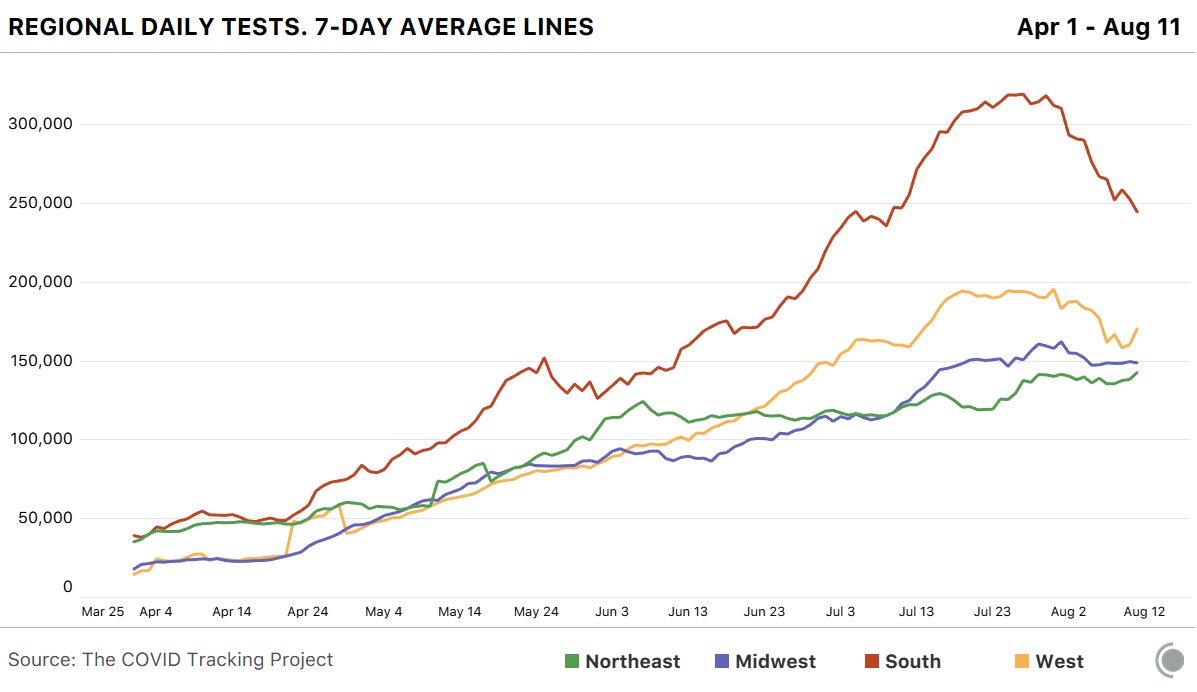
This data is only as far as August 11 and today is August 20. I don’t know what has happened in the last ten days, but I’m not optimistic. The COVID Tracking Project has a blog that reported significant problems with the HHS versus the state reports of patients hospitalized, with irregular data coming from HHS. On August 11, this blog post discussed some of the problems.
Then, on August 14, the blog post for that day was titled, “Something is Wrong With Testing Data in the Great State of Texas.” So something is wrong. That was the last post so far. The penultimate post, for August 13, was titled, “Tests, Cases, and Hospitalizations Keep Dropping: This Week in COVID-19 Data, Aug 13” — So something is indeed wrong.
I don’t know what is going on, but I am very suspicious. Just as the situation at the US Postal Service has grown murkier by the day, the testing situation has become quite opaque even though the topline numbers seem to be improving.
A note about the USPS: the Postmaster General (PG) has apparently retreated on his changes to the Service, but that may be simply because the damage he has done is too advanced to undo.
Photos have shown high-speed sorting machines dismantled, with the pieces thrown into trash bins– probably an irreversible destruction of valuable equipment. I am in despair about the trashing of equipment that surely could have been simply turned off and covered with plastic to prevent deterioration while its ultimate fate is decided.
Apparent reductions in new daily case counts for COVID-19: real or an artifact of reduced testing?

The daily new case counts for COVID-19 have averaged less than 50,000 for the last week. Worldometer gives yesterday’s count as 43,999 and two days ago as 40,560. After an all-time high of 78,584 on July 24, the trend has been steadily downward since. On July 30, 72,574 new cases were reported. On August 14, 60,015 new cases came in. Daily deaths have also been dropping, with less than 1,000 reported on several days.
A marked periodicity in daily deaths is obvious on the graphs shown on Worldometer– two days with lower deaths are followed by five days with higher deaths every week since April. For this reason, weekly averages offer a much clearer picture. The seven-day moving average has shown a plateau at slightly above 1,000 a day since the beginning of August.
The seven-day moving average of new cases peaked at the end of July at around 68,000 and has been dropping since– it now stands just below 50,000.
The total number of daily tests peaked at 926,876 on July 24. Thereafter, the number of tests dropped significantly, to a nadir on August 12 of 479,048. The number of tests increased, but then dropped again, to 642,814 yesterday.
The number of patients currently hospitalized has been dropping as well. The hospital number peaked at 59,718 on July 23 and is now down to 43,747 as of August 18. The previous peak was 59,940 on April 15, which then dropped to 27,967 on June 20.
The overall test positivity rate has dropped from about 8.5% to 6.5%; previously the positive rate was as low as 4.3% in mid-June. At the beginning of May, 15% of tests were coming back positive.
All the figures except the number of tests performed each day have been moving in the right direction for the last two weeks. The number of tests done each day is now about 69% of the number done each day at the peak. The number of people in the hospital has dropped quickly compared to the drop in the number of new positive cases. Test numbers are taken from the COVID Tracking Project. Positive rates are taken from Johns Hopkins Coronavirus Resource Center.
These figures appear to be moving in the right direction except for the number of tests performed each day. I have some skepticism about the hospital numbers (because CDC no longer handles them; the numbers now go directly to HHS) but there is no obvious reason to doubt them.
Honey is effective for symptoms of upper respiratory tract infections (colds and cough): BMJ
A study published in the British Medical Journal Evidence-Based Medicine online first on August 18 described a systematic review and meta-analysis of research on the use of honey for upper respiratory tract infections (URI) and found that it was in fact better than usual care. From the Abstract:
Conclusions Honey was superior to usual care for the improvement of symptoms of upper respiratory tract infections. It provides a widely available and cheap alternative to antibiotics. Honey could help efforts to slow the spread of antimicrobial resistance, but further high quality, placebo controlled trials are needed.
https://ebm.bmj.com/content/early/2020/07/28/bmjebm-2020-111336
This report is welcome news to parents who are faced with few treatment options for their small children. Dextromethorphan, an anti-tussive (cough suppressing drug) is little better than a placebo but is the only available over-the-counter drug for children with coughs. Honey should be considered a better choice now that the evidence has been compiled for its effectiveness.
Honey is also known to have antibiotic properties and could be offered to parents as an alternative to prescribed antibiotics, which are not known to have any beneficial effects in URIs– generally caused by viruses in any case.
New guidelines for acute musculoskeletal pain call for topical NSAIDs and/or menthol: AAFP/ACoP

A new guideline from the American Academy of Family Physicians (AAFP) and the American College of Physicians (ACoP) calls for topical treatment for acute musculoskeletal (MS) pain: topical non-steroidal anti-inflammatory drugs (NSAIDs), possibly in combination with topical menthol.
Two topical NSAIDs are now available. The first, by prescription, has been around for several years: Pennsaid, or 1.5% diclofenac in dimethylsulfoxide (DMSO), a solution that penetrates the skin very readily. This treatment is rapid acting and highly effective. It comes with my personal recommendation, especially for knee and shoulder pain.
It works fast because of its vehicle, DMSO, which has been available for many years. DMSO carries many drugs right through the skin and subcutaneous tissue. Diclofenac, the “active” ingredient, is a potent NSAID that relieves pain and inflammation. When applied topically, its action is limited to the local area and gastrointestinal (GI) side effects are virtually absent (GI effects like stomach pain or even bleeding have always limited the use of NSAIDs, especially aspirin.)
The other topical NSAID is Voltaren Arthritis Pain, or 1% diclofenac gel. This was recently approved for over the counter use and is advertised on TV by Paula Abdul doing a dance that is too frenetic for anyone with arthritis.
A number of non-NSAIDs are also available over the counter. For example, capsaicin (the stuff that makes peppers hot– it directly blocks pain receptors in the skin), Aspercreme (salicylates alone– the active ingredient in aspirin), Ben-Gay (salicylates, camphor, and menthol– the latter being counterirritants), Myoflex (salicylate– a non-greasy form), Sportscreme (salicylate– thicker than average), and Icy Hot (menthol and salicylates). All that from a Healthline web page.
Aspercreme and others are also available with lidocaine (an anesthetic or numbing agent.) This web site says Aspercreme with lidocaine is the best.
The idea behind recommending topical treatment for acute MS pain is that it limits side effects and takes away the onus of “popping pills”– which is arguably a bad habit if you don’t have a serious problem.
Naturally, if you have a significant problem, you are better off consulting a doctor to find out if you have inflammatory arthritis (like rheumatoid arthritis, for example) and need something more effective like a “disease-modifying” drug. NSAIDs merely relieve mild-to-moderate pain and don’t stop deformities, loss of cartilage, or more serious manifestations from appearing.
Take it from me: if you have rheumatoid arthritis, you need to start taking a “disease-modifying” drug before you develop deformities. Don’t wait until you are crippled because those changes are irreversible and just keep getting worse with time. Don’t take cortisone, although it does work; the side effects are even worse than the disease. Try methotrexate or “biologicals”– of which there are at least nine available, each aimed at a different inflammatory process. See this webmd website for more details.
You can review the details of the recommendations for acute musculoskeletal pain due to minor conditions from this article in the Annals of Internal Medicine, published August 18.

The president’s behavior has always been transgressive but so far, predictions that he would do himself in with his pranks have not panned out. This latest misdeed may finally be the straw that breaks the camel’s back. I’m referring to the “kneecapping” of the US Postal Service (USPS.) What’s unique about USPS is that it is the government agency most trusted by Americans, with an approval rating between 77 and 91%.
Congress, by contrast, has an approval rating in the teens, sometimes as low as 10%. No other government agency has such bipartisan confidence as the Post Office, not even the military. Yet the president has done his darndest to vilify the USPS, calling it “a joke” and claiming that vote-by-mail will be impossible without an emergency cash infusion.
Most Americans have forgotten that, in 2006 under President Bush (in furtherance of his privatization urge), the USPS was saddled with a unique burden: pre-funding retirement health care costs for 75 years. No other government or private organization has been forced to fund such benefits for workers who haven’t even been born yet. This Institute for Policy Studies report explains this extraordinary burden, why it was imposed, and how it should be relieved.
The new Postmaster General, pretending that he is making it “more efficient”, has exacerbated the problems at USPS by disallowing all overtime (which is needed because so many workers have been lost to the virus), removing blue mail drop boxes from streets (suddenly and unannounced), and taking away over 600 high-speed mail-sorting machines from key postal centers.
Some of these changes are irreversible, particularly the removal of mail-sorting machines– some of which have been dismantled or junked. To the extent to which machine removals have been specific to battleground states (an unknown factor) this could spell disaster for vote-by-mail efforts.
In an election during a pandemic, taking away the ability of the USPS to quickly deliver mail ballots is a clear attempt to prevent timely access to the ballot box for millions of Americans. These are the actions of a president who knows he will lose the election if everyone is allowed to vote. The more publicity this attempt receives, the greater will be the revulsion of the public for the would-be second term president.
We will find out next week, when Congress returns to session early and the Postmaster General faces a hostile House and Senate, just how bad this publicity will be for the president.
 Conrad Theodore Seitz