Comment of the Day
Guitar Man
New York, NY May 7, 2016
Many thoughts have crossed my mind in the last year, some wild, some way out there, some totally implausible…and I’m not the first, perhaps, to voice them, but here goes:
1) Trump doesn’t want the presidency, and doesn’t think he’l win (even at this stage). It’s all about elevating brand awareness.
2) Trump wants to win. It’s all about the ego, and nothing more.
3) Trump doesn’t want to win because he loathes the idea of giving up his NY life, his businesses, and of living the life he’s come to love, in exchange for perhaps the most stressful job on the planet (and one he knows will in no way resemble his life in the business world).
4) Trump’s primary goal is to intentionally bring down the GOP (for whatever reasons he may have).
5) Trump is devising a way to throw the election so it appears he lost while giving it everything he had (because he really doesn’t want the presidency). He’ll then spin the loss in a way that frames him positively (of course). A loss will, in effect, be a win.
6) Re #5, this is plausible because, in many ways, he’s already won: he’s singlehandedly smoked the GOP establishment and turned the entire party upside down. He can crow about this for years. Great talk show fodder for him.
Who really can say they know for sure?
726 Recommend
This comment appeared in response to an article in the NYT : “Republican Party Unravels Over Trump Takeover”. There were over 2000 comments on this article.
The analysis presented in this comment, that is, possibility #5, is most likely correct; Trump will lose the election but use his support to control a significant group of voters many of whom will have deep resentments over Trump’s loss. What he will do with them is anyone’s guess.
Another comment pointing out the source of much of Trump’s support:
DW
Philly May 7, 2016
I am absolutely astounded at the way these analyses ignore the obvious: the Trump phenomenon is the backlash against our first black president. Come on! You go back decades dissecting American conservatism, and you somehow manage not to mention that Donald Trump headed the “Birther” movement, which gave racists the okay to assert that Barack Obama was not a real American – explicitly because he was alleged (falsely) to have been born in Africa? HELLO?
Are we ever going to be allowed to discuss this elephant in the living room? Are we supposed to pretend FOREVER that the origins of this outburst of hatred are totally mysterious?
1218 Recommend
The racist backlash against Obama’s election gravitated towards Trump’s “birther” position and comprise a significant part of his support.
Finally: by not allying with Ryan, Trump can distance himself from the paralyzed Congress of the last few years:
Sombrero
California May 7, 2016
Where were they when the country was plunged into war, into recession, into engineered government shutdowns and legislative sabotage? Answer: They were aiding and abetting all of it, for their own personal and political gain. Exhibit A: Paul Ryan. Ted Cruz. Mitch McConnell. Eric Cantor. John Boehner. Jeff Sessions. Steve King….on and on and on.
Mr. Trump, for all his faults, stands apart from them and their elite-driven agenda of political, economic, and social destruction.
626 Recommend
Roses on the East Side of the House


According to the New York Times (NYT) Donald Drumpf is trailing Hillary Clinton by about ten percent in national polls, giving her a nearly insurmountable advantage in the Electoral College. Current polls show her winning 347 to 191 electoral votes. Clinton’s current standing matches Obama’s standing in 2012 except that she is ahead in North Carolina, a state Obama won in 2008 but lost in 2012. The only state in which she is polling worse than Obama is New York, and even there she is still well ahead of Drumpf. Even if Drumpf were to improve his standing by five percent in each state, he would still lose by 285 to 253. Only if he improved by ten percent in each state would he win the Electoral College.
Losing ten percent in the opinion polls in every state between now and November is highly unlikely but possible. The NYT gives as an example the 1980 election, when Jimmy Carter was ahead of Ronald Reagan in the opinion polls at this point. The key factor in the 1980 election was the presence of over 400 American hostages in Iran after the invasion of the American Embassy in Tehran. Carter’s inability to resolve the hostage crisis was the cause of his loss to Ronald Reagan in the 1980 election. If he had terminated the situation there would have been much more public opinion in his favor and he would have had a chance to win. The Iranians were aware of this perception on the part of the American voters and they used it to force Carter out of office.
Reagan used his agents to sell anti-aircraft missiles and arms to the Iranians in exchange for cash which he used to fund the “Contras” (rebels fighting the government of Nicaragua) in contravention of specific Congressional bans on payments to the Contras. The International Criminal Court (whose jurisdiction the US doesn’t accept) condemned these actions. Eleven of Reagan’s staffers were convicted in this scandal; Reagan claimed he had no foreknowledge of the plot, but Congress stated that “if he didn’t know what his staffers were doing, he should have.” When news of the plot became public, Reagan’s popularity declined from 67% to 46%, the biggest drop in a week in the history of popularity polling. (Wikipedia)
It would take a scandal of the order of Iran-Contra or the hostage crisis at the American Embassy to have sufficient negative effect on Hillary Clinton to boost Drumpf to victory in November. It is certain that the Republican strategists have many bogus scandals waiting for the right time to be revealed in the news media; these are the only weapons that they expect to have sufficient effect to pull off a victory for Drumpf in the November election.
Republicans are well aware that their policy positions are disapproved by the majority of the American electorate and that they have no chance of winning based on a comparison of their policies with those of the Democrats. They know that they must play the popularity game to smear Clinton sufficiently for at least a brief period of time surrounding the election. Look for revelations of some manufactured scandal implicating Clinton to appear in the closing weeks of the presidential campaign, most likely some time in October.
(The two cats are named Morgan and Kitten; they were raised together.)
Trial in German Courts of Auschwitz Guards
Reinhold Hanning, 94, told a court today that he was sincerely sorry for his service as a Nazi concentration camp guard at Auschwitz in January 1942 to June 1944. (New York Times article of April 29, 2016)
“I am ashamed that I witnessed injustice and allowed it to continue without taking any actions against it,” Mr. Hanning told the court in the North Rhine-Westphalia city of Detmold, WDR, a public broadcaster, reported. “I am sincerely sorry.”
Herr Hanning was a front-line German soldier who was wounded in Russia; after he was rehabilitated from his wounds he was assigned to be a guard at Auschwitz, considered a non-combat position. He claimed that at first, he did not know what was happening, but quickly began to realize from seeing piles of bodies being removed. “I could smell the burning bodies…” he said.
Herr Hanning is one of dozens of former concentration camp guards who are only now being charged as accessories in the murders of millions at the concentration camps. Recent completed cases have included a four-year sentence for one soldier in his nineties and a demise before trial could be opened in another case. Despite the seventy or so years that have passed, a number of eyewitnesses still come to these trials and beg the defendants to confess.
The unique thing about this rash of “cold cases” from the Second World War is that they are being prosecuted in German courts, by German judges, who claim original jurisdiction for these cases and opine that there is no statute of limitations on murder. These cases began with the precedent of the trial of John Demjanjuk, a former concentration camp guard who lived in Detroit and was an autoworker for many years before being deported back to Germany, convicted in 2011, and sentenced to five years in prison. Demjanjuk had served as a guard at the Sobibor concentration camp in Poland in 1943.
A survivor who testified at the Demjanjuk trial said it did not matter how short or long the sentence was for his crimes: (according to a New York Times article of May 12, 2011)
“I had an opportunity to say what I wanted to say for 50 years,” Mr. Cortissos, 73, said outside the courtroom. “I’m satisfied.” He added, “It doesn’t mean I can forget; it doesn’t mean I can forgive.”
Parts of the twentieth century are known to historians as the “bloodiest century in human history”; this includes the fifty million killed in World War Two. We should try to remember the lessons of history, or, as the saying goes, we will be forced to repeat them.

Google has entered into an agreement with the National Health Service, the medical provider for residents of England, which involves sharing a large part of the United Kingdom’s total patient data. The agreement is extensive, including sharing historical medical data, current medical tests, pathology, and radiology results, surgery, patient visits (including which staff sees the patient and when), treatments, and other minutiae. The agreement is limited in time, however, and Google must destroy all data that it retains at the end of 2017. In addition, Google is bound not to use any of the information it derives for commercial purposes (directly.)
The Google company is called DeepMind and it has made an agreement with the Royal Free NHS (National Health Service) Trust to share data on the 1.6 million people who pass through three hospitals in the UK each year: Barnet, Chase Farm, and the Royal Free. DeepMind is using an application called Streams to organize the data for the hospital so they can view it more easily and an application called Patient Rescue that predicts medical outcomes based on large data sets that can’t be visualized by individual doctors.
There is a huge amount of patient data involved, but only for a limited time, and Google will make the best of its analytical capabilities, honed through years of handling data and data requests, to create software engines that will use patient data to make predictions as to outcomes. Treatments will be included in the analytics. The possibilities of having enormous analytical capability honed with millions of patient-years of experience are exciting.
The medical applications that Google intends to create are not expected to replace clinical decisonmaking; instead, “It’s about how can we bring the attention of medics to the right place.”
The risks of misuse of the patient data are also significant, but in this particular case, Google has gone a long way towards insuring against malign use. The contract includes numerous limitations. The patient dataset will be stored in the UK in a separate company from DeepMind, and according to contract, DeepMind must destroy its copy of the patient data when the contract ends in September 2017. The agreement states that “Google cannot use the data in any other part of its business.”
(This information was sourced from a New Scientist article)
Downtown Detroit
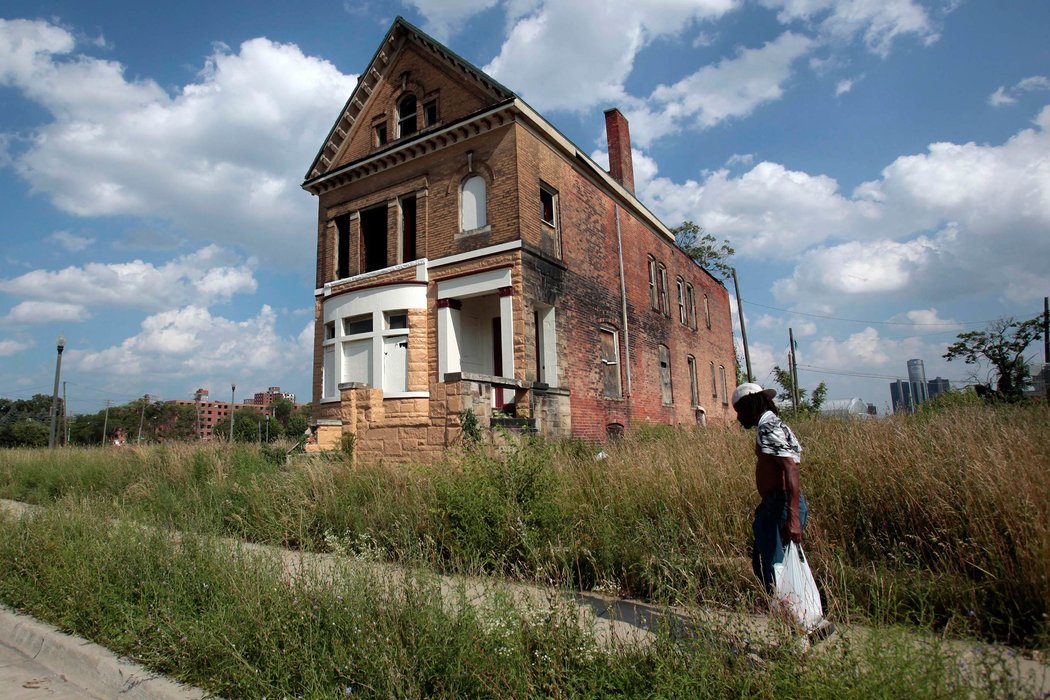
An image I couldn’t resist cribbing from the New York Times… think they’ll sue me? Congress refuses to do anything for Detroit, so President Obama has cobbled together $300 million to help Detroit demolish abandoned buildings, help bus transit, and hire up to 150 firefighters… nothing for the bankruptcy.
A federal district judge endorsed the constitutionality of North Carolina’s restrictive new laws regulating voting that were passed by the legislature one day after the Supreme Court invalidated key clauses in the Voting Rights Act. Those clauses would have subjected those restrictive laws to evaluation for disparate impact on minorities before they could be enforced. The judge was wrong, just as the Supreme Court was wrong, and it is easy to explain why.
The passage of these restrictive laws merely validated Congress’ reasoning in re-authorizing the Voting Rights Act in 2006 and made a mockery of the Supreme Court’s reasoning in calling the Act out of date. Note that the Supreme Court had upheld the entire Voting Rights Act repeatedly until its decision of 2013. The North Carolina legislature, only one day after the Supreme Court freed it from federal supervision, eliminated early voting, same-day registration, pre-registration for sixteen- and seventeen-year-olds, and instituted a requirement to show identification at the polls when voting. All those changes clearly had a disparate impact on minority voting and would not have been allowed if the preclearance requirement was still in effect. These changes proved that Congress was right in 2006 and the Supreme Court was grasping at straws in its reason for calling the Voting Rights Act provisions unconstitutional: because its preclearance requirements were forty years old and “out of date”.
Wisconsin Republican State Senator Dale Schulz, who retired after serving his state since 1983, refused to defend his party’s voting restriction laws when interviewed on a radio show in March 2014, just before he stepped down from his post at the end of 2014. He was quoted as saying, “It’s all predicated on some belief there is a massive fraud or irregularities, something my colleagues have been hot on the trail for three years and have failed miserably at demonstrating.”
“It’s just sad when a political party has so lost faith in its ideas that it’s pouring all of its energy into election mechanics… We should be pitching as political parties our ideas for improving things in the future rather than mucking around in the mechanics and making it more confrontational at the voting sites and trying to suppress the vote.”
“In the spirit of the champion of the 1957 Voting Rights Act, I have been trying to send a message that we are not encouraging voting, we are not making voting easier in any way, shape or form with these bills… Back in 1957 with the leadership of Dwight Eisenhower, Republicans were doing that. And that makes me sad, frankly.” (Quotes are taken from a post in the online magazine, “The Cap Times” published in Madison, Wisconsin.)
Mr. Schulz was referring to the original passage of the Civil Rights Act of 1957, which was “primarily a voting rights bill” (Wikipedia) supported by Republican President Dwight Eisenhower. This Act was intended to show support in federal law for the Supreme Court’s Brown decision of 1954 that attempted to desegregate primary and secondary schools. The Supreme Court decision was so unpopular among Southern whites that they engaged in a campaign of violence that included bombings of churches as well as schools; President Eisenhower was forced to call out the National Guard to enforce the Court’s orders. The Voting Rights Act of 1965 was pressed by President Kennedy and signed by President Johnson.
The Voting Rights Act was re-authorized in 2006 with minimal changes; the Supreme Court on June 25, 2013 held that the section restricting certain specific districts with a history of discrimination to “preclearance” of potentially unconstitutional changes in voting laws was itself unconstitutional because it was “based on 40 year-old facts having no logical relationship to the present day” (notwithstanding the fact that Congress had just re-authorized it seven years earlier.) (All of this paragraph is sourced from Wikipedia.)
None of this seemed to matter to Judge Schroeder, who acknowledged that some black North Carolinians “endure socioeconomic disparities that can be linked to State discrimination,” which make it harder for them to participate in elections. [From the New York Times editorial about the federal judge’s decision.]
We can only hope that the federal Appeals Court will reverse this ill-considered decision before the November elections and allow disadvantaged people to vote without being required to jump through hoops to prove who they are so that they can vote. The best argument against these restrictive laws is that thousands of people do not have the necessary documents, yet are unquestionably citizens of the United States and residents of North Carolina who want to vote. The procedures needed and the cost and time involved in obtaining needed identification documents constitute an unconstitutional poll tax because there is virtually no in-person voting fraud in this country.
In-person voting fraud is ridiculously complex and inefficient for an organization that wants to perpetrate voting fraud. This is the bugbear that Republicans invoke when they talk about “voting fraud”: the idea that the Democratic Party is engaged in institutional voting fraud by opposing these voting restrictions. The problem for the Republicans is that they always do better when fewer people are allowed to vote, because the aims of the Republican Party are essentially aligned with the views of the top 1% of the wealth pyramid. The only way they can win elections is to fool more than 50% of the other 99% into voting for representatives who will obey the dictates of that upper 1%.
The problem that the Democratic Party has is that the Republicans have engaged in wholesale fraud at least since the Presidential campaign of Richard Nixon in 1968, sufficient to fool that 50%, in claiming that the policies of the Democrats are bad for the country as a whole, even though they are in line with the interests of the bottom 99% of people. For example, raising taxes on the top 1% of the people by a modest amount will be sufficient to pay for all the progressive programs that the Bernie Sanders wing proposes, even free college tuition.
Nonetheless, a myth circulates and is widely believed, that the only way to pay for these “entitlement programs” would be to increase taxes on the “middle class” by an unsustainable amount. This is demonstrably false, yet is widely believed for no apparent reason other than that it has been repeatedly asserted by the likes of Ronald Reagan and has not been adequately contradicted by the rest of the people’s representatives. Ronald Reagan promulgated a reduction of taxes on the upper classes that produced a severe budgetary deficit. This fact was hidden from the public, but the deficit was so severe that he was forced to reverse some of his tax reductions (but not the ones on the upper class.)
Restrictions on voting enacted by the Republicans in every state in which they control the state’s legislature have the effect of tilting the table in favor of Republican candidates. These restrictions are not necessary to ensure the integrity of the voting process, nor are the extra hours they eliminate excessively expensive. Additional hidden restrictions on voting, such as shortages of voting machines and personnel and inadequate numbers of polling places, have been deployed by Republican voting officials to great effect in suppressing votes in districts with Democratic majorities.
Additional structural restrictions on voting, such as holding elections on Tuesdays instead of Sundays and making voting optional rather than mandatory (voting is mandatory in countries such as Australia) have the effect of reducing the percentage of people who vote. Just imagine what would happen if, instead of 35% or 55% of the voting population actually voting, all 100% of eligible voters cast ballots. Would the Republicans be able to fool all of us, all of the time? (as a famous Republican once said.)
Perhaps you remember Dennis J. Hastert. Mr. Hastert’s highest position was Speaker of the US House of Representatives. He served in the House from 1987 to 2007. Before that, he was in the Illinois State House of Representatives from 1981 to 1986; his biggest accomplishment in Illinois was preventing the ratification of the Equal Rights Amendment in Illinois. Before entering politics, he was a teacher from 1965 to 1981 at Yorkville High School in the suburbs of Chicago; he coached wrestling and soccer. He also became a born-again Christian while a sophomore in high school. (All these items are from Wikipedia.)
After being kicked out of the Speakership of Congress in 2007 by voters who elected Nancy Pelosi Speaker of the House (for two years) Hastert left his position in November 2007; a special election to succeed him resulted in the election of a Democrat, Fermilab scientist Bill Foster. Hastert made a fortune in real estate while in the US House; he entered Congress with a net worth of about a quarter of a million dollars and left the House worth over 4 million and up to 11 million. He redoubled his fortune as a lobbyist and even registered as an agent for the countries of Luxembourg and Turkey; he was an active lobbyist for the ethanol in motor vehicle fuel industry (a boondoggle I have denounced elsewhere.)
While he was in Congress and afterwards, as a lobbyist, he skated close to the legal limits on conflicts of interest and bribery, and was close to representatives who were indicted like Tom DeLay and Mark Foley. While he was Speaker of the House, he was responsible for tilting the House rules towards increasing partisanship; for example, a rule called the Hastert Rule prevented a bill from going to a vote unless the majority of the majority party favored it, reducing the chances for controversial but bipartisan bills to make it to a vote. He was a right-wing extremist, he favored the War on Drugs and opposed the clean needle program, he was against abortion under any circumstances, and he endorsed heavy penalties for sex offenders.
So it will be no surprise that he was found to be guilty of the rankest hypocrisy. He finally pleaded guilty to structured withdrawals of cash to avoid bank reporting requirements and will be sentenced in a few days. Like Al Capone being found guilty of tax evasion, structured withdrawals had nothing to do with Hastert’s real crimes. In fact, Hastert was withdrawing cash to avoid publicity for the recipient of the cash, who turned out to be a former high school wrestler who had been coached by Hastert. This young man had been sexually touched and massaged by Hastert when he was alone with him.
What was much, much worse was the story that emerged when the prosecutors wrote their recommendations to the judge for Hastert’s sentencing on the structuring charge; I suggest that if you have read this far, you should take the link to the recommendations, which are conveniently on the documentcloud dot org site. It seems that a young man who had been a wrestler in high school had been Hastert’s “partner” during the entire four years he was there, until 1971. The young man turned out to be gay, and he died of AIDS in 1995. In 1980, he told his sister what Hastert had done to him. At the young man’s funeral, which Hastert attended, the sister confronted Hastert, and he did not deny her allegations.
Hastert, who has diabetes, suffered a stroke after he pled guilty last fall, and was near death for a time. He developed sepsis and had surgery while in the hospital. He was released from the hospital in mid-January. His sentencing hearing has been repeatedly delayed, this last time in order to allow yet another person to speak at the hearing. The sister mentioned in the last paragraph also intends to speak.
I was also surprised to learn that the Olympic Games has dropped wrestling as of 2016. Many high school and college wrestling programs in the US have been dropped and there have been several scandals involving sexual misconduct by wrestling coaches. It seems that karma has come back and bitten Mr. Hastert in the nether regions. You who have advocated against human decency and forbearance towards others beware: you could come to a downfall too.
Here’s a quote from a New York Times story that should make you worry about convincing the average American that global warming is bad:
Climatologists customarily report weather changes averaged over the land surface — an approach that counts changes in sparse Montana just as heavily as shifts in populous California. But because we were interested in the typical American’s exposure to weather, we took a different tack, calculating changes over time on a county-by-county basis, weighted by population.
Our findings are striking: 80 percent of Americans now find themselves living in counties where the weather is more pleasant than it was four decades ago. Although warming during this period has been considerable, it has not been evenly distributed across seasons. Virtually all Americans have experienced a rise in January maximum daily temperatures — an increase of 1.04 degrees Fahrenheit per decade on average — while changes in daily maximum temperatures in July have been much more variable across counties, rising by an average of just 0.13 degrees Fahrenheit per decade over all. Moreover, summer humidity has declined during this period.
As a result, most people’s experiences with daily weather since the time that they first heard about climate change have generally been positive. By our calculations, the mild winters now regularly experienced in New York City make its weather nearly as pleasant as that of Virginia Beach back in the 1970s.
To those of us who believe climate change is the most profound challenge of our age, our discovery is both illuminating and disheartening.
In order to convince people that global warming is dangerous, we need a more intellectual argument, because their experience of the weather is “rather pleasant.”
The National Center for Health Statistics has released a report indicating that the suicide rate in the US is at a thirty-year high. The greatest increase has been among less-educated men aged 45 to 64 but other rates have increased as well. The suicide rate among girls 10-14, among the lowest of all groups, has tripled in the last fifteen years. The rates of suicide among both men and women over 75 has gone down, but all other rates have gone up. Another change in suicides of potential significance is that the use of firearms and poisons has gone down, with the rate of suffocation (including hanging) has gone up. Suffocation suicides are most often seen in people who have very few ways to kill themselves.
The history of suicide in the US has shown that, for example, during the Depression, when many people were impoverished, suicide rates went up. As the economy improved, suicide rates went down. Suicide rates among children were very low but increased significantly during the 80’s and 90’s. Suicide rates among the elderly were the highest of any age group in 1950 but have decreased by half since then; rates had increased progressively from age 45 on up but now have leveled off. Now the rates among those 45-54 are the highest of any age group, at 19.6 per hundred thousand population. By comparison, in 1950, 31.1 per hundred thousand people between 75 and 84 succeeded at suicide, the highest rate of any age group.
Women generally have had much lower suicide rates than men as long as statistics have been kept. Women tend to threaten or ineffectively attempt suicide more often than men, but less often succeed. Rates among women increased somewhat between 1950 and 1970 but then declined to a baseline of about 5 per hundred thousand, which has remained little changed through 2014. The shocker has been a tripling of death rates among girls aged 10-14 by suicide, from 0.5 to 1.5 per hundred thousand; the rate among men has little changed, from 1.9 to 2.6.
Social Security and particularly Medicare have reduced the suicide rates among those over 65 during the past 50 years. Of most concern now is the rise in suicides among middle-aged adults, mostly men, and the increases among the very young. The increased rates among the middle-aged are probably related to the economic damage inflicted by the Great Recession of 2007-8; they are part of the same phenomenon as the increase in opioids and heroin use and overdoses. Increases in suicides among children may be related to the increase in autism that has been seen during this same period of time.
It turns out that autism is a very potent risk factor for suicide, but it may not explain the increase in risk among girls because autism is so much more common in boys. Wikipedia’s article on suicide states that there is at least a 10 fold increase and possibly as much as 28 times the incidence of suicide among those with autism and Asperger’s syndrome. It is little appreciated that autistics are very prone to depression and abuse by their peers, and this is vividly reflected in their suicide rates. With the incredible increases in autism rates of the past fifty years, it is possible that suicide rates in children are reflecting that in part, but the increase in young girls is mysterious.
Suicide rates vary dramatically according to one’s state of residence. Wyoming, Montana, and Alaska have the highest rates; while Massachusetts, New York, and New Jersey along with the District of Columbia have the lowest rates. The states with the lowest population density seem to have unusually high rates of suicides, while those with high population density have lower rates. There may be other factors, but population density seems to be the most significant.
My prescription for reducing suicide rates: make our society (in the US, not the rest of the world) less stressful:
What is needed now is “Medicare for all” and maybe even “Social Security for all.” Medicare needs to be upgraded to cover all the deductibles and copays, to get rid of the Medicare supplement industry that has been fleecing Americans since Medicare was implemented. The cost of medicine is so high now that no-one who is not already rich can afford to pay even twenty percent of their hospital bills. Yet insurance companies are doing extremely well taking in over twenty percent of the bill as their fee for deciding who is eligible for insurance and who is not, whether the procedures and drugs ordered by the doctor are acceptable or not, and what tests can be performed on which patients. Insurance companies are parasites on the health industry.
To improve government revenues, we need full employment, and to get full employment we have to match everyone who can work to a job that he or she can do. This means a giant, comprehensive jobs bureau that has the authority and means to create jobs by finding things that have been left undone and things that need to be improved. That doesn’t mean “make-work” jobs, it means looking critically at our infrastructure and our way of living and trying to find problems that could be solved by the application of elbow-grease or burning some midnight oil, to use a figure of speech.
Having the federal government accept (albeit reluctantly) the burden of insuring the welfare of all US citizens would inexorably lead to the finally effective effort to find full-time employment for everyone. Whether that employment comes as a result of private sector jobs or public works really doesn’t matter; the point of having any job is to produce income that will sustain the economy by being used to buy things rather than to save.
Given the mandate to match every working American with a job, a jobs bureau could work miracles with the unemployment rate and bring people back into the job market who had given up on trying. A matching service could be created to have the flexibility to match unusual jobs with unusual job requirements. Job satisfaction would be greatly increased because each individual could be set up with the kind of job that most closely matches their abilities and inclinations.
Putting everyone to work will increase the Gross Domestic Product out of proportion to the population by obtaining more productivity with job matching. Suicide rates are already known to go down with improving income and job status.
Having a job for everyone means no-one will have time to lounge around on street corners. At the same time, everyone will have sufficient money to buy at least a basic menu of nutritious food, wear an acceptable garment, and live in a decent home. No-one will be longing for a job and suffering for lack of basic needs. More importantly, suicide rates will go down because people will not have the leisure to sit around and brood nor the desperation born of poverty.
That brings me to taxation. We should abolish sales tax for two reasons: first, sales taxes are regressive, and second, they are too complicated and a burden on the small retailer. We should replace the sales tax with a truly progressive income tax that is adjusted so that the federal government can take in enough money to pay for the operations that it has already undertaken and for the infrastructure maintenance required to keep its public spaces (highways, buildings, parks, etc.) in good condition.
To a very rough estimate, the costs come to about 20% of the current Gross Domestic Product. This percentage was that which sustained the government back in the 50’s; today we take in much less than that every year in taxes and yet extremists claim we are over-taxed. We only feel over-taxed because the wrong people are feeling the pinch. Taxes should be carefully allocated to those who can afford to pay, not to those with the least political clout.

